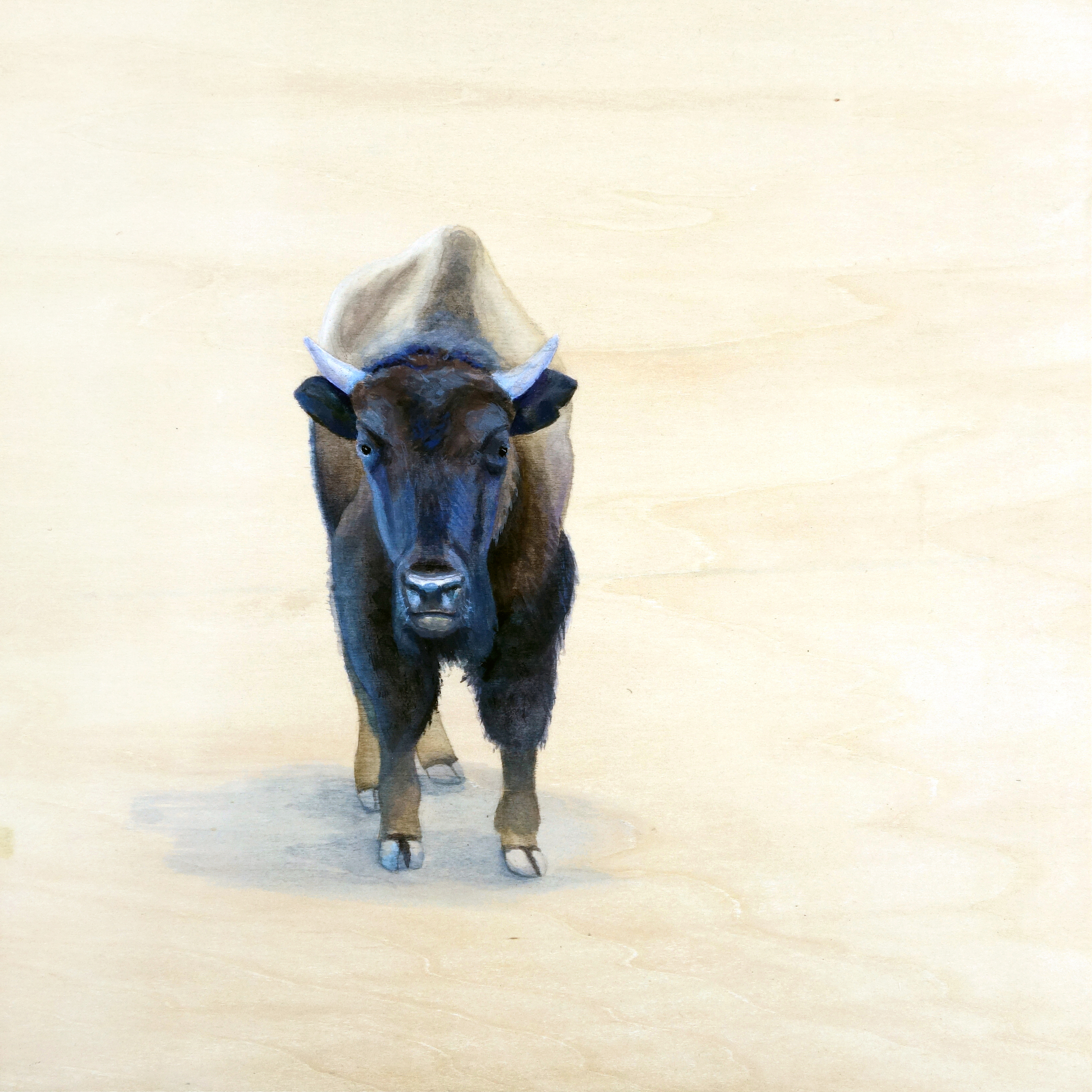
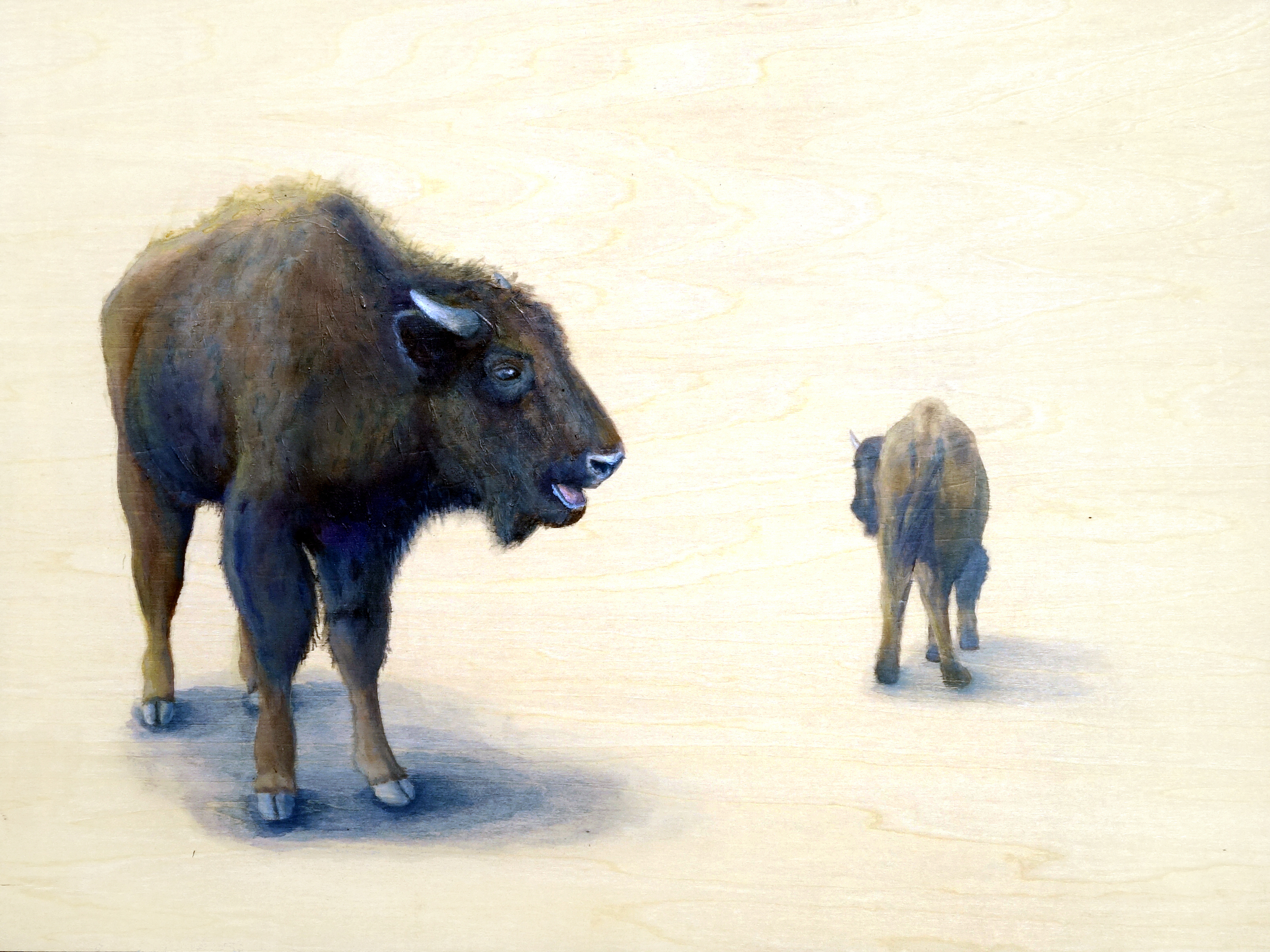
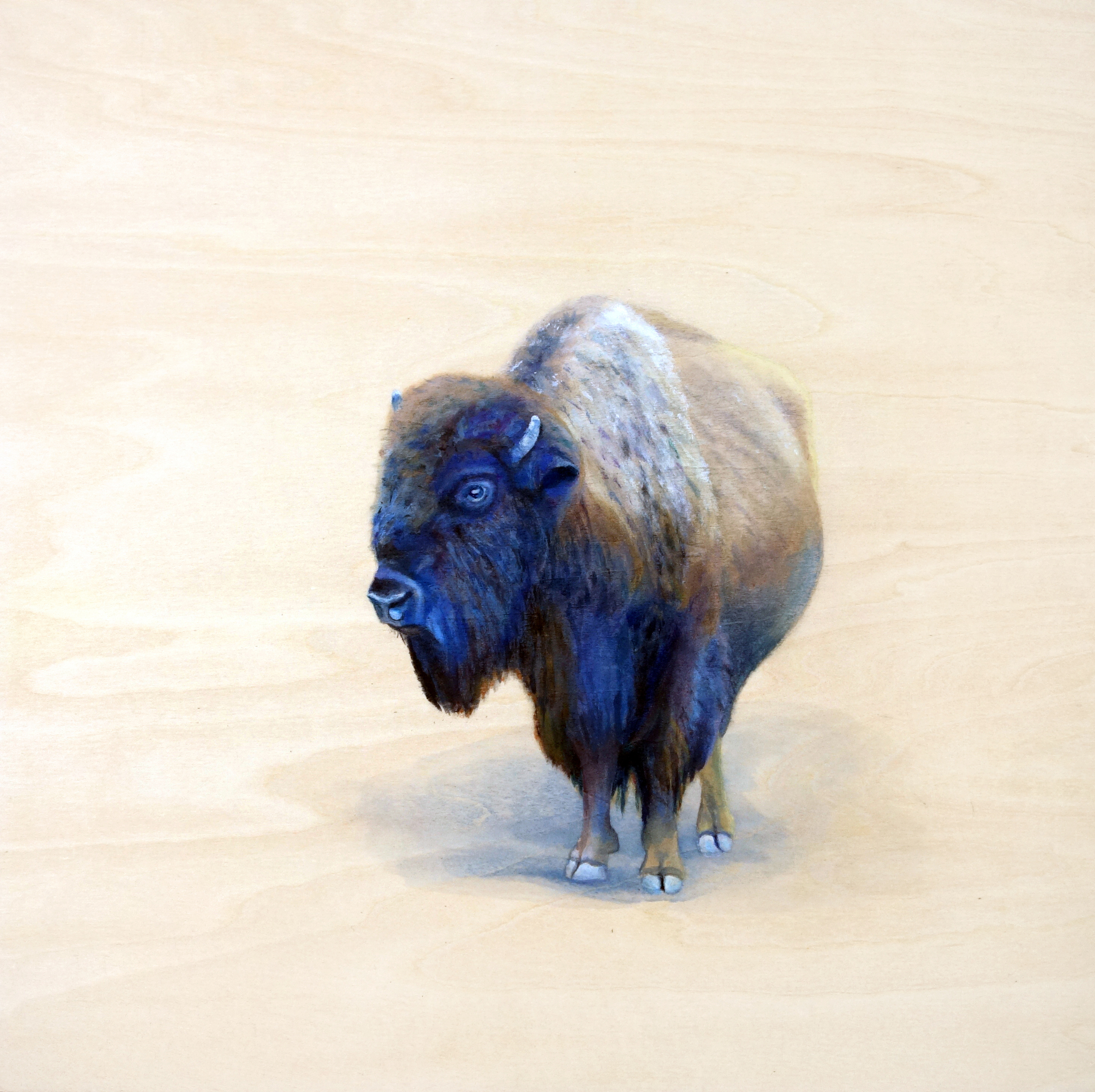
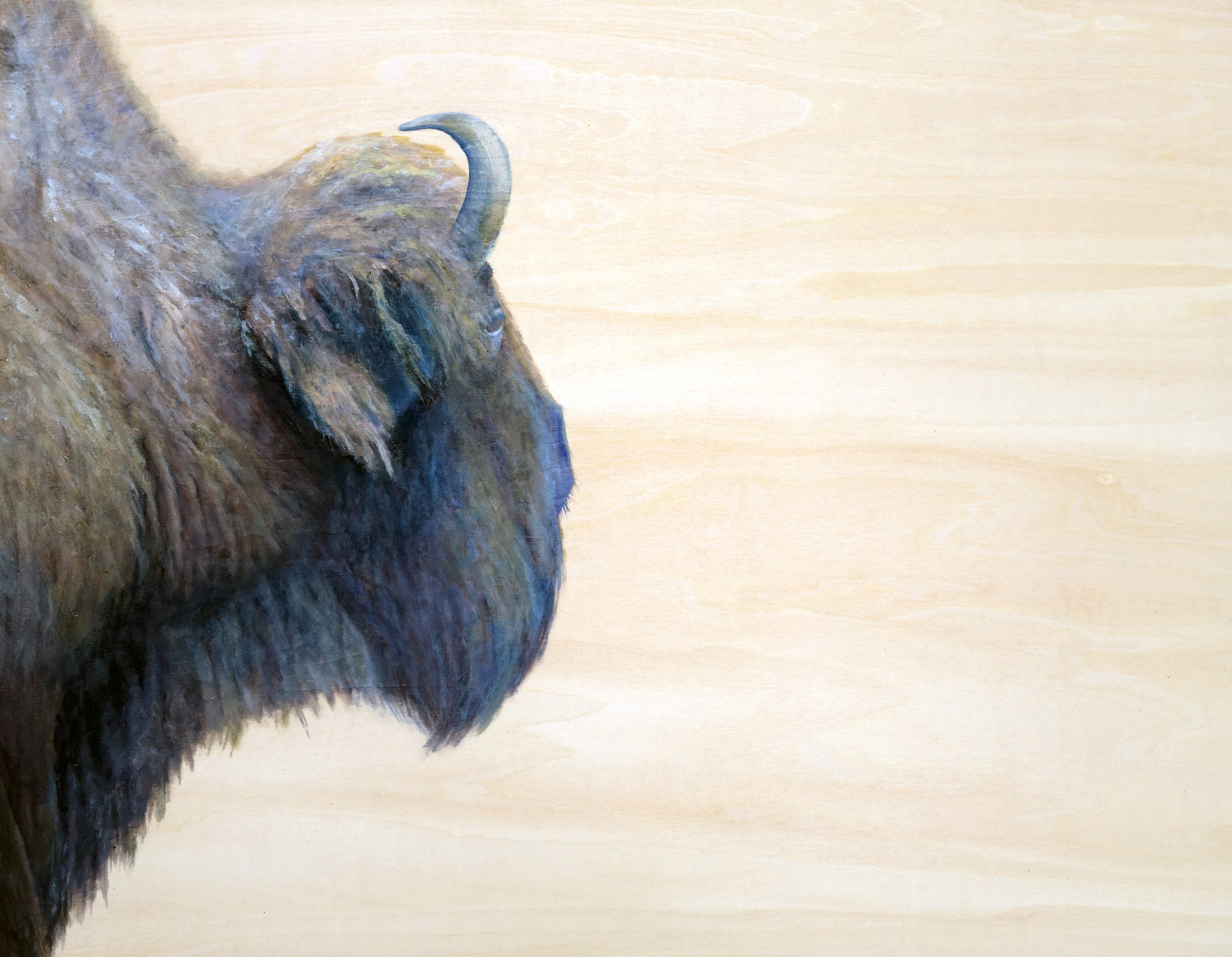
Bison Are the First National Mammal!

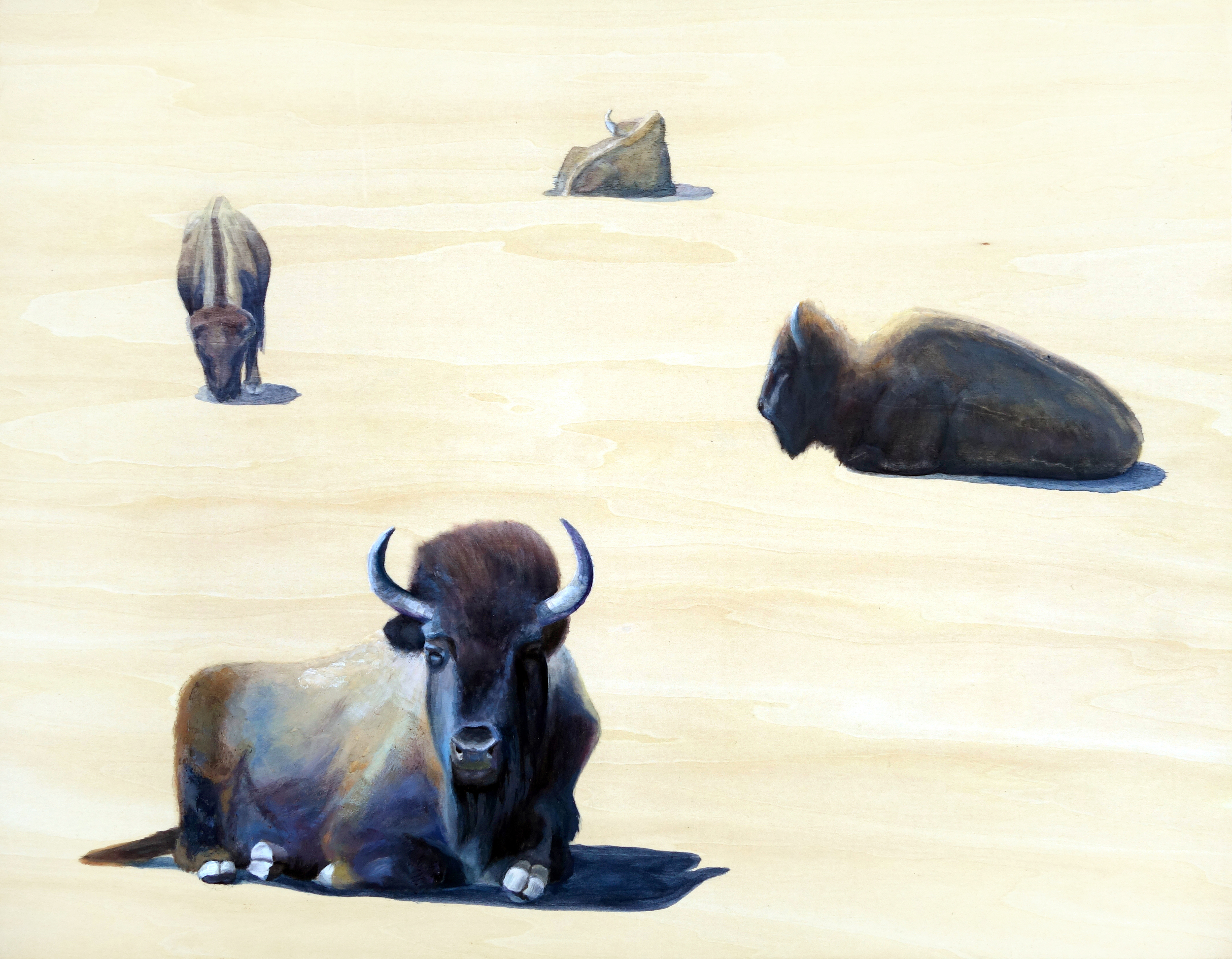
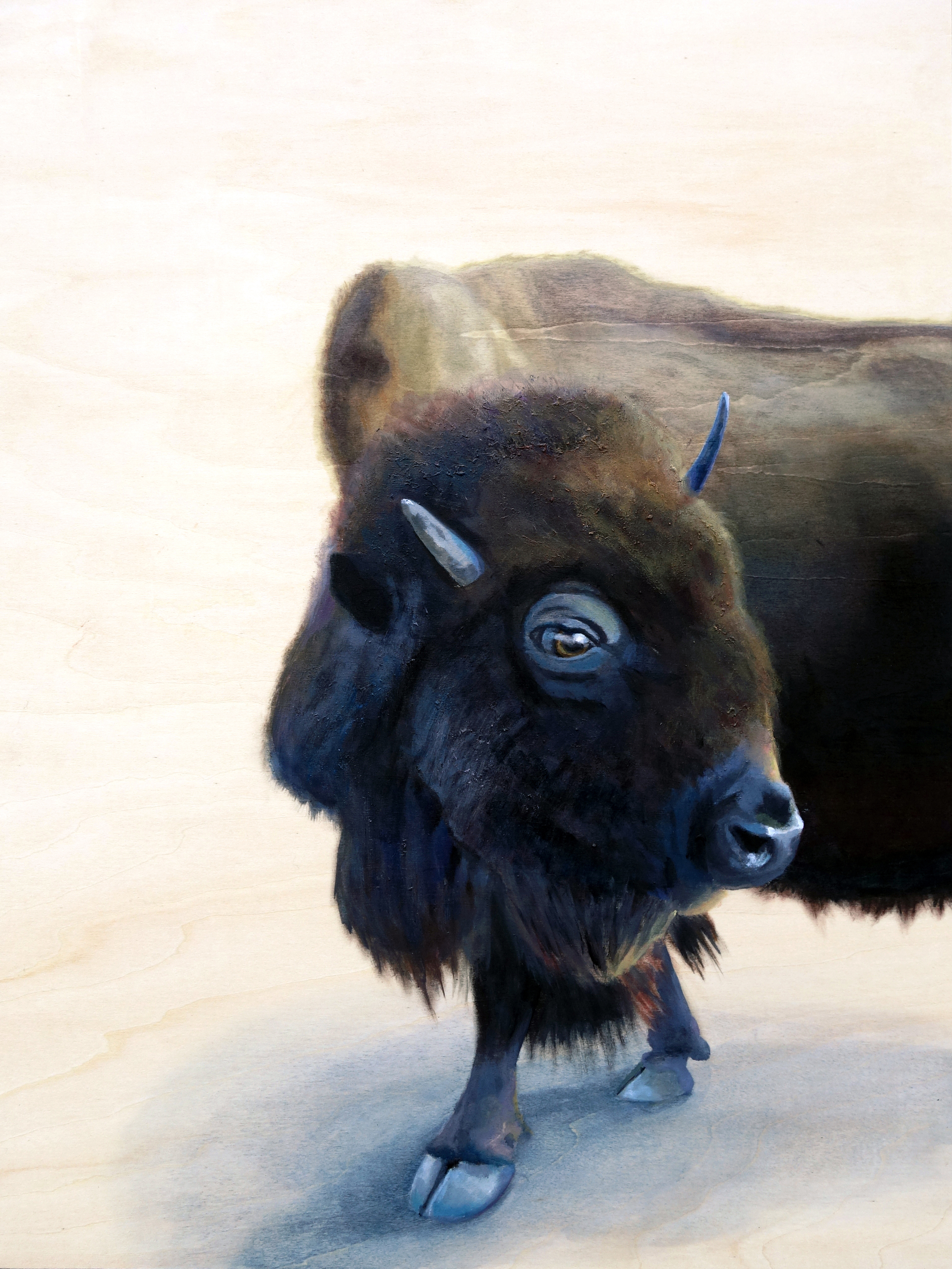
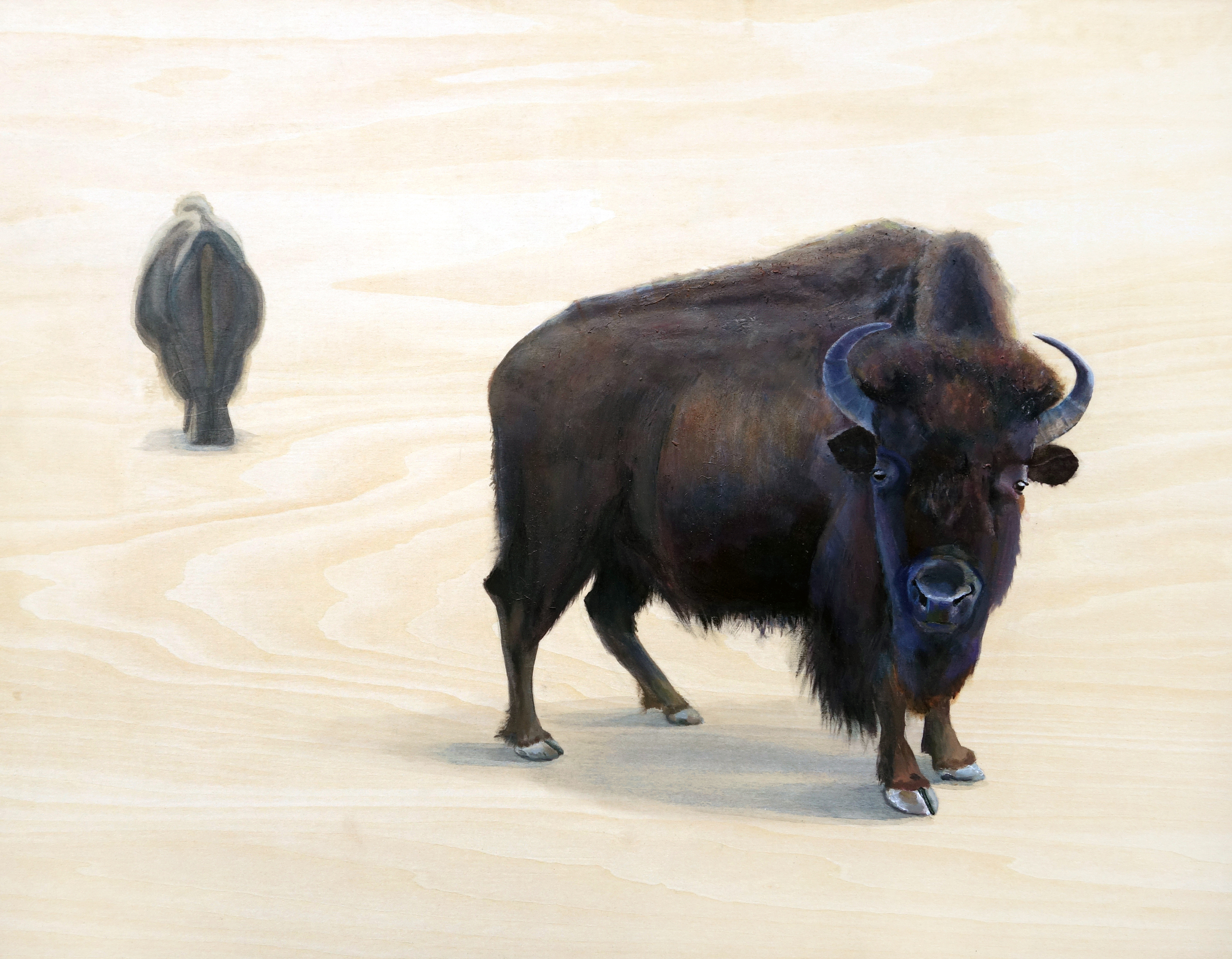
How cool is this - President Obama has signed the National Bison Legacy Act making bison the first national mammal (though bald eagles are still secure in their national animal status).

To celebrate, here's a gallery of all of my bison paintings completed thus far!

Spring 2016 Student Art Exhibition Reception Photos

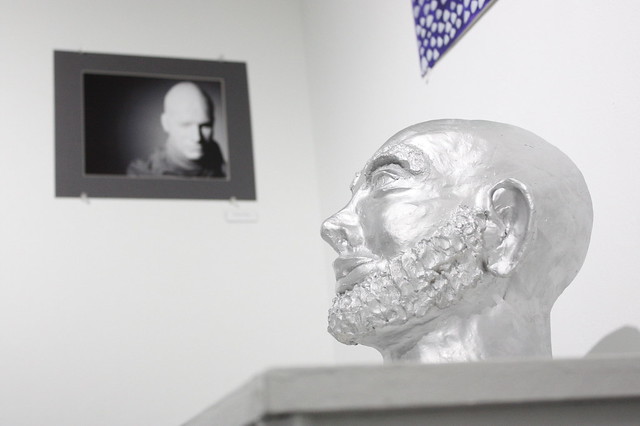
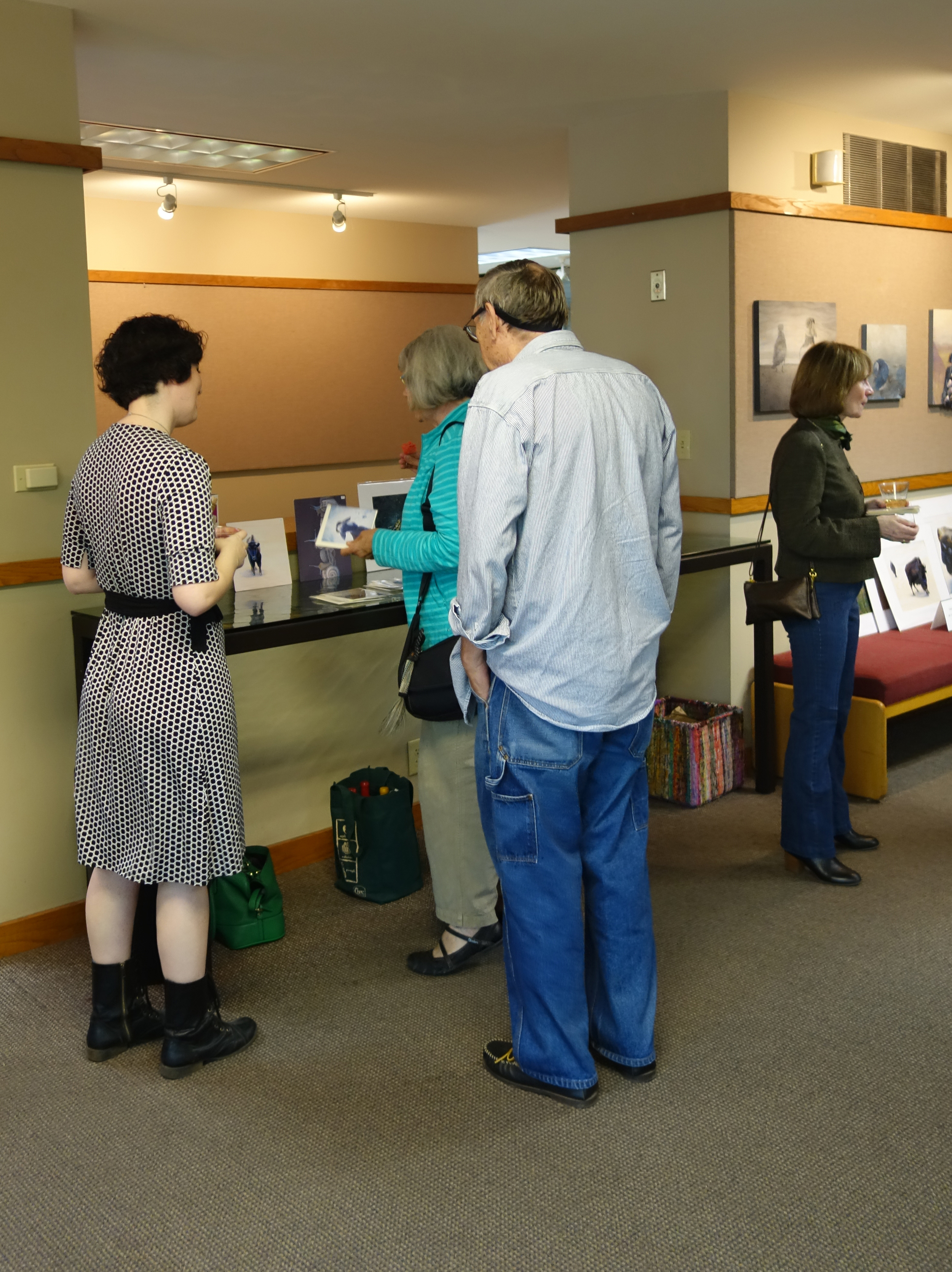
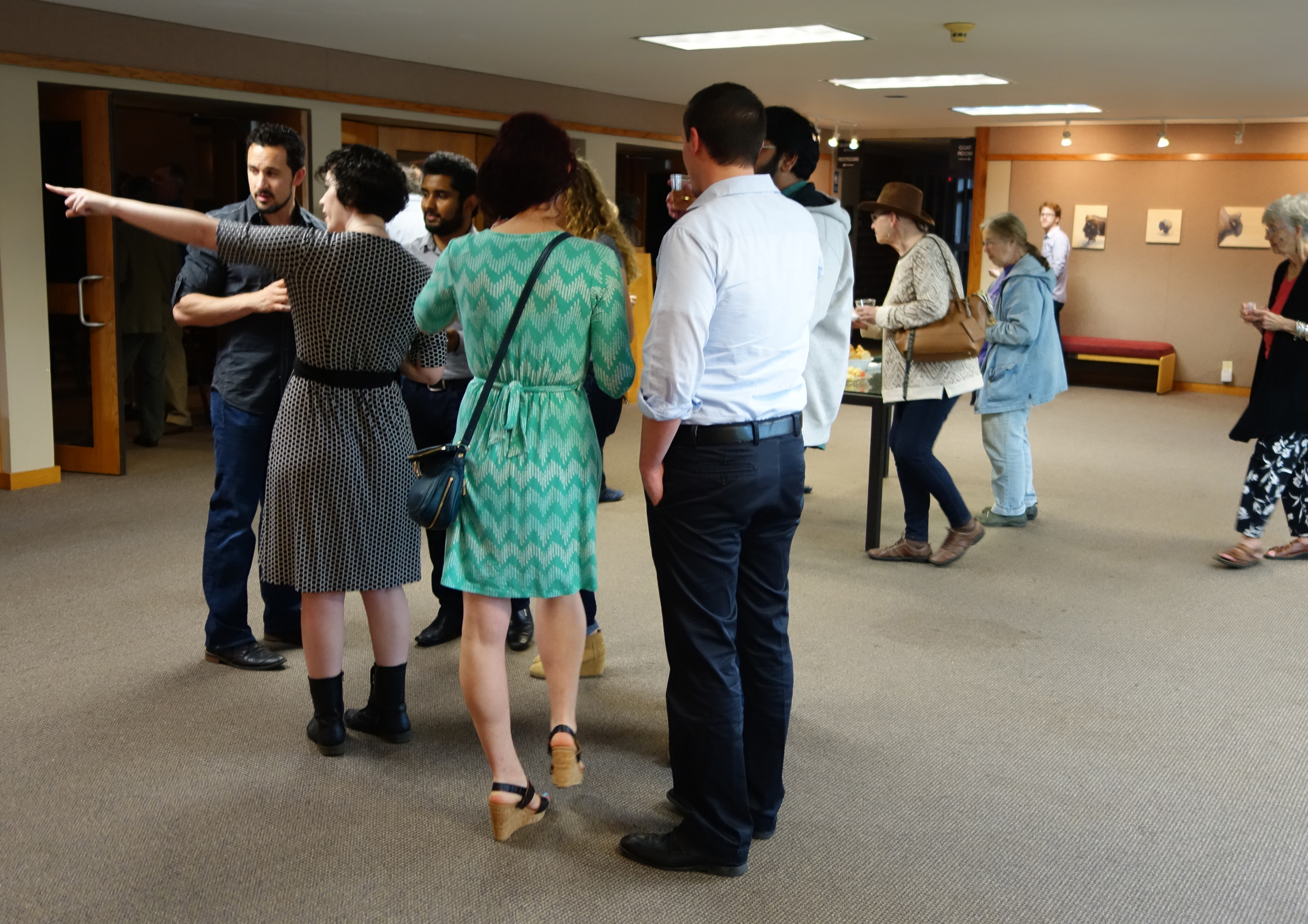
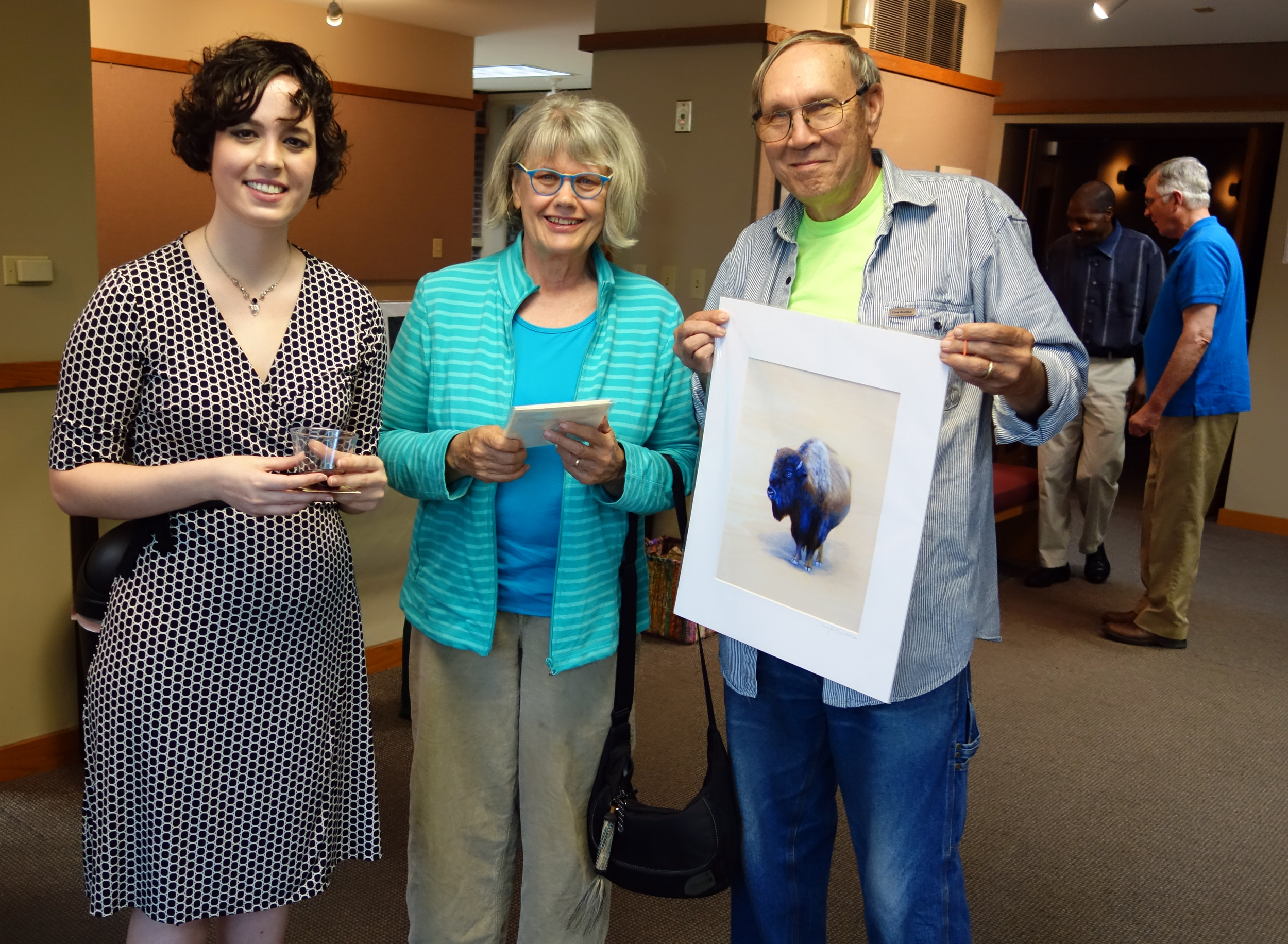
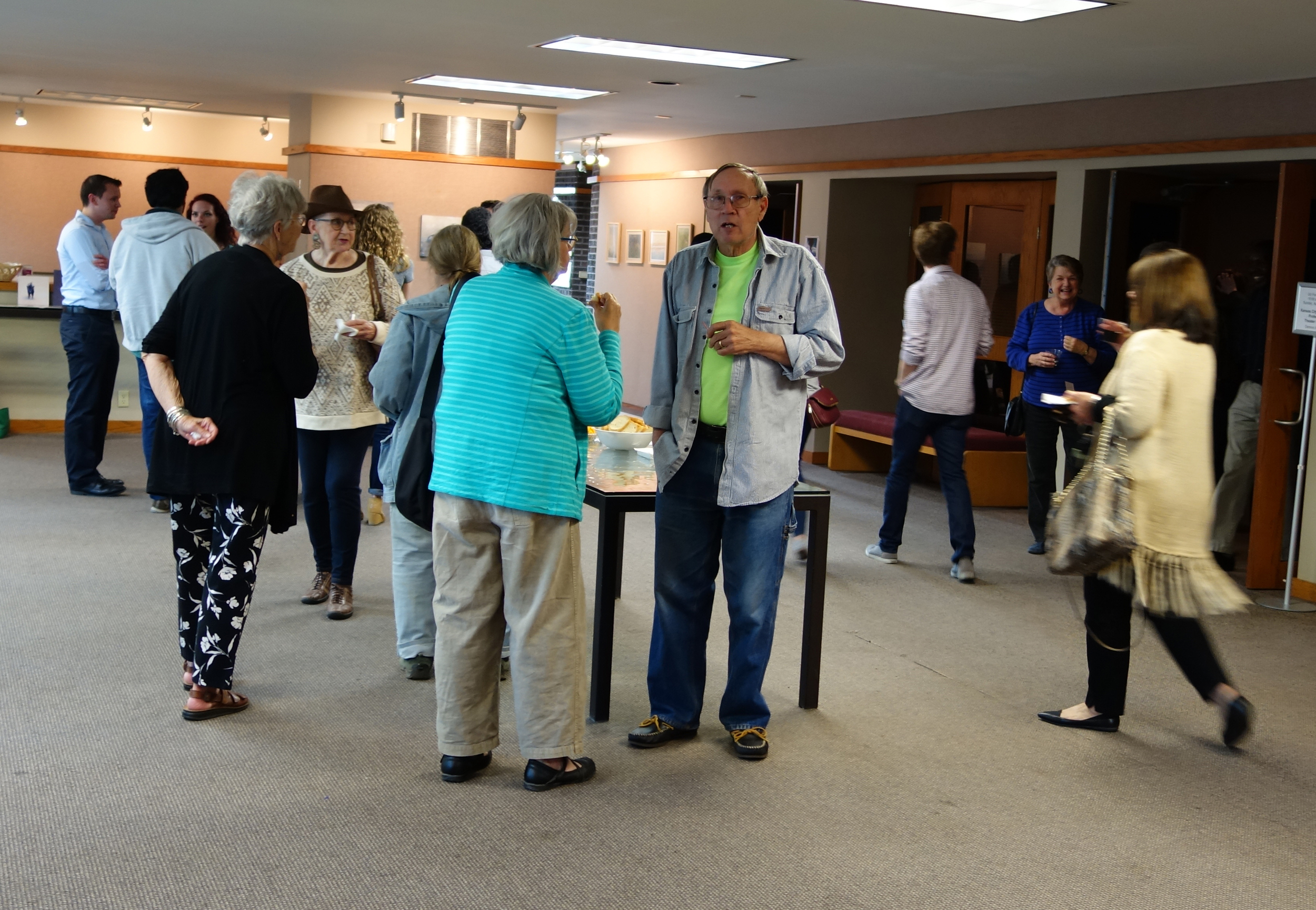
Here are the Spring 2016 Student Art Exhibition photos!  We invited local artist Beth Snider to be our guest judge in handing out Miller Awards, so you can see her presenting those in a couple photos.  44 students exhibited in the show (which ran from April 29 through May 5).  Classes I taught that were represented include Typography, Printmaking, Painting I & III, and Advanced Studios in Mixed Media and Tattoo Design.

End of Year Art Exhibit 2016

Upcoming: Residency at La Maison Verte

As you might have noticed in USM's recent press release about my upcoming exhibitions, toward the end of this month I'll begin a five-and-a-half week residency in the Pays'art program at La Maison Verte in Marnay-sur-Seine, France.  I'm very excited, as this residency takes place at the Jardin Botanique de Marnay-sur-Seine; I love working with plants both professionally as well as having a houseplant addiction, so this is a great fit.  La Maison Verte has a "Final Friday" opening each month, and so I will have an exhibition on June 24th.  In addition, they have arranged for the program's artists in residence to participate in Art & Jardins 2016 on June 25th and 26th.

If I have any readers who have experience with the region and can share any travel advice, I'd be grateful to hear it!

Animal Autonomy Is Becoming More Academically Accepted

I feel like there's a new groundswell of acknowledgement regarding animal sentience and intelligence happening lately in the academic arena, and I'm digging it.  Here's Dr. Frans B.M. de Waal discussing his perspective in "What I Learned From Tickling Apes," published in The New York Times.

University of Saint Mary Press Release on My Early Summer Shows

The University of Saint Mary just published a new press release on my early summer exhibition schedule (though I have another application out, so I may have more to share coming up!).

Art Program Director Honored for Her Masterpieces

(Leavenworth, Kan.)—The University of Saint Mary Art Program Director Shelby Prindaville was recently selected for a solo exhibition in the All Souls Gallery at All Souls Unitarian Universalist Church at 4501 Walnut Street, Kansas City, Mo. The public is invited to an opening reception for the exhibit on Friday, April 22, from 6-7 p.m. Her work can be viewed in the gallery April 14-May 20, Monday through Friday 10 a.m.-4 p.m. and Sunday 9 a.m.-2 p.m.
 
Prindaville was also juried into the 47th Annual Smoky Hills Art Exhibition at Hays Art Center at 112 E. 11th Street, Hays, Kan. The annual exhibition is a statewide fine art competition open to any artist currently living in Kansas. Juror Mark Hartman selected Prindaville’s “Perspective” to be included in the show. The public is invited to view the piece, along with the other selections, from April 29-June 8. An opening reception and awards ceremony is scheduled for Friday, April 29, from 6:30-9:30 p.m.
 
“I am very pleased that my work is being recognized by each of these organizations,” said Prindaville. “I hope my art inspires viewers to reflect and deepen their connections with the natural world through my pieces' thematic exploration of environmental conservation and sustainability.”
 
In addition to both of these achievements, Prindaville was accepted to a summer artist residency program at Pays'art in La Maison Verte (The Green House) at the Botanical Garden of Marnay-sur-Seine in France. The residency will culminate in her onsite "Garden Lore" exhibition opening June 24.

To see her work, visit shelbyprindaville.com.

Solo Exhibition at All Souls Gallery in Kansas City

Here I am, beginning to install the show.

Here I am, beginning to install the show.

This Monday, the All Souls Gallery coordinator reached out to me asking me if I would do a solo exhibition in their space, preferably to be installed immediately though later in the year was also an option.  I accepted their invitation and said that immediately was actually a great time for my show schedule.  So yesterday afternoon, I stopped by and installed the show; the elapsed time from invitation to installation was two days!

Below, please find the pertinent information regarding the reception and overall exhibition details, and if you're free and in the area I'd appreciate it if you'd consider stopping by the opening (wine and cheese will be served)!

Opening reception: next Friday, April 22nd from 6-7pm
Location: All Souls Gallery is located in the All Souls Unitarian-Universalist Church at 4501 Walnut Street, Kansas City, MO, 64111
Exhibition dates: April 14 - May 20
Gallery hours: Monday through Friday from 10am-4pm and Sunday from 9am-2pm

And here's a sneak peak of one section of the exhibition!

And here's a sneak peak of one section of the exhibition!

Sierra Club Annual Fundraiser

If you're not attending the University of Saint Mary's SpireFest this Saturday, you should consider visiting the Sierra Club's 2016 Annual Fundraiser!  For the second year in a row, I've donated artwork - this year I donated an aluminum print, a matted paper print, and three packaged greeting cards - for their silent auction.  I raised $300 last year through my donation of an original drawing on panel, so I'm interested to see what the reproductions bundle will go for! 

2016 SpireFest

Every year, the University of Saint Mary holds an event called SpireFest which is aimed at raising money for student scholarships.  There's a silent auction, student performances and entertainment, food and drink, and even dancing.  This year, I've donated a signed, matted print and five greeting cards as an artwork bundle, so keep your fingers crossed it gets some good bids!  I'll be there for the third year in a row, so if you're interested in keeping me company, check out this flyer - but hurry, as SpireFest is this Saturday...

Mimosa Pudica Remembers You

Here's a neat article from The New York Times on one of the plants I work with in my interactive installations, the Mimosa pudica or "sensitive plant."  I do have to qualify their results, however, because none of the plants I've grown has ever stopped recoiling from human touch/interaction.  I wonder just how repeated their "repeated exposure" was.

Abraham Lincoln's Life in Images Lecture at USM on C-SPAN

A couple months ago, the University of Saint Mary hosted Smithsonian National Portrait Gallery senior historian David Ward at our annual Lincoln Event.  He gave a fantastic art-history-focused lecture that I got to experience live, but which is also being broadcast by C-SPAN 3 this Sunday at both 7pm and 11pm.  A preview clip is available here.

Upcoming: 47th Annual Smoky Hill Exhibition

I've been juried into the 2016 Hays Arts Council's 47th Annual Smoky Hill Exhibition!  Juror Mark Hartman selected Perspective to be included in this show held in the Hays Arts Center in Hays, Kansas.  If you'd like to see the exhibition in person, the exact address is 112 E 11th St, Hays, Kansas 67601, and you can contact the Arts Center with any questions at 785-625-7522.

Opening reception: Friday, April 29 from 6:30-9:30pm
Exhibition dates: April 29 - June 8

Linguistic Relativism and Color

I was discussing with my colleague Susan this afternoon how I've read that men are more likely to have color identification and distinction issues in part because they are culturally raised with a more limited color vocabulary - girls are encouraged to learn names for (and wear) a wider variety of colors, and so women become better able to distinguish color differences in part because of their vocabulary.  I've also read that young Western children kept away from cultural discussion of the sky as blue often label the sky as "nothing," "white," or "grey" before being taught the appropriate answer. These types of studies demonstrate that how we perceive the world is not only down to our biology but also to cultural and linguistic cues.

I decided to try to relocate another study I'd previously read about, so as to refresh my memory on the exact details and perhaps learn more.  The research focused on an indigenous people who had in their language a different color category for what in English we would call a variant of yellow-green but at the same time did not linguistically differentiate blue from green.  I remembered that I had looked at two circular grids, one having all green squares with one being very slightly different in hue and value and one having one cyan square and all the rest green squares.  The all green grid was as easily scanned and the odd one out identified by these people, while the blue and green grid was a stumper.  For Western people, the difficulties were reversed.  After a decent amount of googling, I learned the tribe was the Himba of Namibia, the two grids can be seen herea clip from a BBC documentary explaining it is here, and, if you're so interested, you can read an academic study on the topic entitled "Knowing color terms enhances recognition: Further evidence from English and Himba."  As you'll find out if you watch the BBC clip, the Himba also label the sky as black and rivers as white, and have a more limited color vocabulary than English speakers use. 

I also, in my research trail, learned a few other facts from various sites:

  • This overall topic is called linguistic relativism and as it applies to color, there is still some debate as to how relativistic (versus universal) color differentiation actually is. 
     
  • Very young sighted children are no more reliable than blind children at correctly identifying color (sometimes up until the age of four).
     
  • [In] languages with fewer than the maximum eleven color categories, the colors followed a specific evolutionary pattern. This pattern is as follows:

1.  All languages contain terms for black and white.
2.  If a language contains three terms, then it contains a term for red.
3.  If a language contains four terms, then it contains a term for either green or yellow (but not both).
4.  If a language contains five terms, then it contains terms for both green and yellow.
5.  If a language contains six terms, then it contains a term for blue.
6.  If a language contains seven terms, then it contains a term for brown.
7.  If a language contains eight or more terms, then it contains terms for purple, pink, orange, and/or gray.

I am fascinated and somewhat alarmed by the thought that English is holding me back from the world of green that the Himba and Koreans get to experience.  I've wished for the mantis shrimp's color spectrum vision and ultraviolet perception in the past, but perhaps I don't even need more rods and cones - perhaps all I need is new words.  Though since the brain stops developing around age 26, it sadly might already be too late for me.
Someday I'd Really Like to Meet a Woodcock

I'd like to meet a woodcock primarily because they are ridiculously proportioned animals that I'd enjoy drawing and painting, but also because they have a really cute bobbing walk and their mating call is called "peenting," which you cannot deny is an adorable name.

Here's a short clip of a woodcock dancing:

And here's one of peenting mixed into a snippet of Collective Soul's famous "Shine" song:

Puffin Painting #1 - Byssal Bird

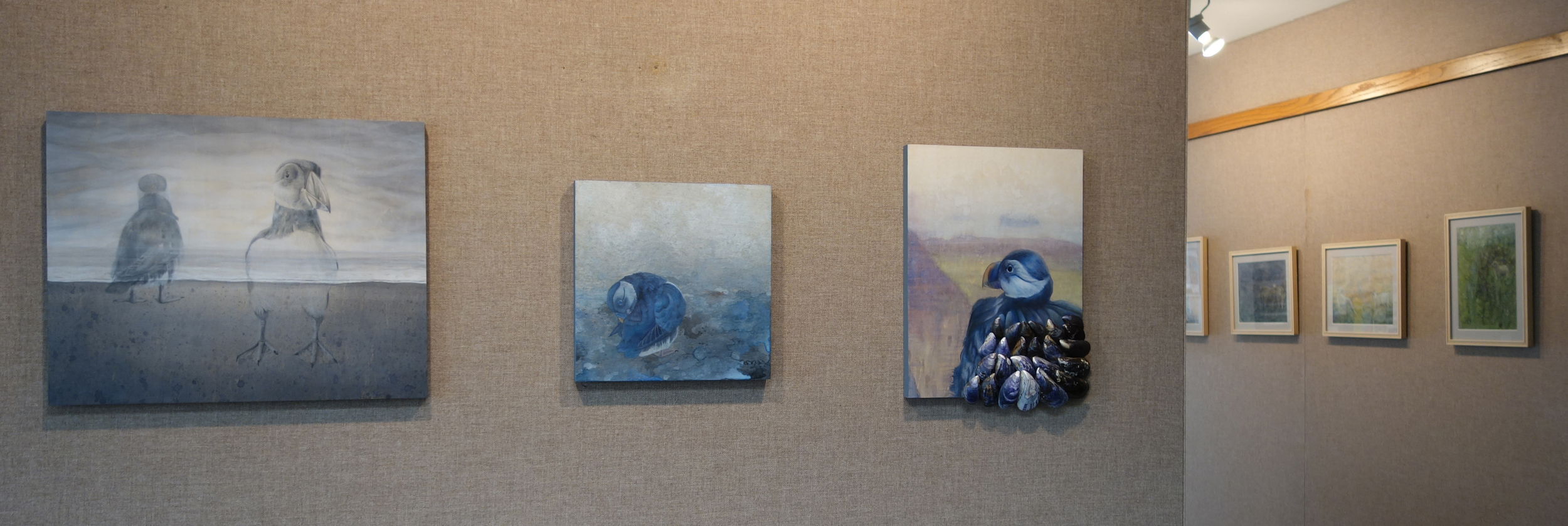
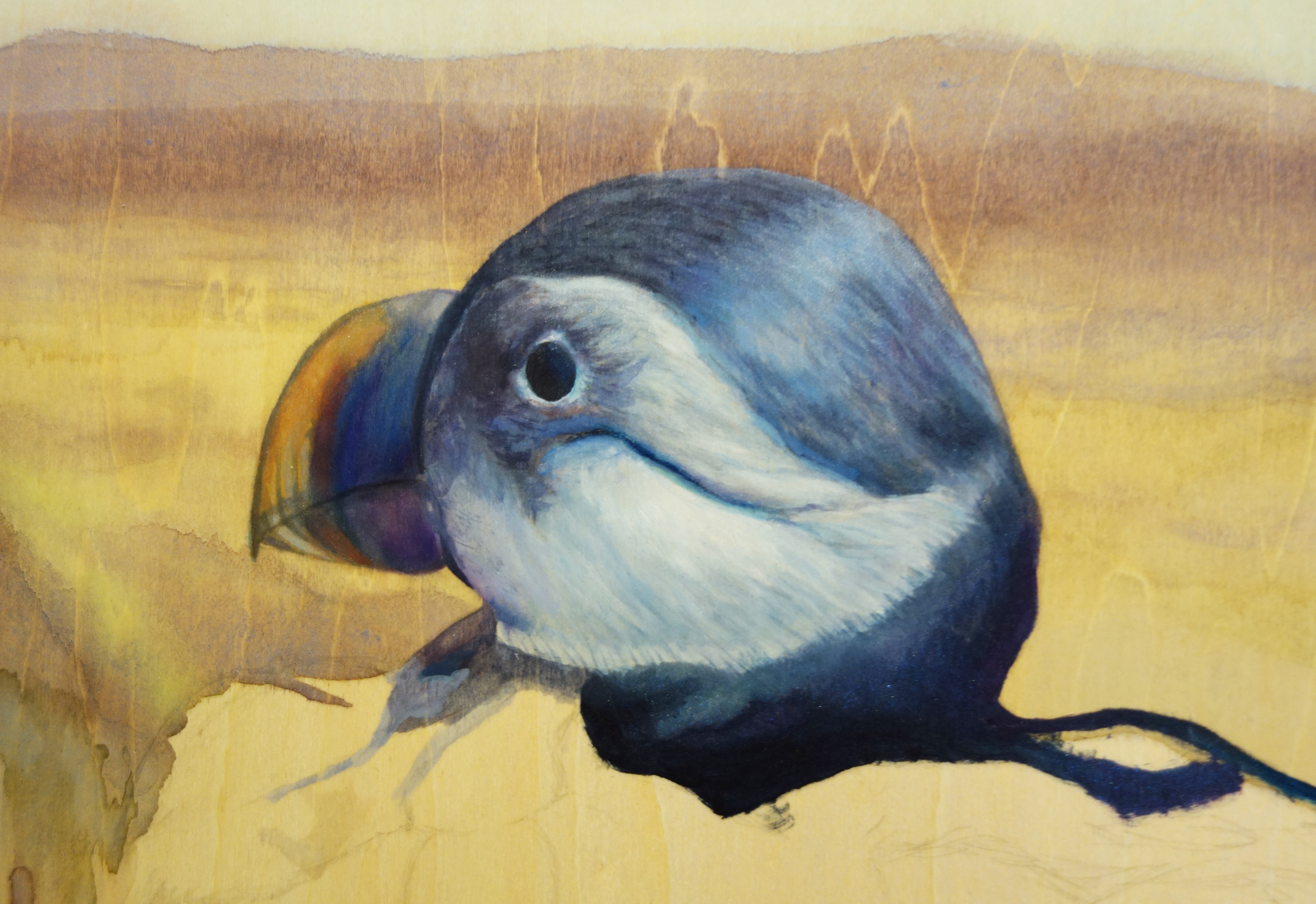
And here's the finished first painting!  It's a conceptual, experimental piece - those are real Atlantic blue mussel shells (Mytilus edulis) adhered to the panel; I beachcombed some while I was in Iceland and was quite interested in their coloration and form and how I might use them to break the picture plane.  I wanted to explore ideas of illusionism, perspective, shaped or irregular canvases, cast shadows, organic versus architectural form language, and intertidal zone ecosystems.

I'm titling this painting Byssal Bird, and it's a mixed media piece with acrylic, watercolor, Atlantic blue mussel shells, and epoxy on a 16x12" basswood panel.

Byssal Bird.jpg

Puffin Painting #2 - Littoral Layers

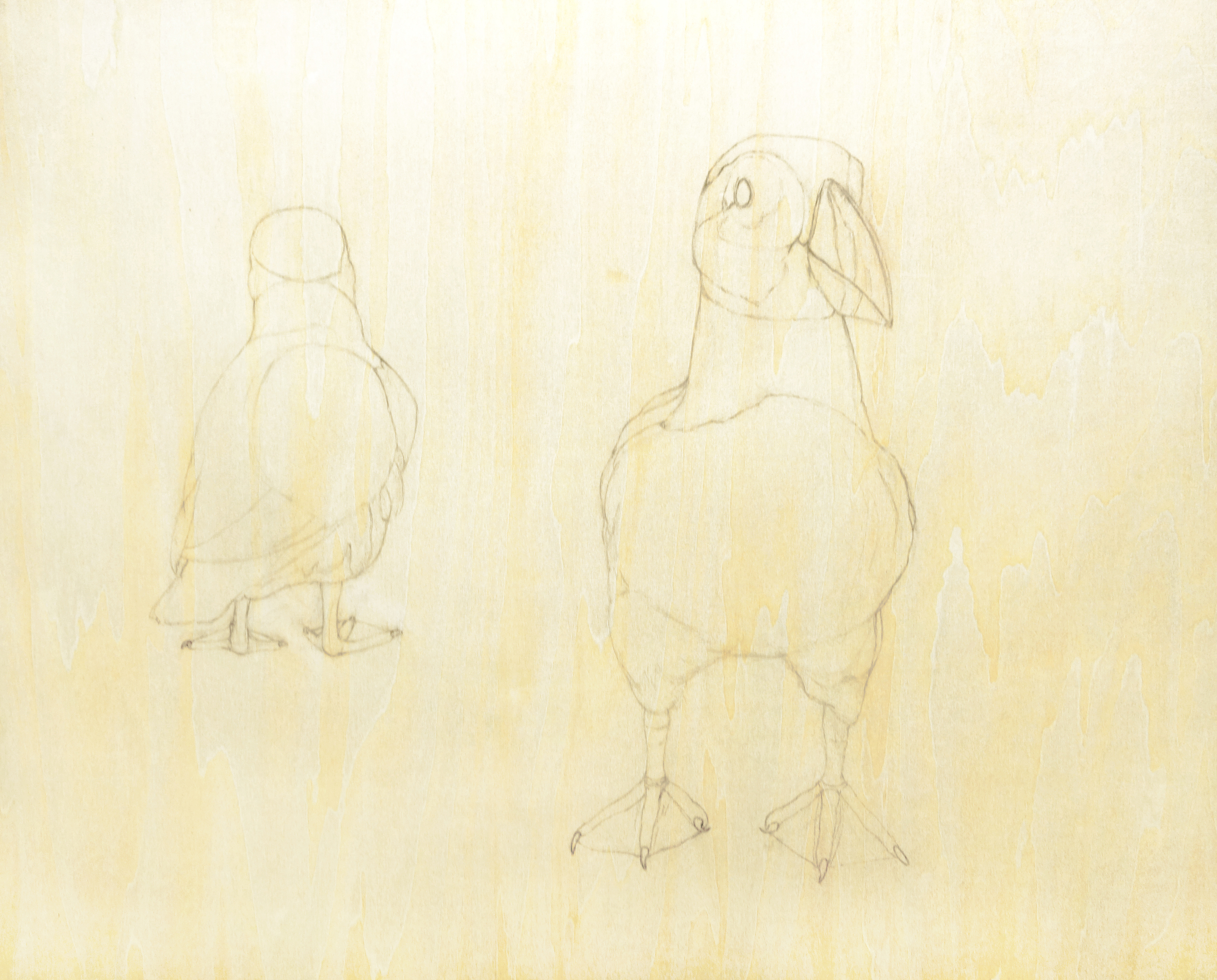
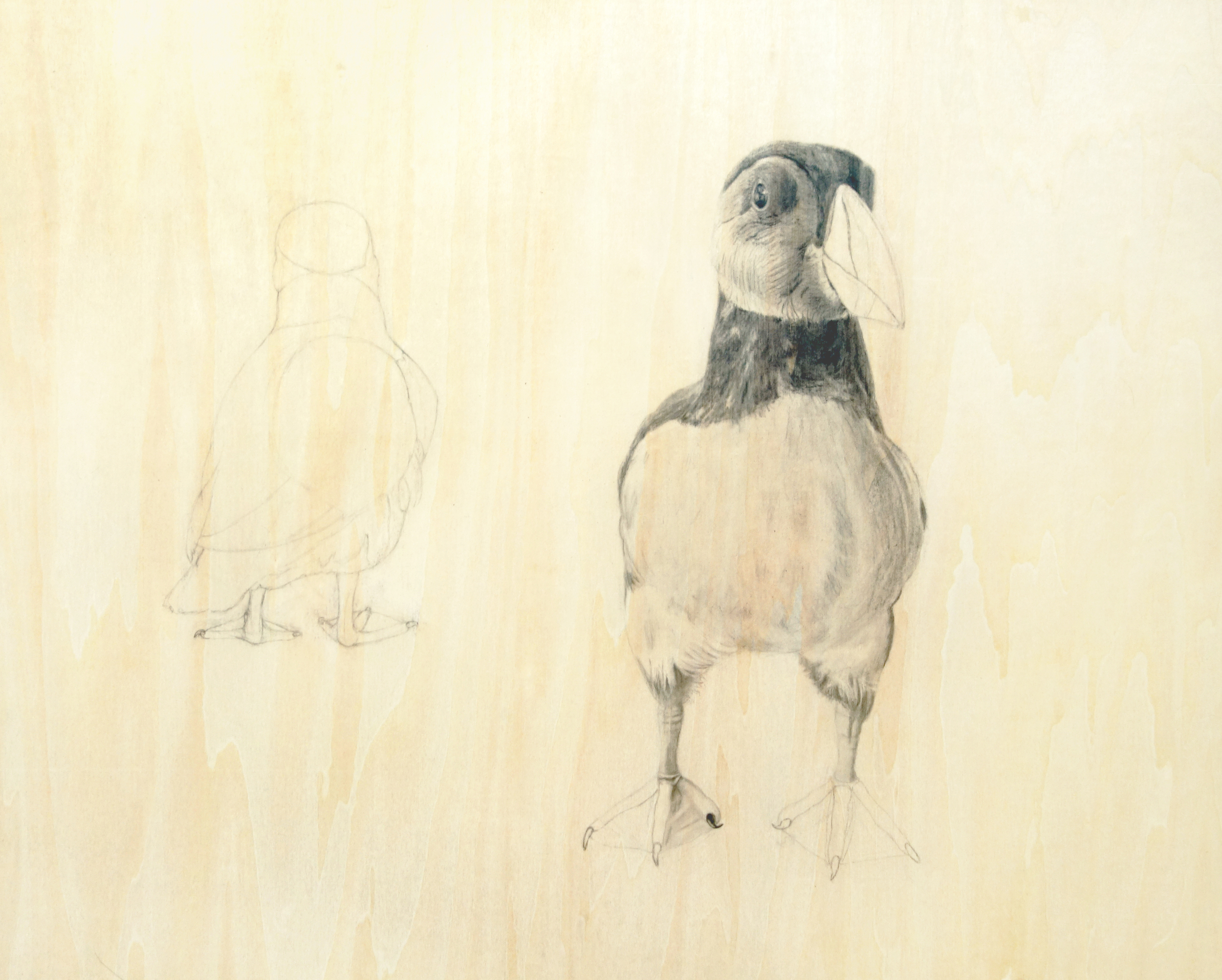
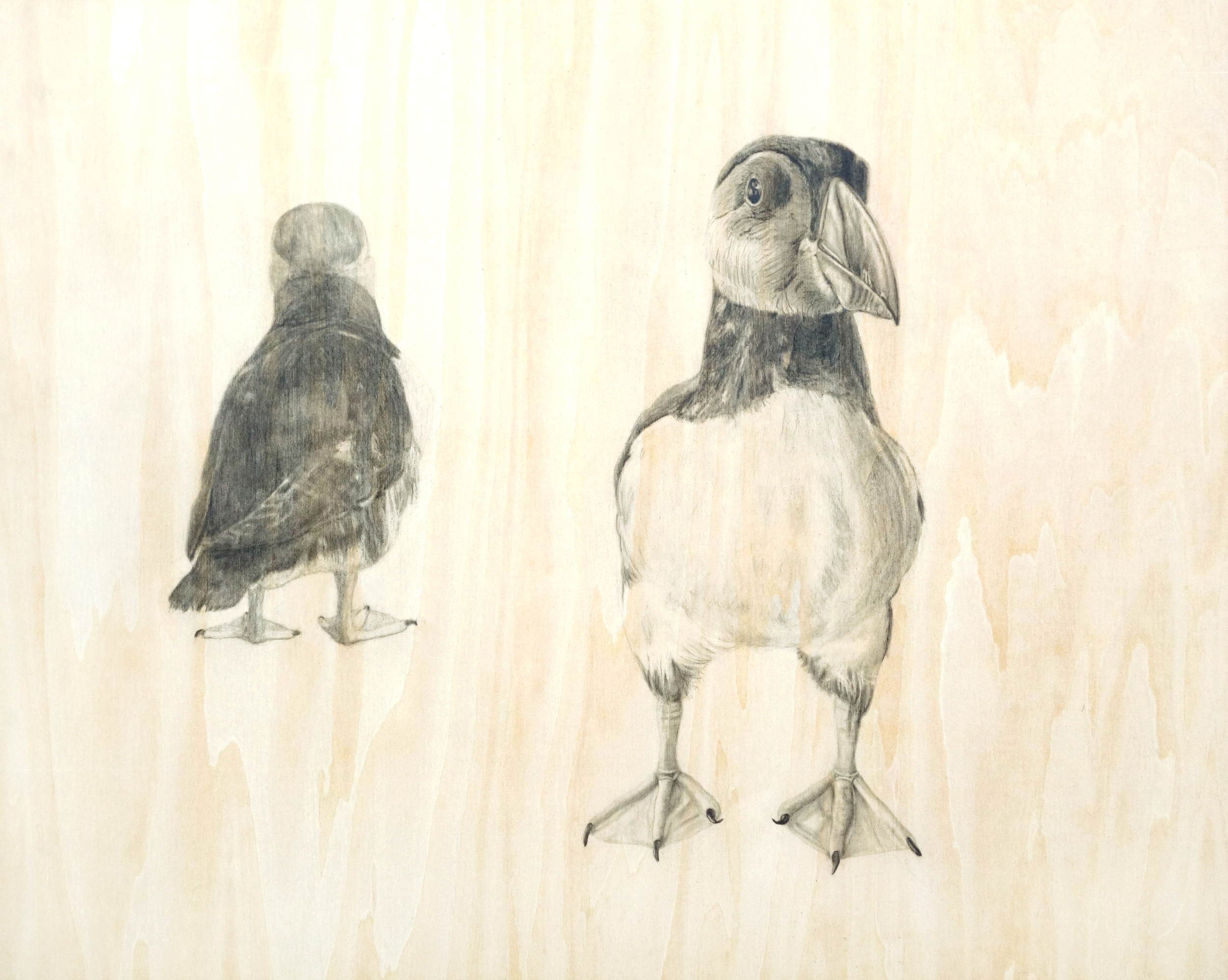
I'm almost done with the first puffin painting - the one I gave you a sneak peak of - but in the meantime I'm potentially done with the second; I've been adjusting it over the past couple days and I may go back into it again, but here's where it's at now.  If I do go back into it, it'll be for minor changes at this point.  I'm typically pretty bad about taking progress photos (particularly in taking well lit/consistent lighting source ones, so please excuse the slight lighting changes in the thumbnails) but I'm trying to make more of an effort to document my processes.  

I'm titling this one Littoral Layers.  The final piece is graphite, charcoal, and acrylic on a 16x20" basswood panel.  I typically do start with a line drawing (after preliminary sketching, of course), but then in paintings where I add to the natural support media for the background, I usually paint in the beginnings of a background before moving on to the foreground elements and then go back and forth until there's a resolution.  This painting was different in that I really developed the foreground elements before addressing the background, though after that I did my normal switching back and forth routine.

Littoral Layers.jpg

New Series Started - Puffin Paintings!

I've started a new series of paintings on the juvenile puffin, Toti, that I met at the tail end of my residency in Iceland in 2014.  Toti was a puffling that failed to launch and imprinted on humans, so he is now a permanent resident at the Saeheimar Aquarium.  I wanted to start on these pieces sooner, but better late than never.

Here's a sneak peak of progress on the first painting!

Anti-Intellectualism - an American Cultural Failing We Need to Fix

Most Americans know who Albert Einstein was, but comparatively very few people know who Neil deGrasse Tyson is.  They know who Kim Kardashian is, though!  In the present in the United States, entertainment and lowest-common-denominator appeal are revered and expertise has less impact than demagoguery.  When people stop admiring intelligence, they stop working to attain it.  That's where we are now.  The United States has a lot to learn from other older, more mature cultures, and I hope we can wisen up soon.