Residencies

Second Week in Athens

I had a studio day on the 19th. I tried to sand more of the tiles with the rotary sander attachment, but the sanding pad gave out after the first one. Dimitri suggested I buy a different, heavier-duty ribbed sanding head, and we went to a neighborhood hardware store to do so. They didn’t have it in stock, but ordered it in for me and said it’d come in later in the week. Then on the 20th I set an alarm for 7:30am, as I was told by people I asked on my previous mountain visit that the tortoises are most active and likely to be seen around 8-9am. Waking up so early and then doing an intense hike first thing isn’t my favored order of events, but I kept telling myself I had a date at “tortoise time” and it helped! This time, I entered the mountain from the place I had exited on my last visit, as I’d been told that it’d be more likely to see tortoises on that side. I had dropped GPS pins on some fountains that I had hoped might attract some tortoises who wanted a drink, but neither had gathered any as I checked them.

I wandered a while without any sightings, and eventually my path crossed with a worker who was swapping out garbage bags. I assumed someone who follows all the trails swapping bags would be a great resource, so I asked her about turtles (in my experience, few people who primarily speak other languages know the word tortoise as most languages just have one word for both turtles and tortoises, and turtles is the much better known English option). She didn’t speak much English but the word and my mimicry of them worked, as she did clearly understand the question. She managed to get across that they are here in general but she didn’t know in specific where any might be, and then she summoned another fellow I’d seen several times over and together they discussed my desire to find turtles, had a meandering conversation that included the local fox that can sometimes be found at night, and eventually lasted long enough for another passerby to arrive - and when they included her in the query, it turned out she was headed for a spot where tortoises frequently hang out in the morning because people feed them lettuce (as she was planning on doing)!

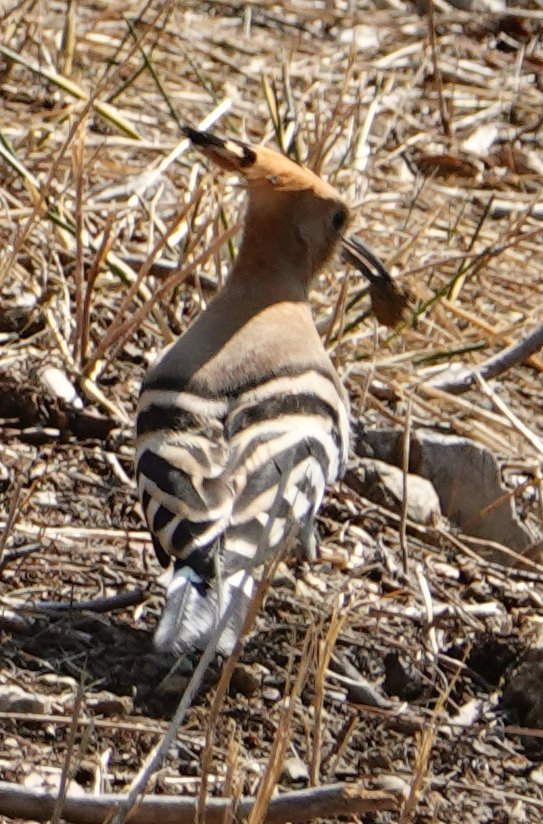
We walked together with her dog to this new site, and it turned out she is British, lives in Athens, and recently spent some time in the USA as well, so we had a lot of conversational topics to explore. When we eventually arrived, we were in luck! There were two tortoises already feasting on some lettuce, and she added hers to the mix. I took a bunch of photos, and after a spell a hoopoe showed up so I paused to photograph it. This hoopoe didn’t let me get as close as my previous one had, but my camera settings were way better, so overall I got a few decent shots. Then I went back to photographing the turtles, but by this time a group of locals showed up to add fruit to the pile and they had a bunch of dogs with them, one which would not stop barking at anyone who wasn’t in their group (including me), so I didn’t hang around too much longer though I did make the acquaintance of Giselle, a cute, friendly puppy, when she plopped herself into my lap while I was trying to photograph the tortoises.

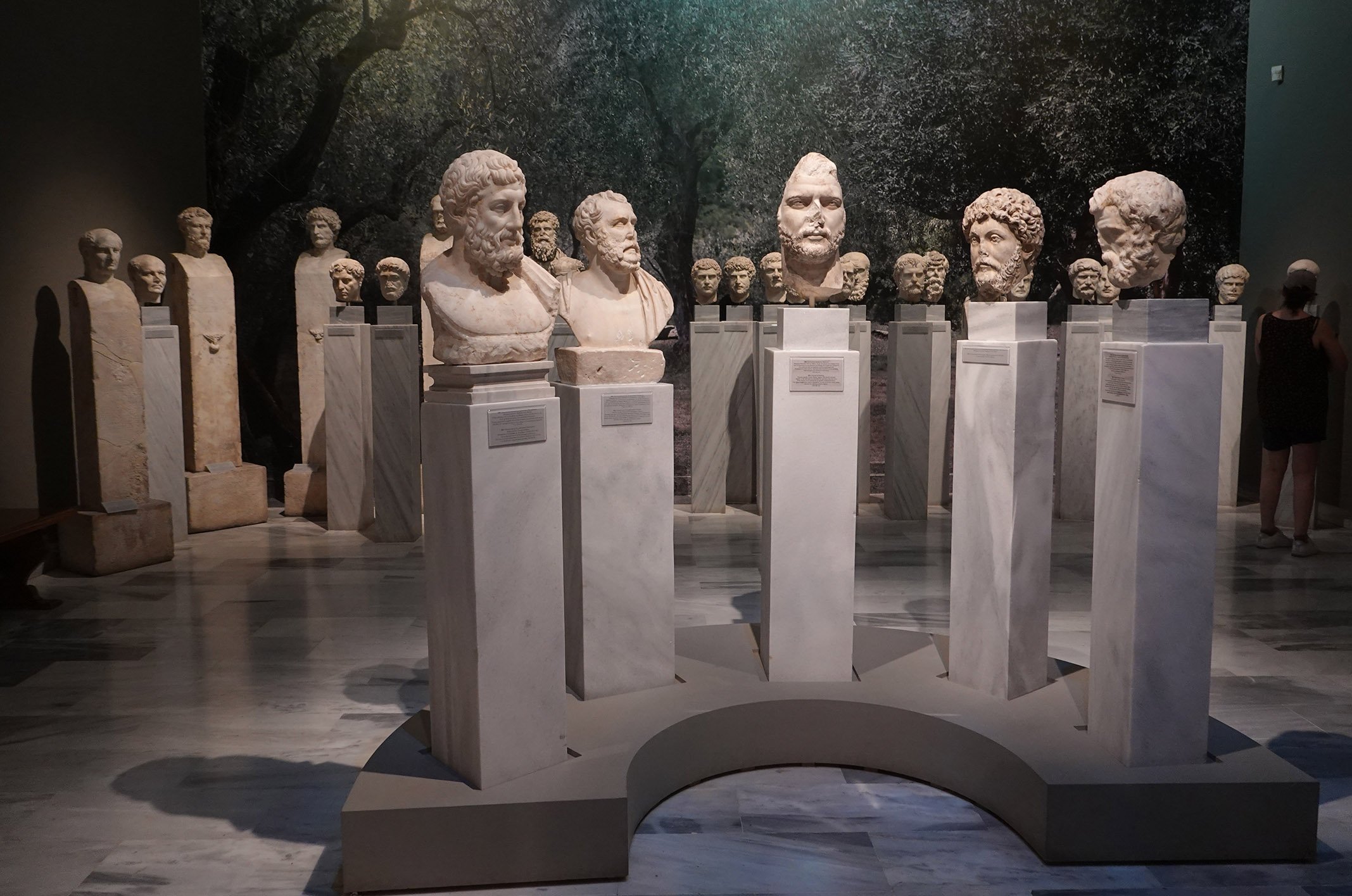
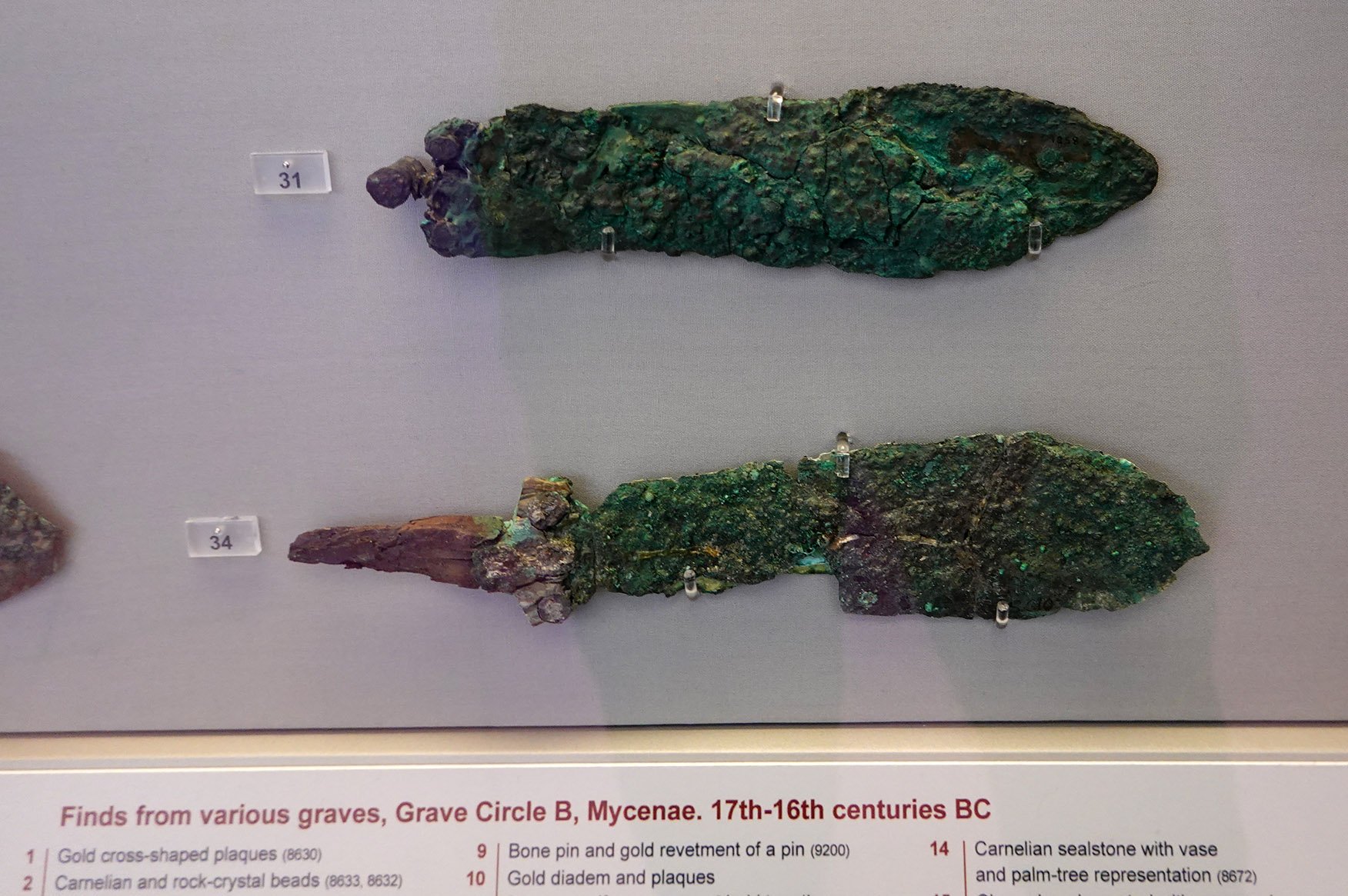
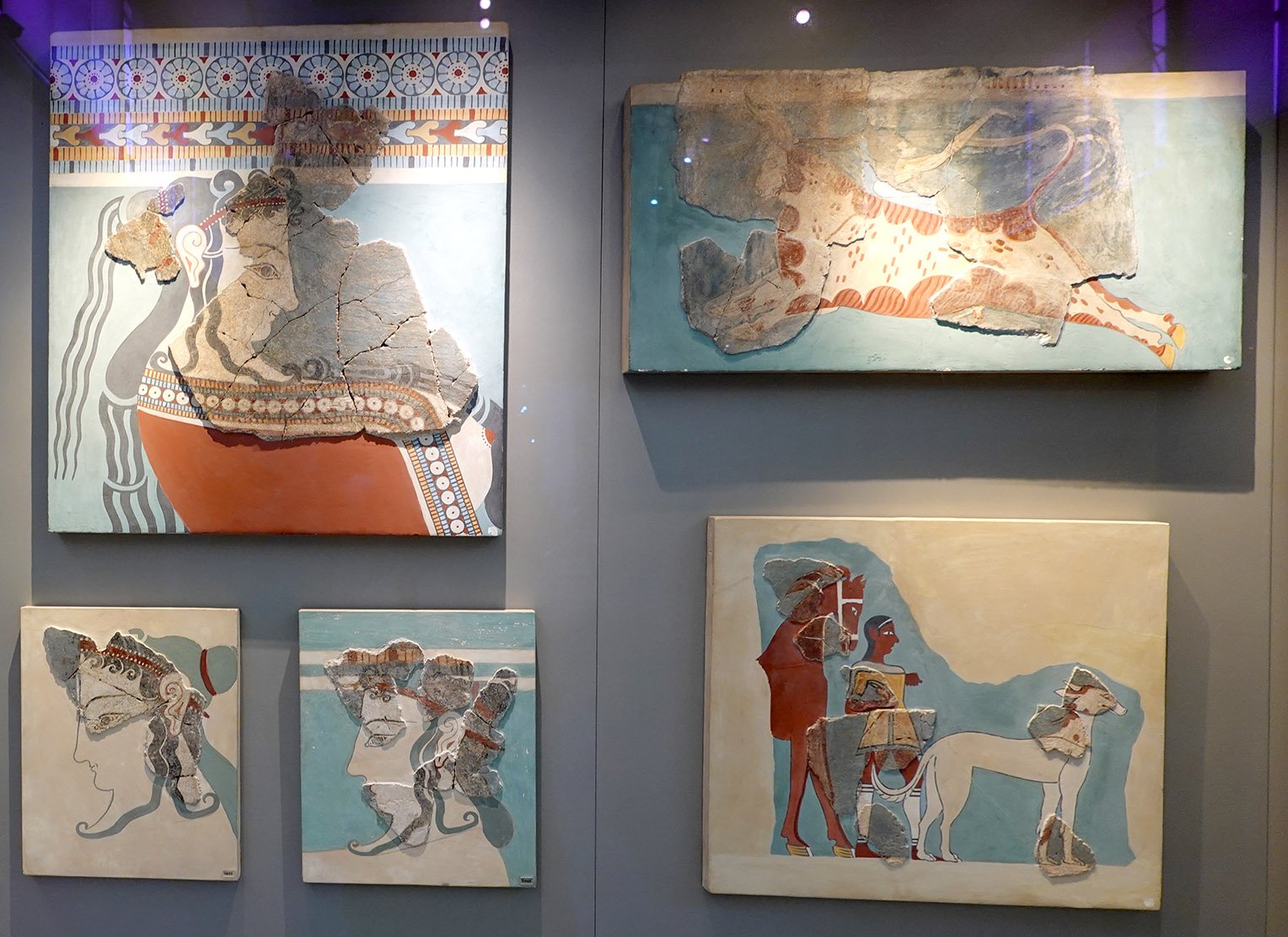
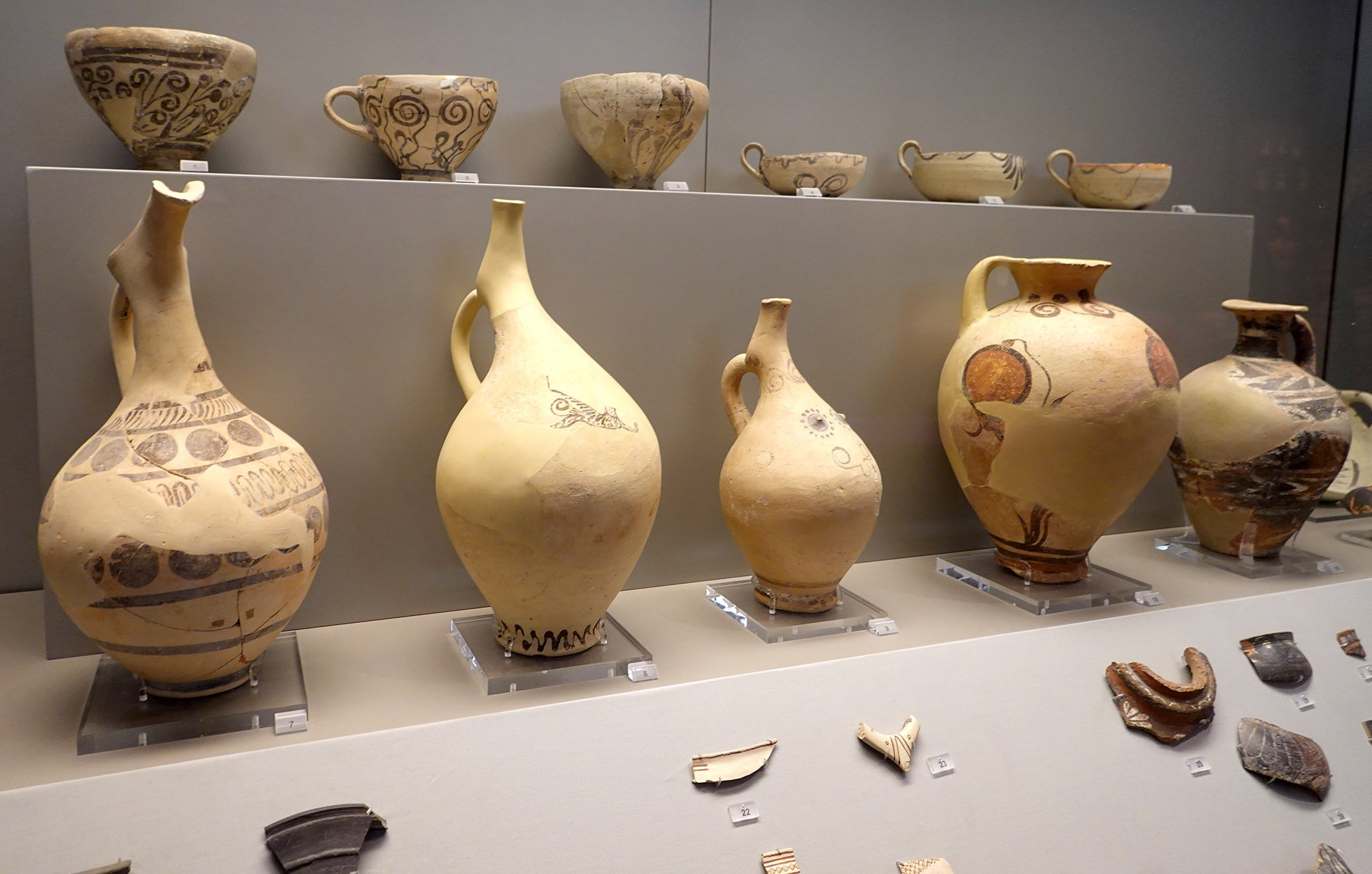
The next day, I decided to visit the National Archaeological Museum. It is an immense collection that takes several hours to explore, and while I did the whole thing at once, I think there’s a limit to how much you can really register and retain, and to do it properly you might want to do it in three or four visits. I really enjoyed seeing how they exhibited partial finds (like frescoes or vases that were broken, needed to be pieced together, and were missing segments), and I was reminded of how beautiful oxidized bronze is. My one complaint is that they have no water fountains anywhere; you have to order and pay for water in the basement cafe (which has a permanently long line) or drink from your hands from the bathroom sinks.

I then spent more time in the studio! The new sanding head came in on Thursday, and I picked it up that evening. The next day, I tried it out on a piece of concrete first to get the feel for it (and it powered through the concrete). I then tried it on a tile, but it just buffed it so that too was a no-go. In between all of these and my previous attempts, Dimitri and the other artists in residence tried to help brainstorm but also kept suggesting that what I wanted to do was impossible. I credit my ceramics knowledge with the fact that I knew it wasn’t! I bought a new velcro head and 4 sanding heads of 40- and 60-grit, and went at the tiles again. This time, I got through almost all of the top layer of the glaze (but left a lower layer intact but now much more receptive to paint)! It turns out, the brand new sanding pad and velcro head were successful (though I also still think liquid/cream etching acid would have worked a treat). I did need to use a new sanding pad per tile, as the irregular surface meant I needed to use the very edge of the pad to get into the lower areas and that quickly ate up the perimeter, but the pads only cost 50 cents each so that was a reasonable expenditure. I went back to the hardware store and bought another 6 pads, and sanded away.

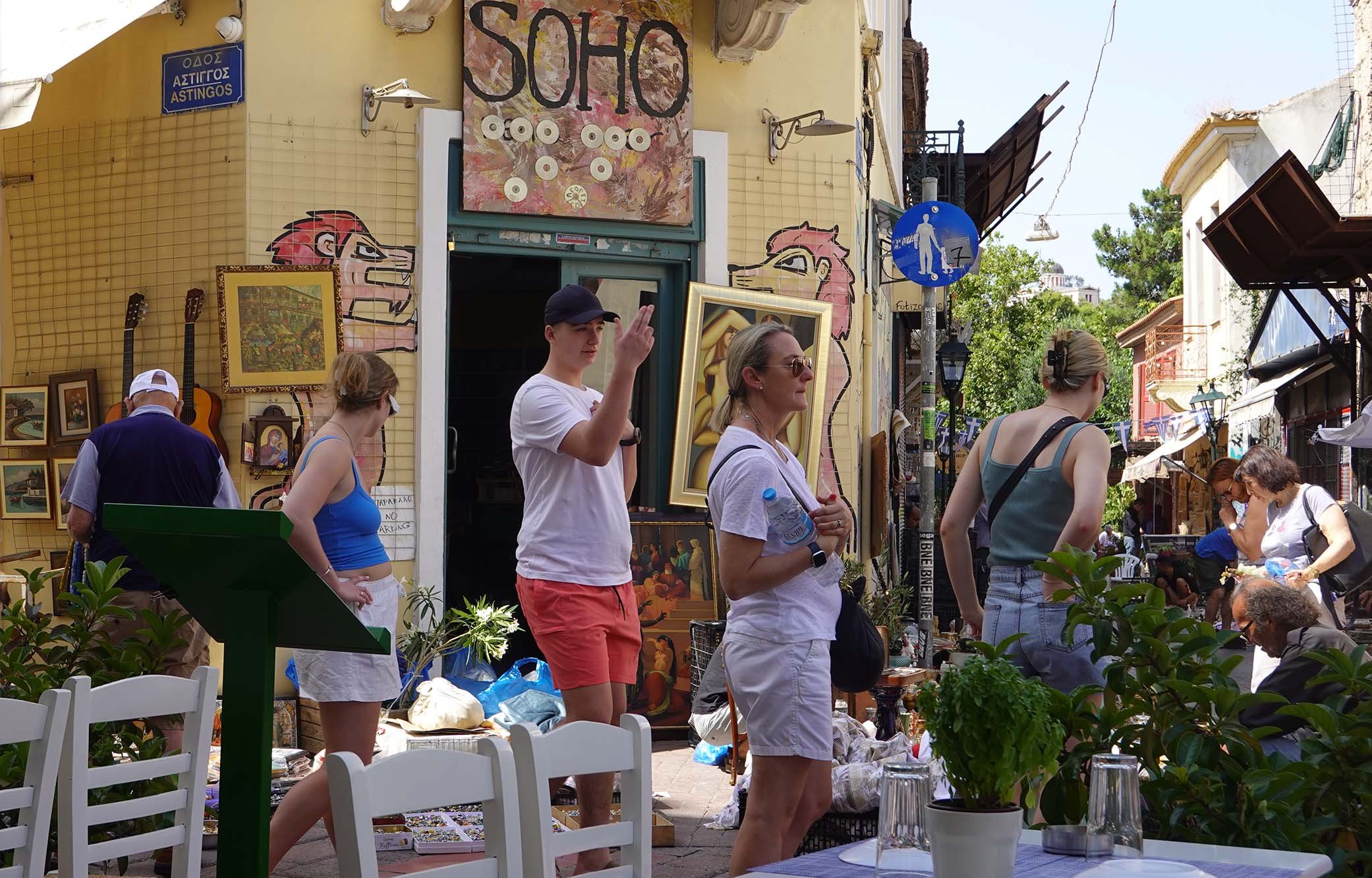
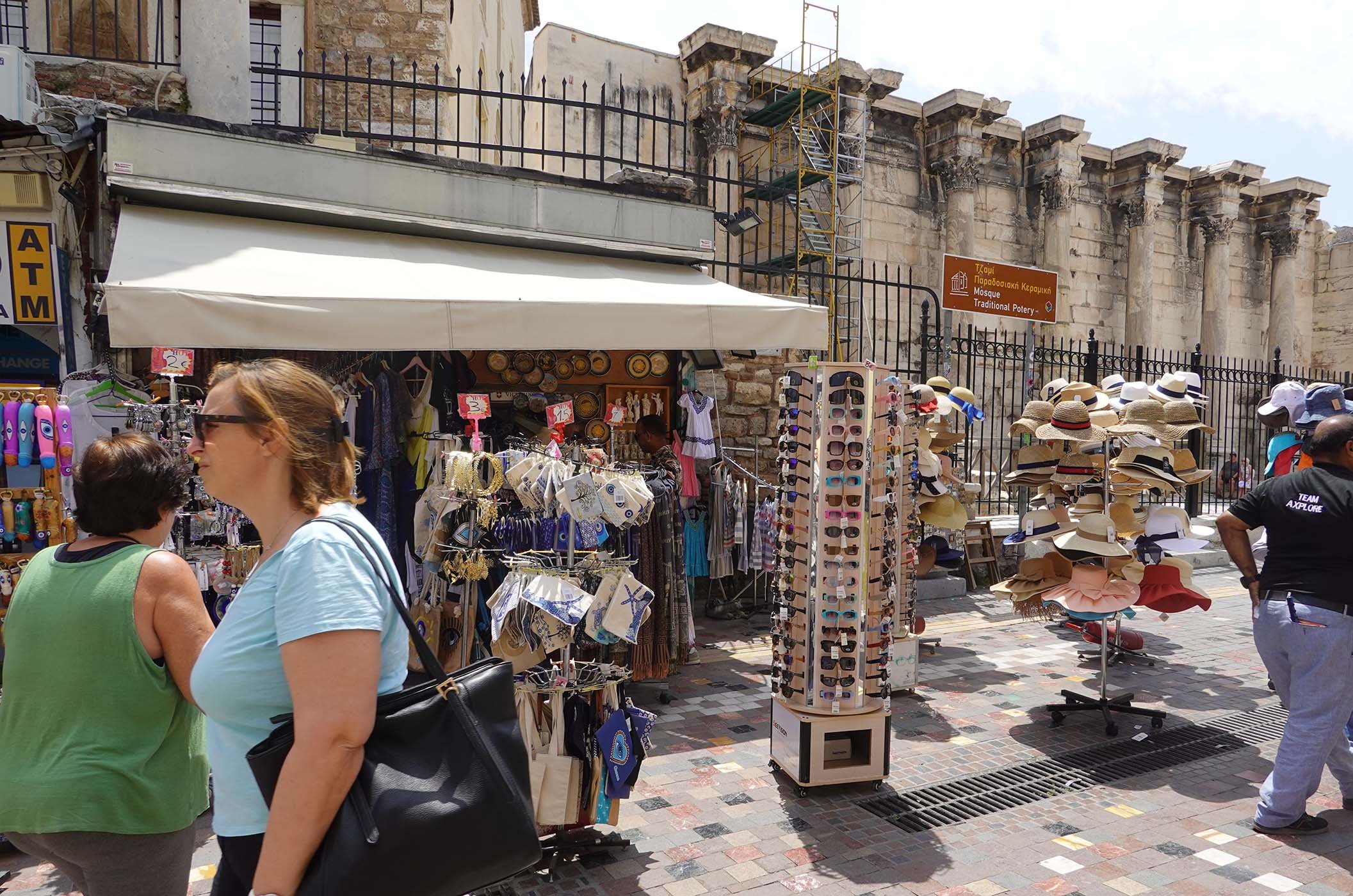
On the 25th, I decided to visit the Sunday Monastiraki flea market and then walk through the touristy shops of Plaka. The flea market was a bit of a disappointment, in that it’s mostly fixed tourist shops, a few antique stores, and a handful of street vendors, but the tourist shops throughout both neighborhoods went on and on. Most of them sold approximately the same type and range of goods, but every so often you could find one that had different wares. The prices in these neighborhoods were astronomical though. A tablecloth I liked cost 80€, a decorative plate cost 26€… it was clear you’d pay a large markup for anything you wanted. The main tourist shops included olive wood stores (featuring various cutting boards, serving tools, games, etc. made out of olive wood), jewelry stores, shoe stores, general tourist shops with shot glasses, mugs, dishes, statuettes, bags, and T-shirts, and edible gift stores with boxed baklava, halva, teas, and olive oil. There was also the occasional bookstore and art gallery mixed in.

Phoenix Athens Residency Artwork 1

Here is my first finished painting completed as an artist in residence at Phoenix Athens in Greece! It depicts a wild sparrowhawk chick in a somewhat stylized nest of branches.

This is Potential, acrylic on papyrus, 24x16.5”, 2023.

Shelby Prindaville’s painting of a wild Eurasian sparrowhawk chick on papryus.

My First Week in Athens

I arrived in Athens on Monday, June 12th in the late afternoon, and by the time I got my checked luggage and took a taxi to my residency, it was around 6:30pm. I greeted my hosts and their two artists in residence. The residency director, Dimitri, showed me to where I’d be staying and mentioned he didn’t have time to prepare it as he would have liked but hoped it would be acceptable and that he knew I wanted access to A/C (I had requested that if possible given that it can get up to 104°F/40°C in the summers), which this apartment has. Then we went out for drinks and invited a field biologist friend of Dimitri’s, as I had asked to have him show me some of the local fauna and flora on the nearby Lycabettus mountain. It is also the highest point in the whole city (and is inexplicably titled a hill here, as in Lycabettus Hill, but I assure you - and have photographic proof - that it is not!).

I returned back home and went to bed. I awoke in the middle of the night and discovered a large cockroach, so the next morning Dimitri brought a can of spray over. Unfortunately, it turned out to be a bigger infestation than the can of spray could resolve, so he then spent hours patching crevices and holes in the place with cement, caulk, and tape, and finally a couple days later an exterminator came. Since then, I haven’t seen another (fingers crossed)! In the midst of dealing with that, my bathroom plumbing also flooded the place with contaminated water, and we’ve since had three plumber visits - I now have a brand new toilet, too. I’m hoping that was all my bad luck for the trip, right at the beginning!

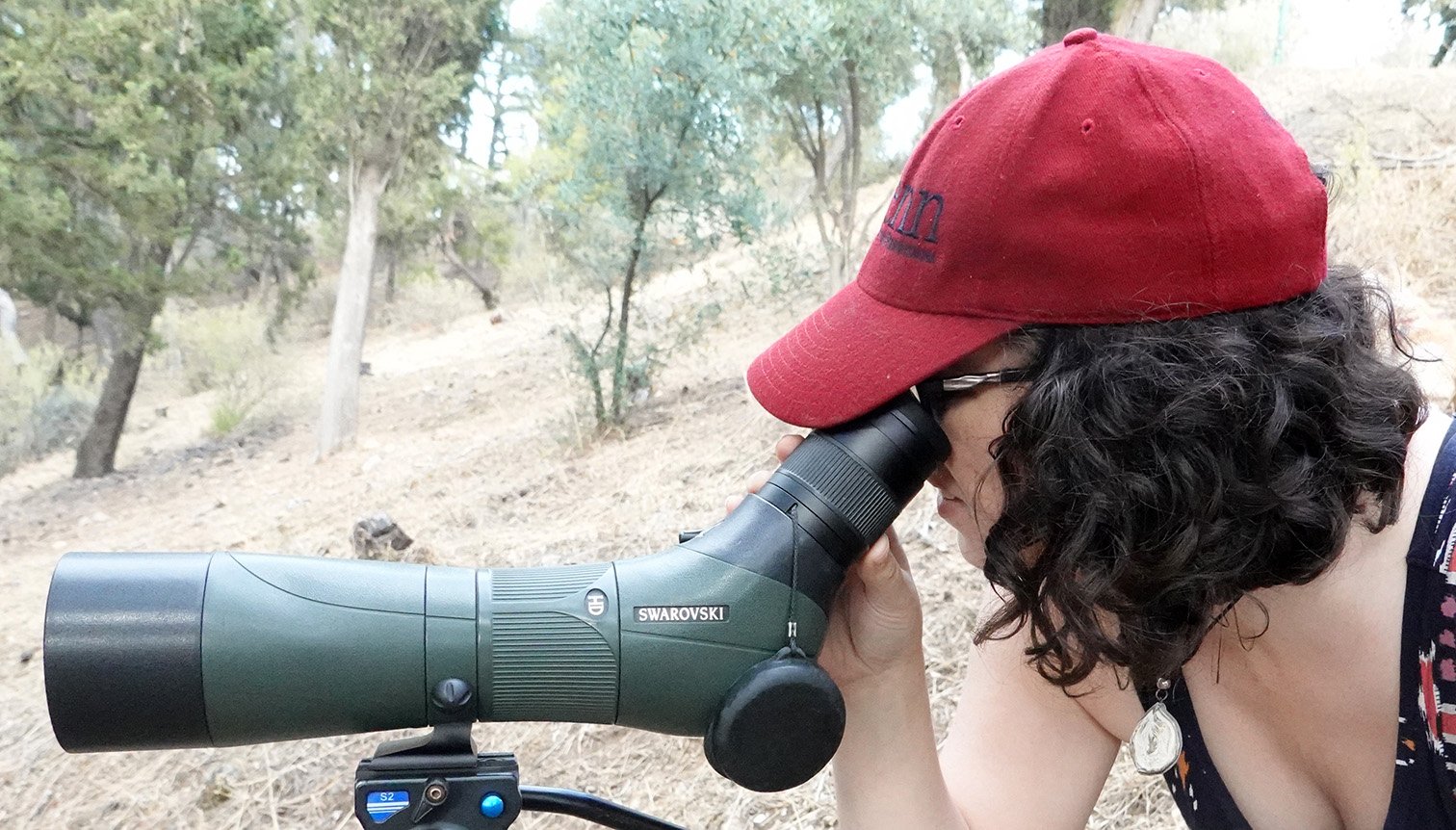
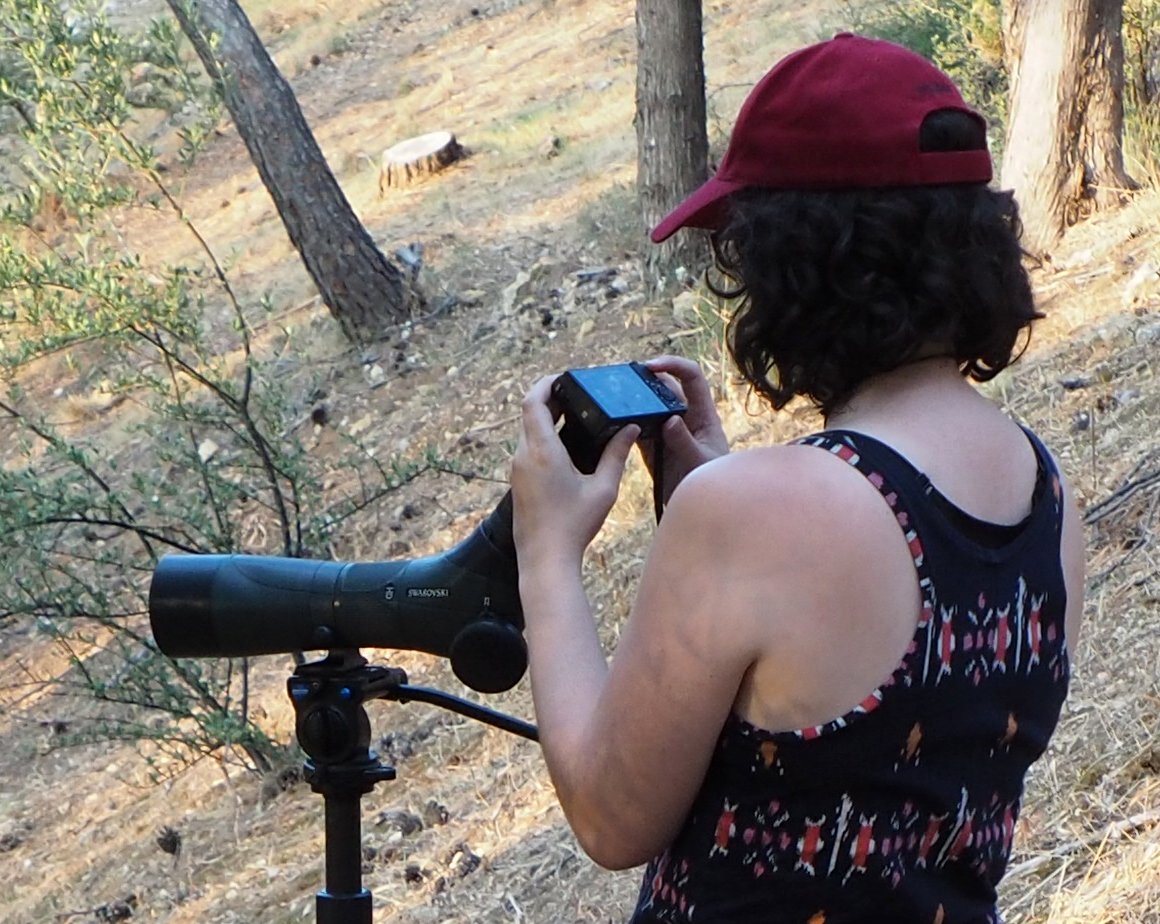
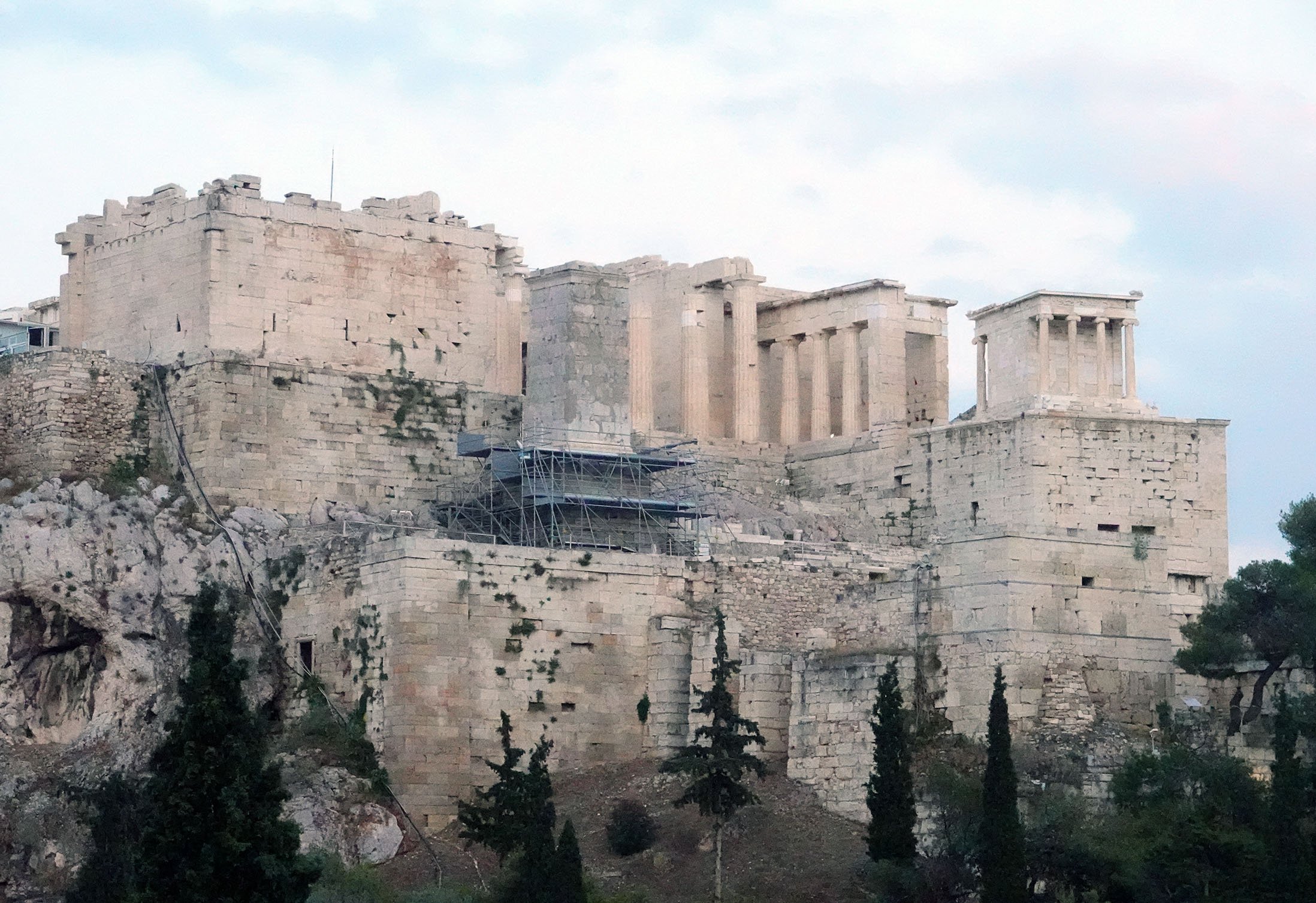
I’ve had great luck, too, though! On my second day here, I went up Lycabettus with my new field biologist friend (somewhat confusingly for narrative purposes, he’s also named Dimitris so I will just refer to him as the field biologist). He brought his very nice birding photography gear, including a tripod and scope, because he has been observing a sparrowhawk nest and was happy to show it to me. It was AMAZING. I had a great time observing them; I’ve seen both adult and baby raptors up close before at LSU Vet Med, wildlife sanctuaries, and/or zoos, but to intimately see a healthy, wild sparrowhawk family through a scope was magical. We then climbed to the top of the mountain at sunset to get a bird's eye view of the city and the Acropolis.  A few days later, I went on a five-or-six mile walk around the Athens city center and the base of the Acropolis with one of the other artists. I next visited the National Garden, as I was hoping to find one of the native tortoises. I did not, so I went back up the mountain the following afternoon to try to spot some, but then heard from other people in the trails that they're mostly around in the early morning.  However, the trip wasn’t wasted as I then ran into a Eurasian hoopoe. Unfortunately, I had the wrong camera settings still running from the previous evening and didn't realize it, so those photos are not usable.

Interspersed between all of the above events was studio time! I began work on two different sparrowhawk paintings on papyrus and have been trying to get the surface of the 19th century tiles I acquired in Amsterdam to become more receptive to paint, as I want to use my OPEN Acrylics atop them and would like the resultant work to be relatively archivally stable. First, I tried hand sanding to no success. Then I tried a rotary sanding attachment on an angle grinder, but the surface of the tiles is not actually flat so it left a lot of pockets of shiny glaze. I decided to see if I could find a store capable of etching my tiles instead, as etching liquid/cream or sandblasting would uniformly work on irregular surfaces. I took the tiles to a glass store that told us they could sandblast them, but when I arrived it turned out their sand was far too fine and it would not result in the type of more open surface I was looking for, so they sent me to a sandblasting factory. There, they assured me they could do it and that I should come back the next day to retrieve them and pay. However, the next day it turned out the glaze was too hard for their sandblasting material, and they could not do as I’d asked after all.

The food here has been uniformly delicious, and Athens is in my opinion the most vegan and vegetarian-friendly city I’ve been to, which has been a very pleasant surprise! I knew the Mediterranean diet would lend itself pretty well to my vegetarianism, but there are an abundance of purely vegan restaurants around and several servers have proactively offered vegan modifications to vegetarian dishes.

I've Finished a New LSU SVM Artwork: Overlooked!

I’m beginning a new artist residency, but I still have some paintings I’d like to do from my summer 2022 artist residency at the Louisiana State University School of Veterinary Medicine so I worked on them before I headed out! Last summer I had begun, but not yet finished, the contour drawing underpinning this painting of two juvenile possums. I worked on the background this past fall, and began to paint it at the beginning of this summer! The background is a chemical stain from the anatomy lab; I’ve had some trouble with the lightfastness of the veterinary stains I’ve tried in the past, which is why I gave this one so much time between setting it down and painting atop it! Both due to the time involved and my research, I have more faith in this particular stain’s staying power. This stain is called orcein and is derived from lichens, and it has been used as a fabric dye in addition to scientific usages.

This is Overlooked, acrylic and orcein stain from the LSU SVM anatomy lab on Aquabord panel, 24x18x1.5”, 2023.

My Upcoming Summer 2023 Artist Residency

I am very excited to announce that I will be a Villa Exarchia artist-in-residence at Phoenix Athens with director Dimitri Yin in Athens, Greece for six weeks this summer!

I hope to create a new body of artwork atop substrates that speak directly to the age and history of Athens: papyrus, old ceramic tiles, and marble. Dimitri has shared that I will be able to visit a population of endangered tortoises residing nearby, and I look forward to documenting them as well as other fauna and/or flora in the Athenian ecosystem.

This will be my first time in Greece, and it will also be my first international artist residency since the pandemic descended (though it will be my ninth international residency and thirteenth residency total).

Είμαι πολύ ενθουσιασμένη! (That hopefully is Greek for “I am very excited!” I’ve been learning a little Greek in anticipation of my stay, but it’s pretty slow going as switching to a new alphabet is difficult for me.)

UPROAR Magazine Cover Image and Feature!

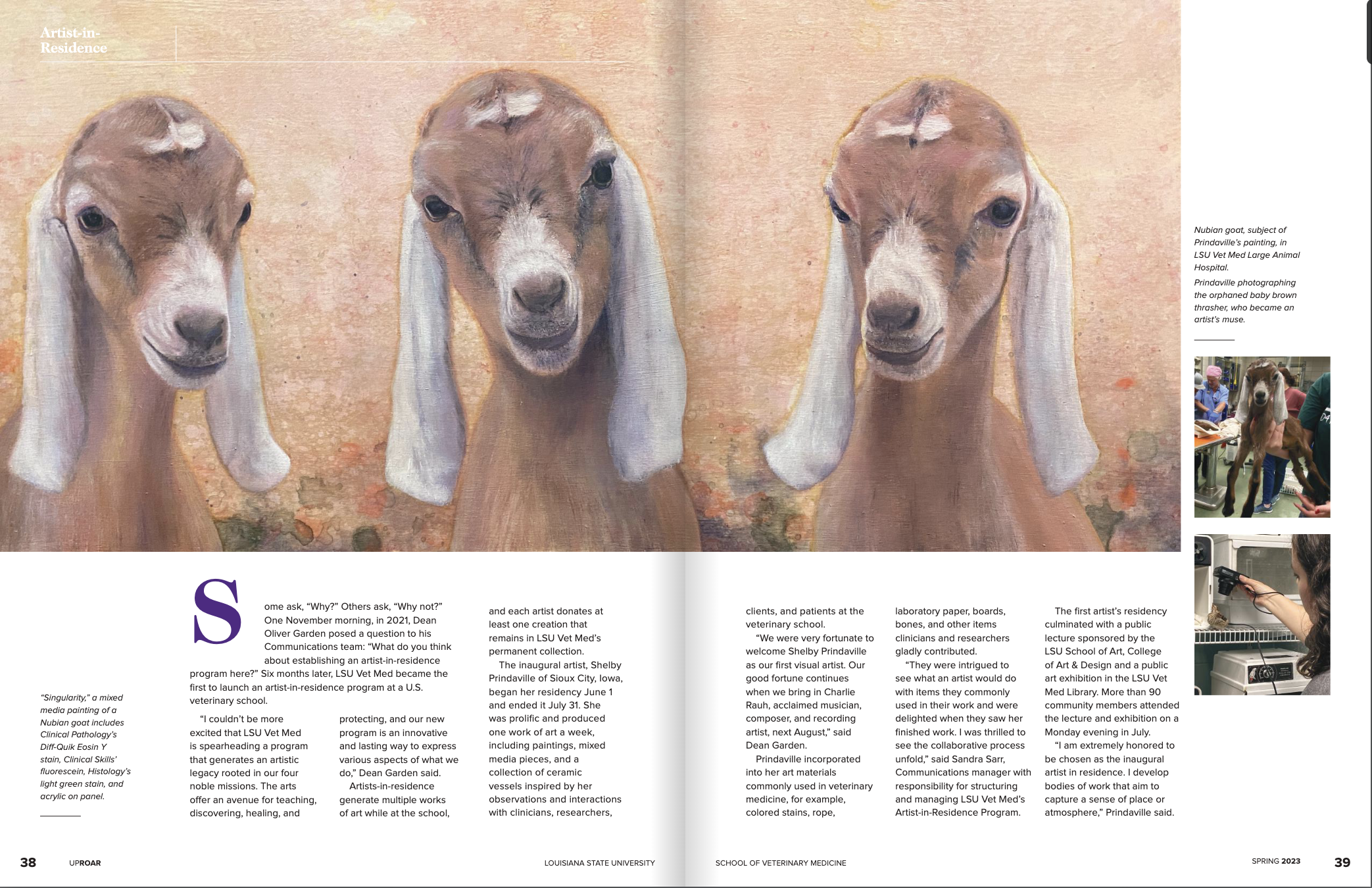
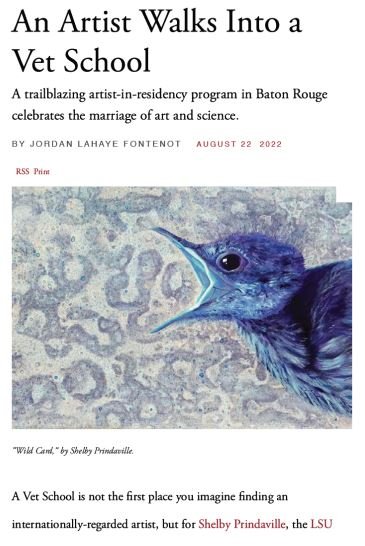
Louisiana State University’s School of Veterinary Medicine just launched a new magazine, titled UPROAR. For its inaugural Spring 2023 issue, my painting Wild Card is on the cover and a feature story on my trailblazing artist residency is inside! Here’s a digital version to check out, with some screenshots included below. Hopefully I’ll receive contributor’s copies in the mail soon!

LSU School of Veterinary Medicine’s inaugural Spring 2023 issue of UPROAR Magazine has cover artwork by Shelby Prindaville as well as a feature story on her trailblazing artist residency.

LSU School of Veterinary Medicine’s inaugural Spring 2023 issue of UPROAR Magazine includes a feature story on Shelby Prindaville’s trailblazing artist residency.

LSU School of Veterinary Medicine’s inaugural Spring 2023 issue of UPROAR Magazine includes a feature story on Shelby Prindaville’s trailblazing artist residency.

LSU School of Veterinary Medicine’s inaugural Spring 2023 issue of UPROAR Magazine includes a feature story on Shelby Prindaville’s trailblazing artist residency.

LSU School of Veterinary Medicine’s inaugural Spring 2023 issue of UPROAR Magazine includes Shelby Prindaville’s cover artwork and a feature story on her trailblazing artist residency.

New Artwork: Earth Measurer

An in-progress photo showing my contour drawing which underpins the finished painting!

I made the acquaintance of this inchworm at Whiterock Conservancy, and began the contour drawing over a year ago. I picked it back up this winter break!

The title of the piece, Earth Measurer, is the English translation of the Ancient-Greek-derived “geometer.” Geometridae is the scientific name for the family of caterpillars (and moths) that make use of the distinctive method of locomotion that is not only described in the family’s scientific name but also in many of their common names: inchworm, spanworm, looper, and measuring worm.

After spending a lot of time really looking at inchworm anatomy and learning terminology (FYI, they have true legs and prolegs), I am again impressed with the variety and richness of animal forms in the world; there’s plenty of alien to explore right here. This past summer, while painting mosquitoes from LSU Vet Med’s epidemiology department, I was surprised by how hairy they are upon examination. Similarly, on this so-called hairless caterpillar, there’s still a fair amount of hair, called setae! I included it in the painting as well, though you’ve got to get close to the painting or zoom in quite a bit to see it.
This is Earth Measurer, acrylic on basswood panel, 6x12x1.5”, 2023.

Whiterock Art Show Photos!

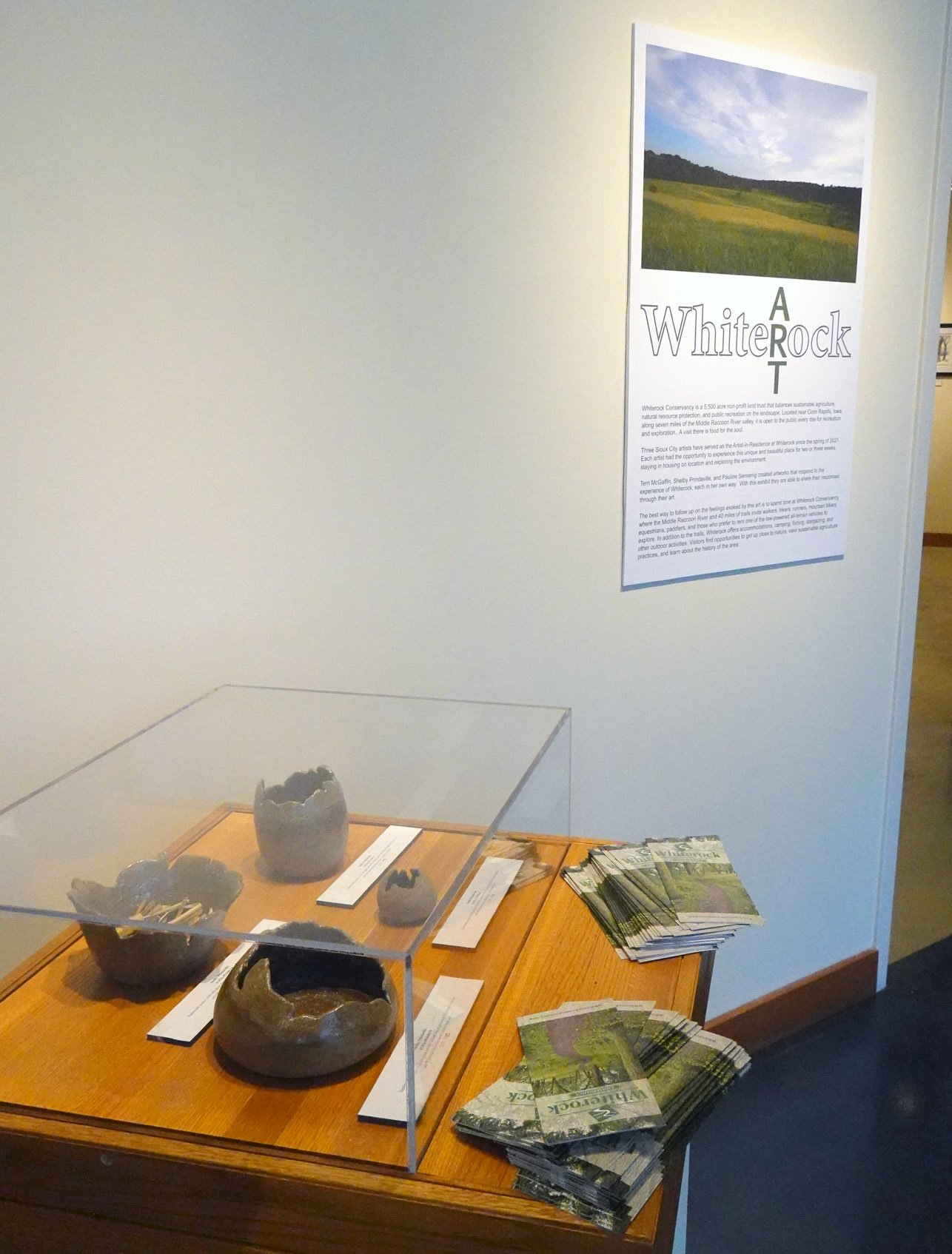
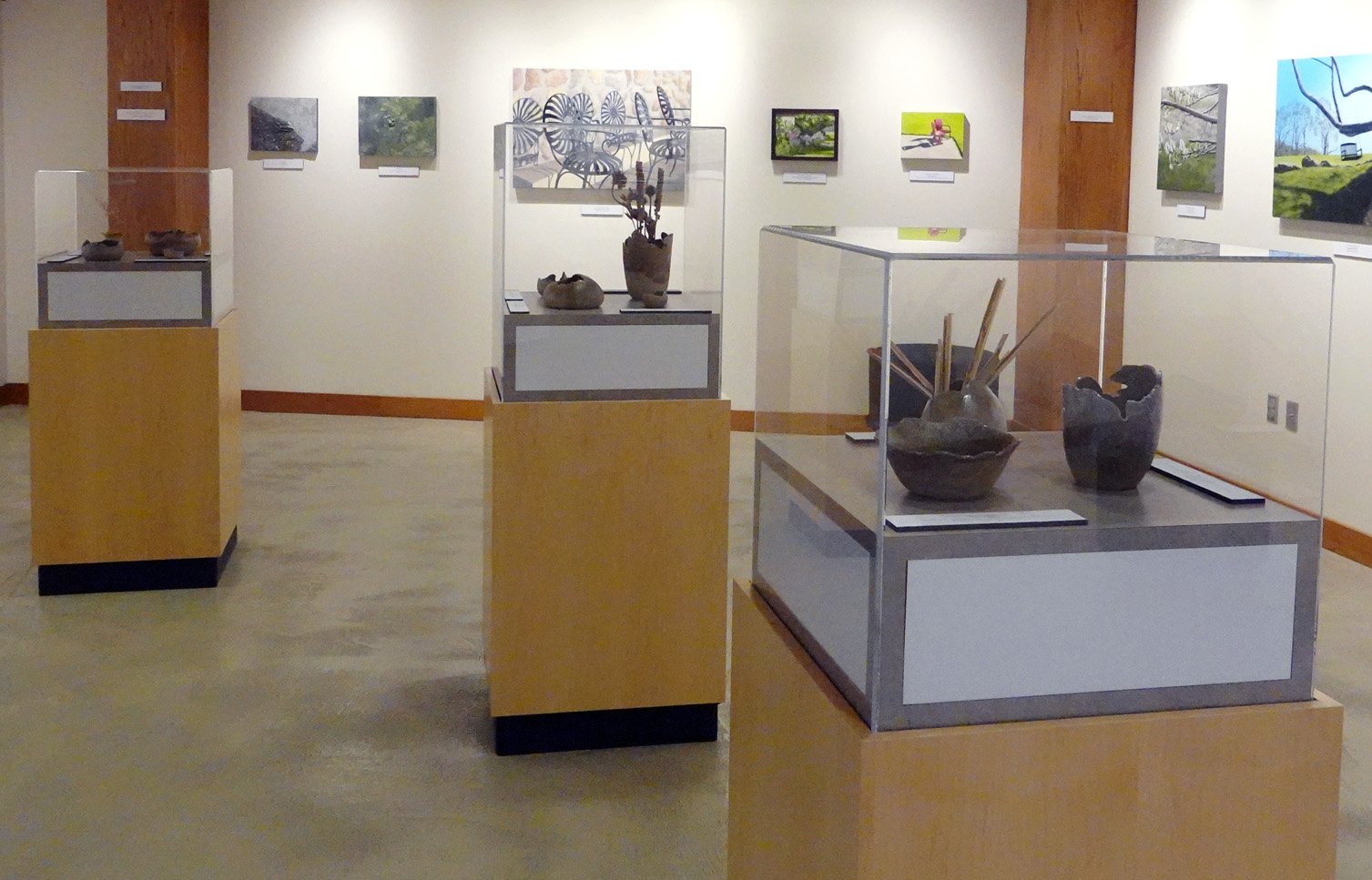
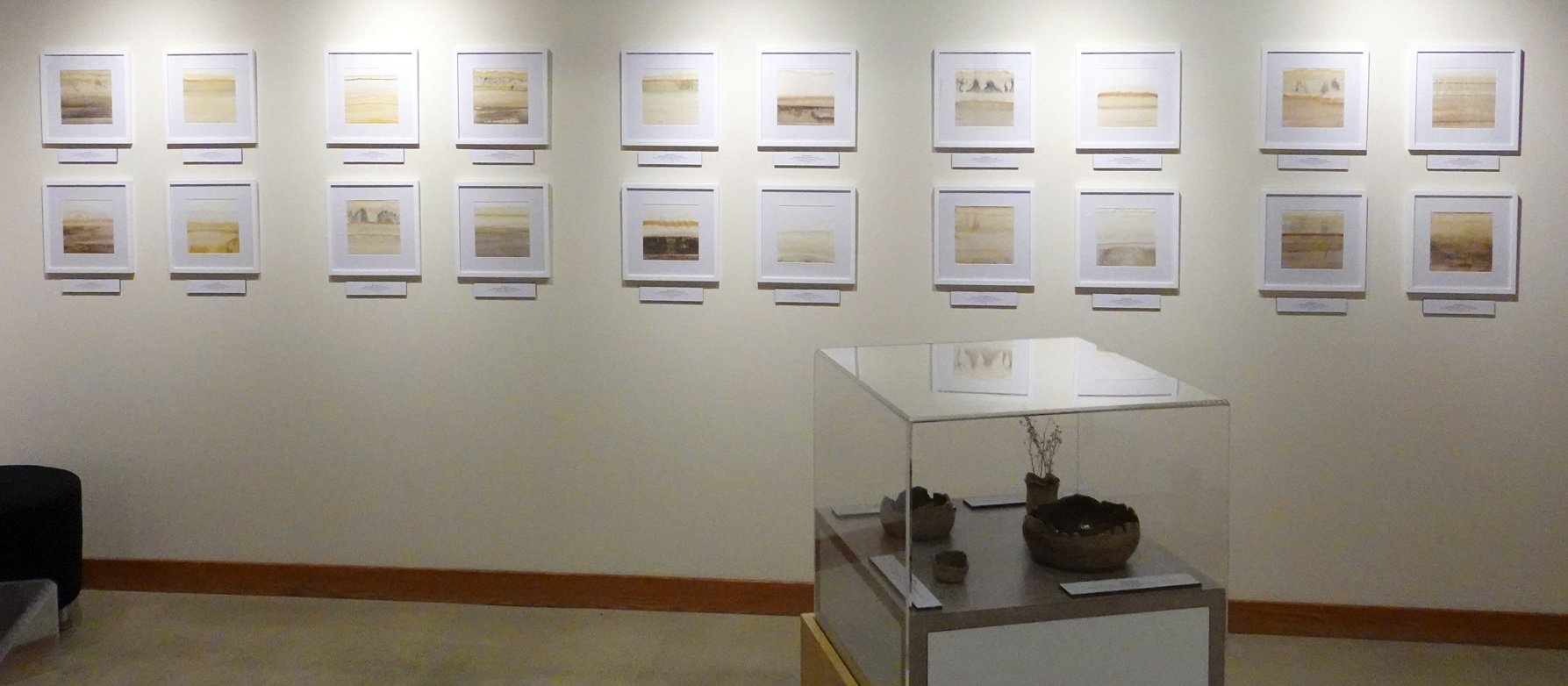
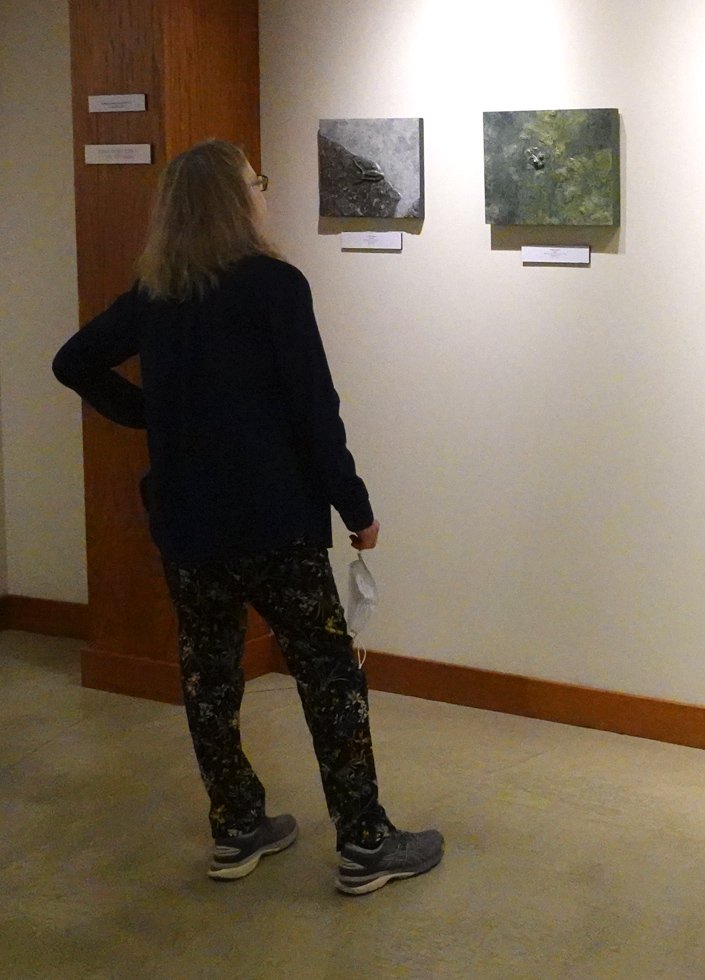
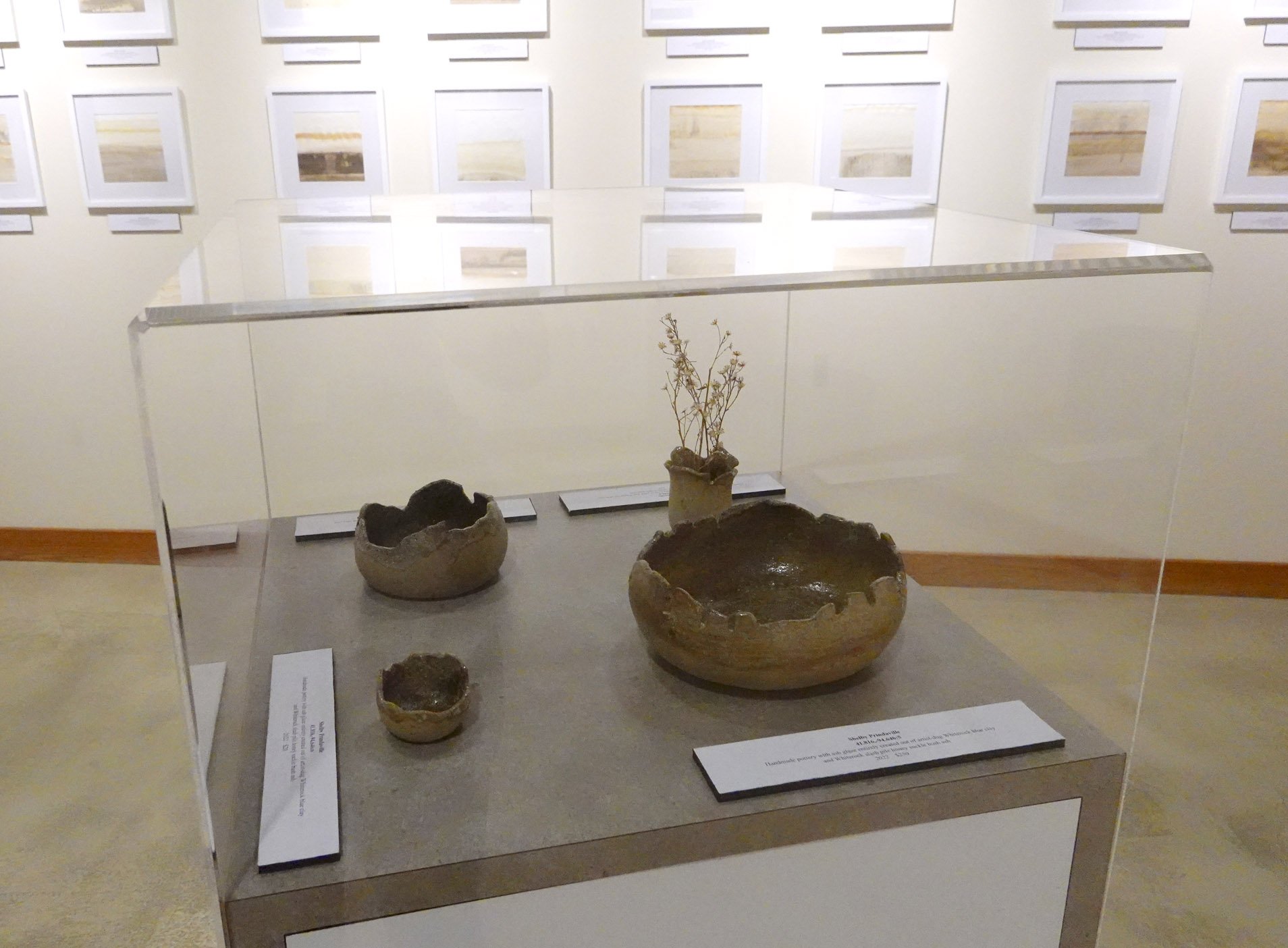
Here are some photos from my three-person show Whiterock Art at the Betty Strong Encounter Center in Sioux City, IA! You can still check out this exhibition in person through November 13, 2022. I have 37 works on display, including 20 chromatograms, 15 site-specific ceramics, and 2 painted bas reliefs on panel using the polymer clay I helped create (QuickCure Clay).

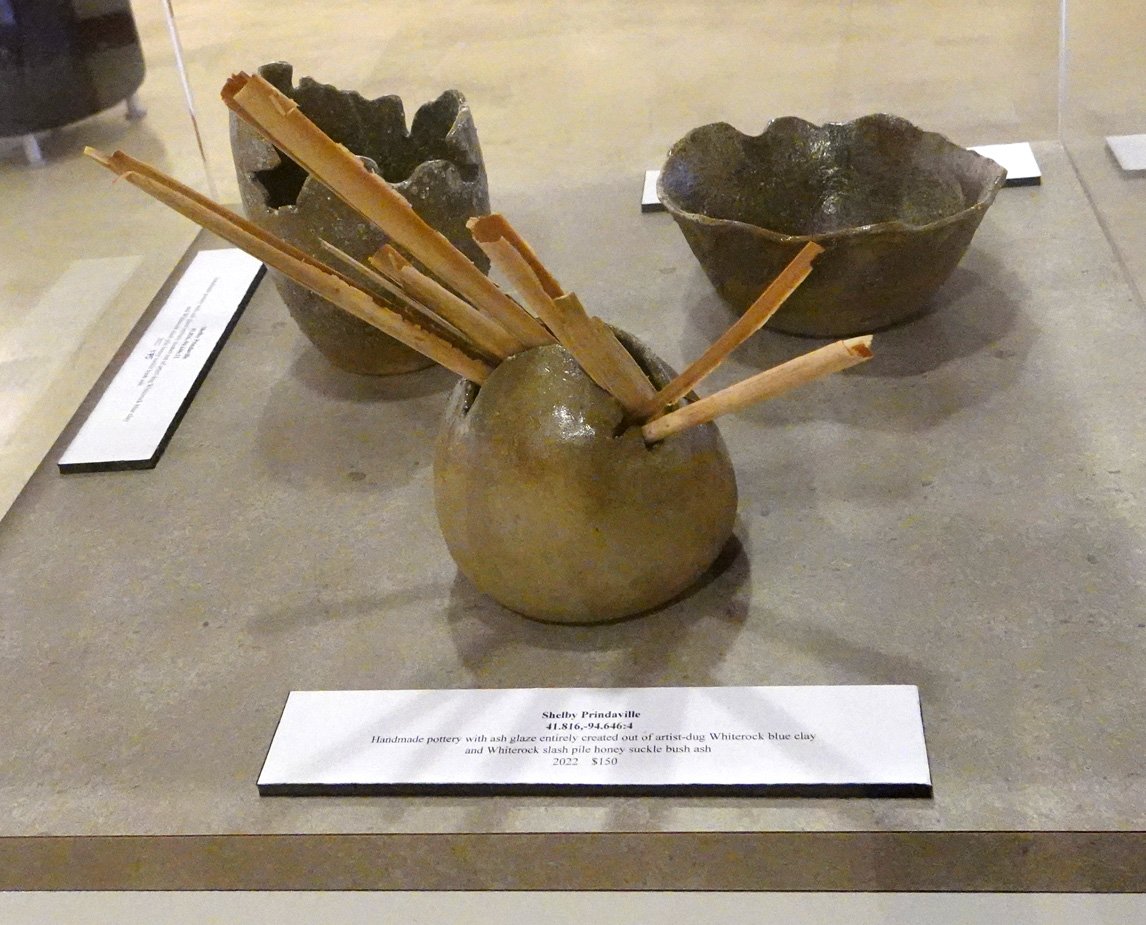
As you can see, I arranged dried botanicals harvested from Whiterock Conservancy in four of my 41.816, -94.646 ceramic vessels to show this ceramic collection’s utility and connection to the landscape. My friend, former colleague, and master ceramist Susan Nelson inspired me to do this, as she often shows and photographs her ceramic work with ikebana, or the art of Japanese flower arrangements. I also placed a representative sampling of the small rocks, twigs, and other debris I cleaned out of the clay in a fifth display inside one of the smallest dishes.

At the reception for the show, I sold four of the 41.816, -94.646 ceramic pieces! I was pretty pleased with that, particularly because my price point for pieces in this collection was significantly higher than that of my stoneware work, given all the additional labor that went into this site-specific series. One of the buyers selected a piece holding dried botanicals, and another picked the vessel containing the rocks, twigs, and debris cleaned out of the clay body; both shared with me that they plan to keep those displays intact. That intent surprised me, but I’m happy that my decorative touches felt so appropriate that they’ll continue on beyond the exhibition!

Upcoming: Whiterock Art at the Betty Strong Center!

You may remember I attended an artist residency at Whiterock Conservancy outside of Coon Rapids, IA, in summer 2021. My good friend and colleague Terri McGaffin had already completed a residency there that spring 2021, and turned me on to the opportunity. Another Sioux City artist, Pauline Sensenig, then followed suit this summer 2022.

All of us will be exhibiting our work in a three-person show called Whiterock Art at the Betty Strong Encounter Center in the Lewis & Clark Interpretive Center in Sioux City, IA, from October 2 - November 13, 2022. The reception will be on Sunday, October 2nd at 2pm, and I hope you can join us - there will be a reception and presentation by Whiterock’s own Liz Garst, co-founder and Board of Directors member of Whiterock Conservancy.

I designed our show logo, postcard, and poster (viewable at the exhibition) - below you can take a look at the digital postcard.

Show postcard back design

And Now, the Morningside University News!

A screenshot of the beginning of the Morningside University News article about my LSU Vet Med residency.

The Morningside University News just got in on all the excitement - “Associate professor of art Shelby Prindaville uses skills towards historical process” was published on August 26th! The image on the right is a screenshot of the introduction, but check out the whole article in the link above or take a look at this PDF.

Country Roads Magazine Feature!

A screenshot of the beginning of the write-up.

Country Roads Magazine just published a fabulous article on my LSU Vet Med artist residency in both their digital and September print edition! On the left, you can see a screenshot of the beginning of the write-up to whet your appetite.

You can read the digital piece here, see a full PDF, or pick up a physical copy if you’re in the Louisiana/Mississippi distribution zone!

Sioux City Journal Feature!

A screenshot of the beginning of the SCJ feature

I’ve been getting some nice Louisiana press for my summer LSU Vet Med artist residency, and now there’s great local coverage as well - with more in the works! Here’s the Sioux City Journal digital article “Morningside professor participates in first-ever artist residency at LSU vet school” by reporter Dolly Butz, and here’s a PDF of the print version!

Louisiana PBS Televised Feature!

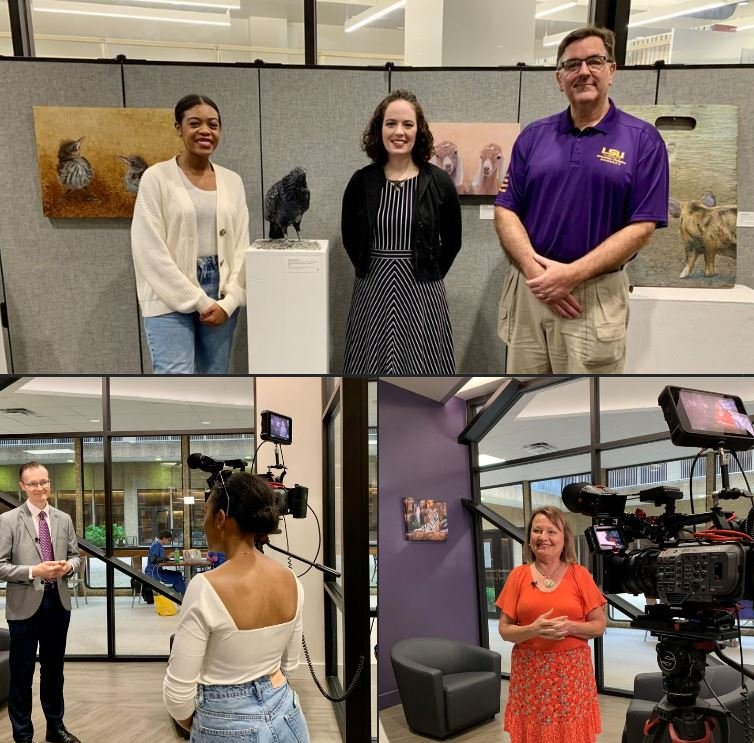
Some documentation of the interviews for my LPB PBS feature.

Louisiana Public Broadcasting Service’s The State We’re In did a televised feature on my artist residency and exhibition at the LSU School of Veterinary Medicine - you can watch it here!

From their own website: “Louisiana: The State We’re In, Louisiana's only statewide news magazine, is in its 45th season on the air. The program airs Fridays at 7PM and Sundays at 4:30PM on the six-station LPB network that includes stations in Alexandria, Baton Rouge, Lafayette, Lake Charles, Monroe, and Shreveport. It also streams at lpb.org/livetv and airs on LPB’s sister station WLAE-TV32 in New Orleans on Fridays at 7PM and on WYES-TV, the PBS station for New Orleans and the Gulf Coast, at 7:30PM.

This award-winning show combines in-depth coverage about the important issues in the state along with expert analysis. […] It is one of the longest-running television programs in the nation.”

My LSU Vet Med Exhibition and Opening Reception!

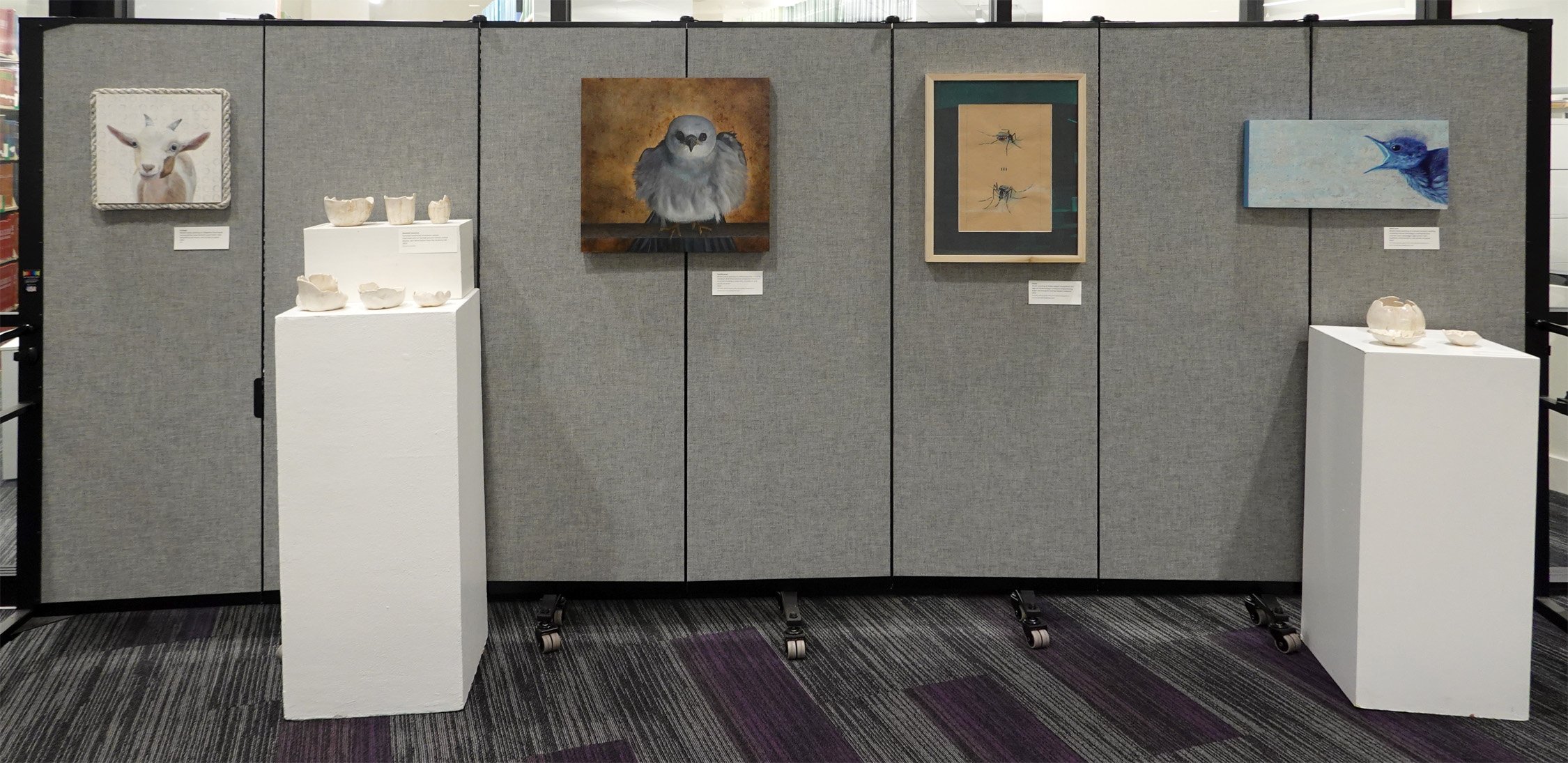
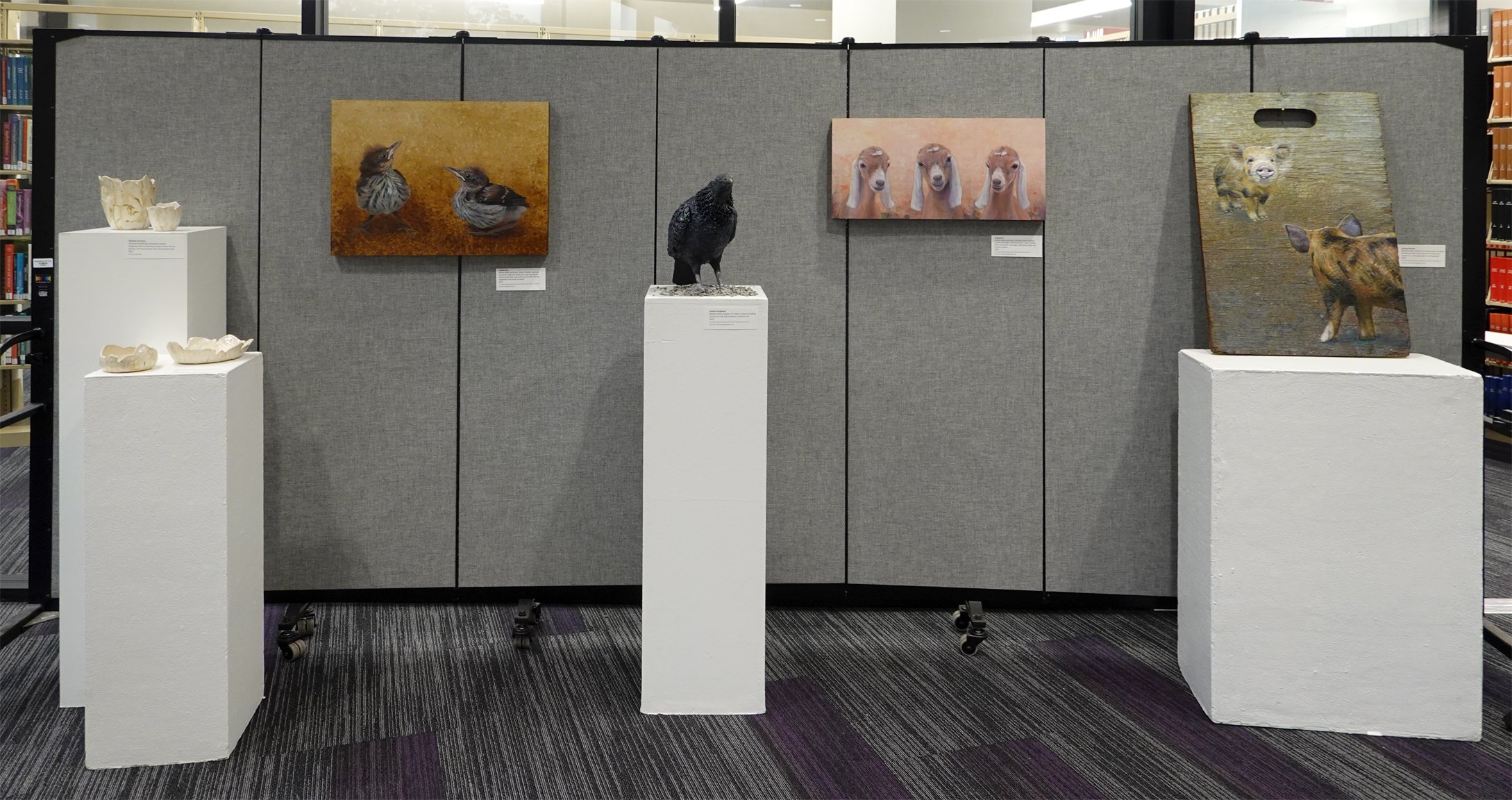
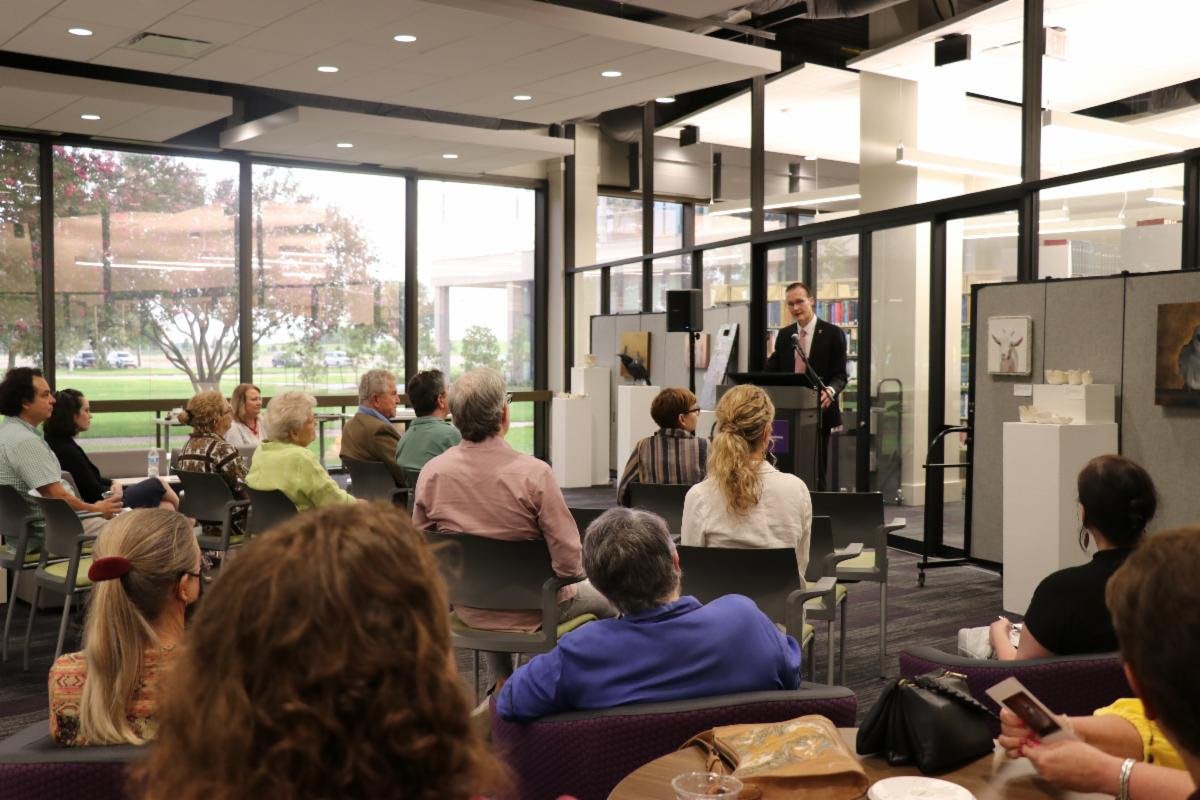
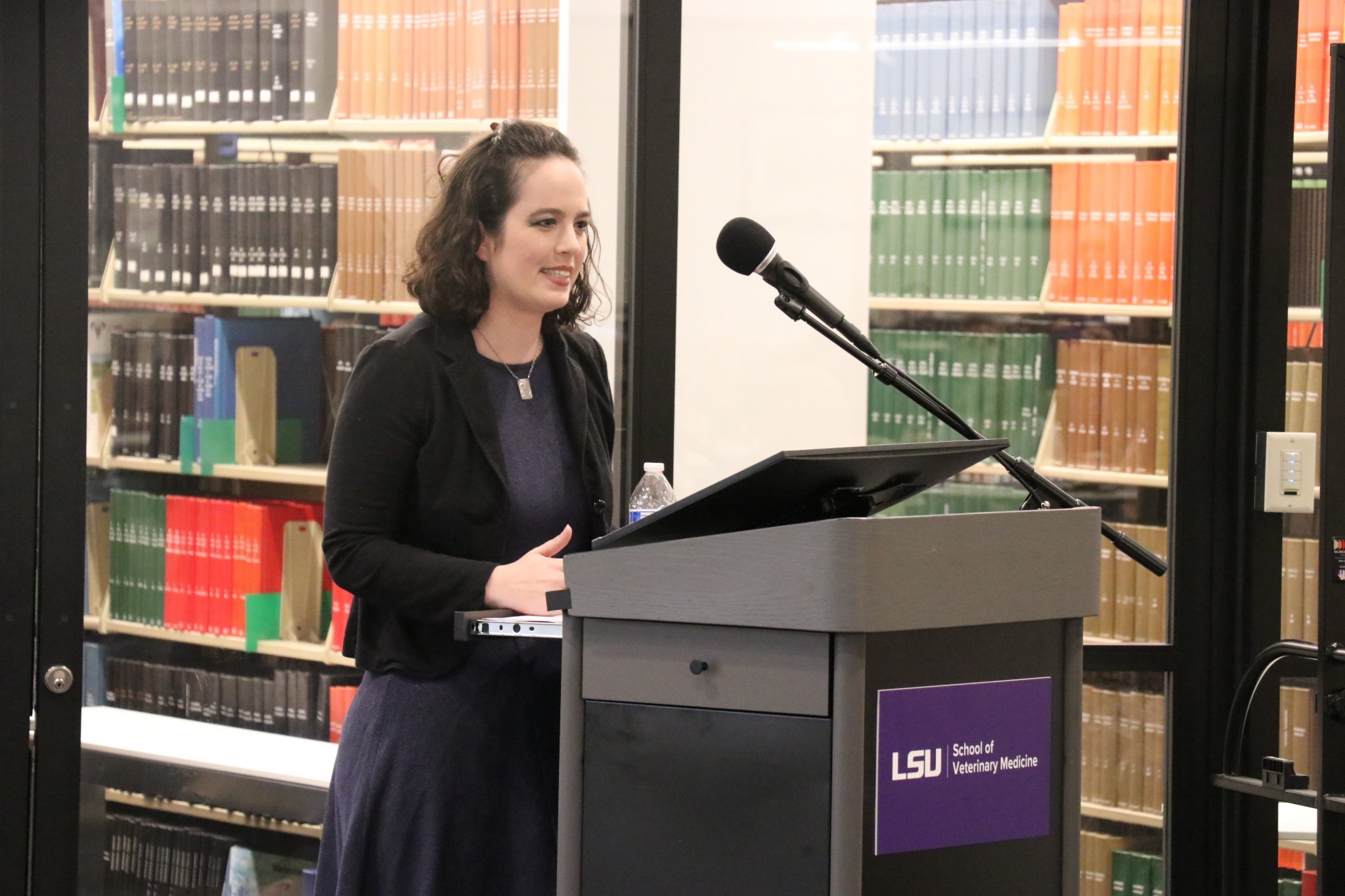
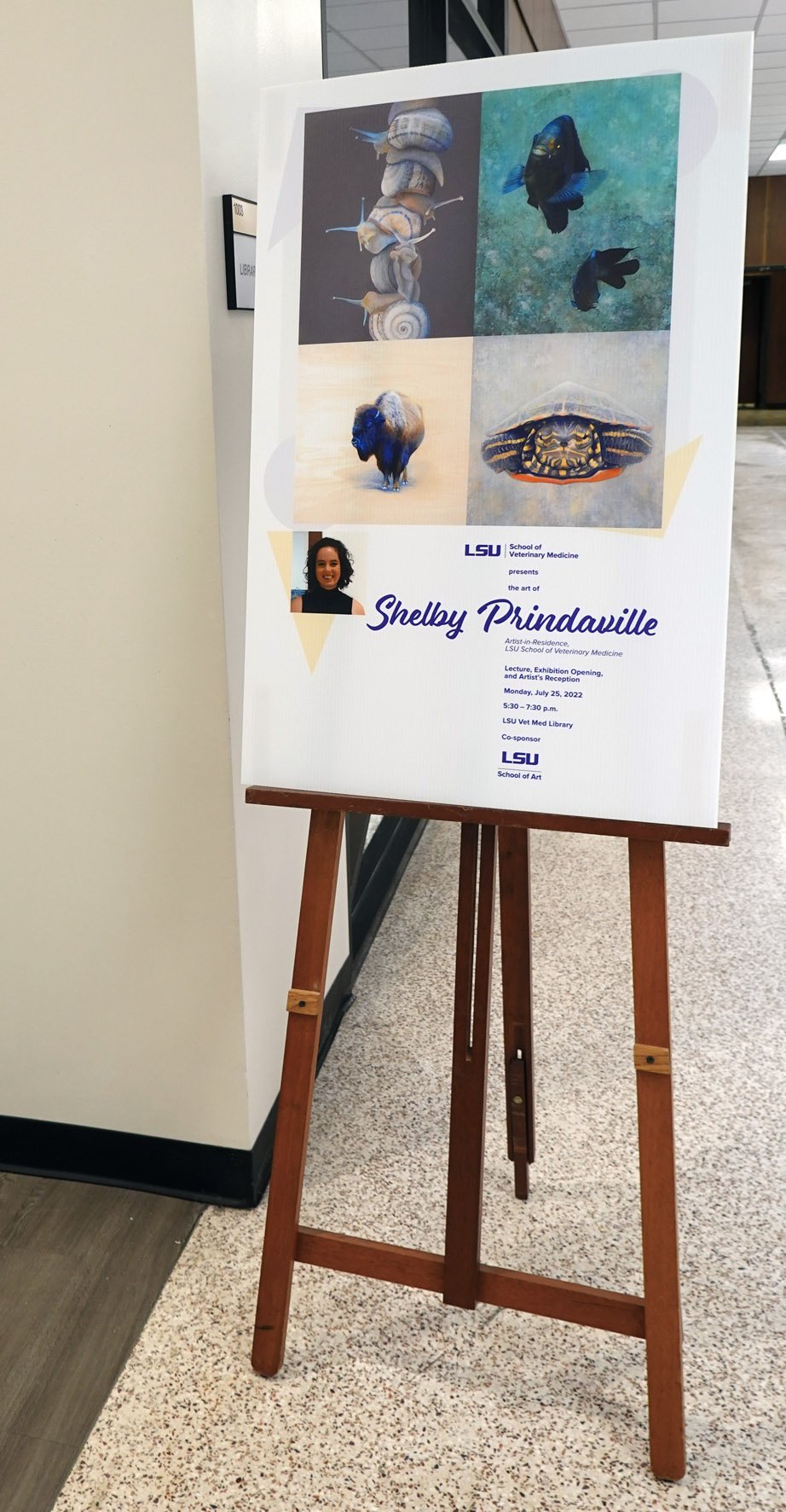
Here are photos from my solo exhibition and opening reception at the LSU School of Veterinary Medicine, co-sponsored by the LSU School of Art! The reception was amazing; over 80 people attended and they were all very engaged throughout the evening. We began with a welcome speech delivered by LSU School of Veterinary Medicine Dean Oliver Garden, followed by speeches from LSU College of Art + Design Dean Alkis Tsolakis and LSU School of Art Director Rod Parker, and then my artist lecture!

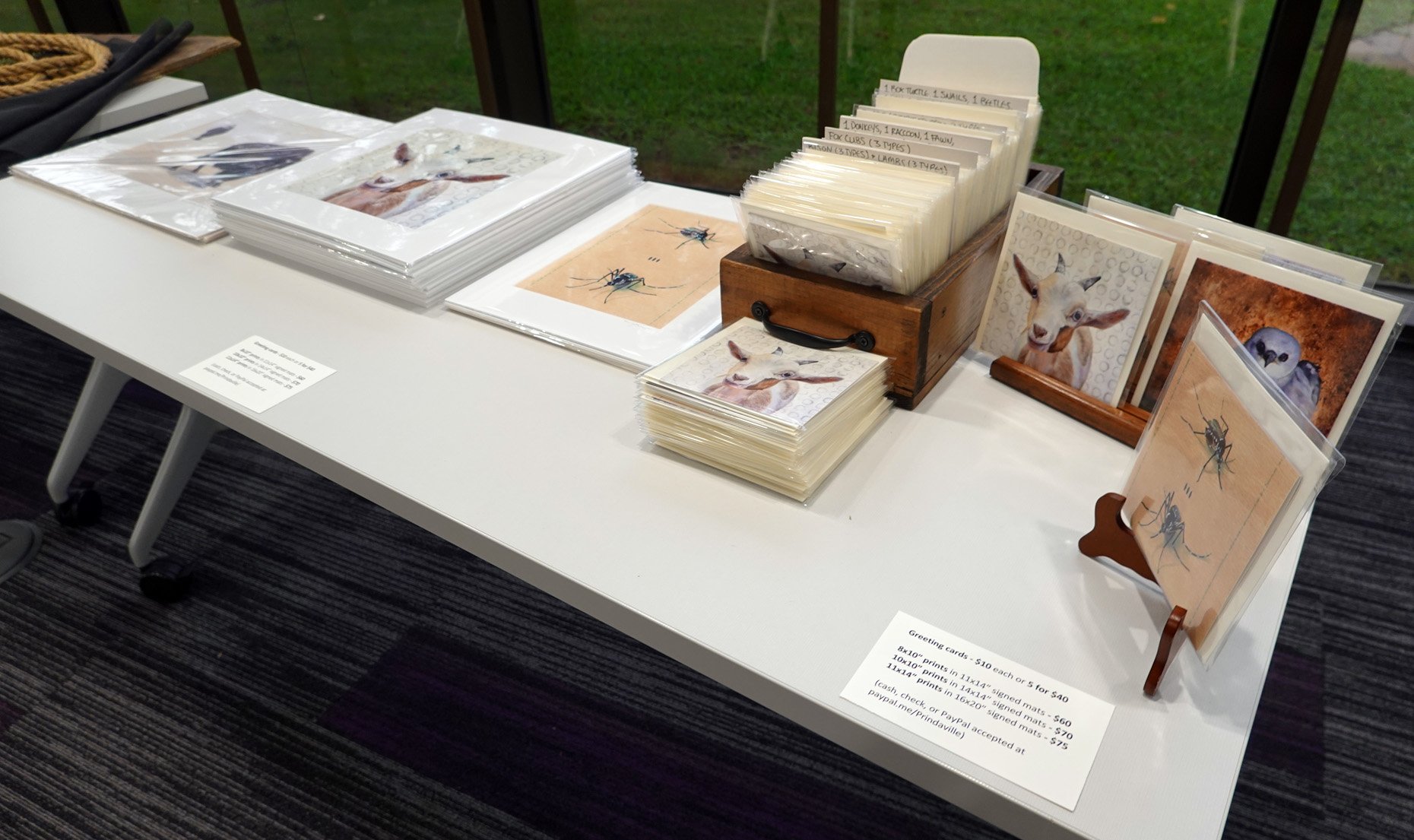
By the end of the evening, 6 of the 8 paintings/relief/sculpture were sold (only Hosts and Singularity remain available), and 3 of the 13 ceramics were purchased in addition to countless prints and greeting cards. Through the course of the rest of the exhibition, 3 more ceramics sold along with additional prints and greeting cards. I was a little surprised at how popular the mosquito reproductions were as they sold out quite quickly, but I’ve since learned there’s a well-known joke that mosquitoes are the state bird of Louisiana!

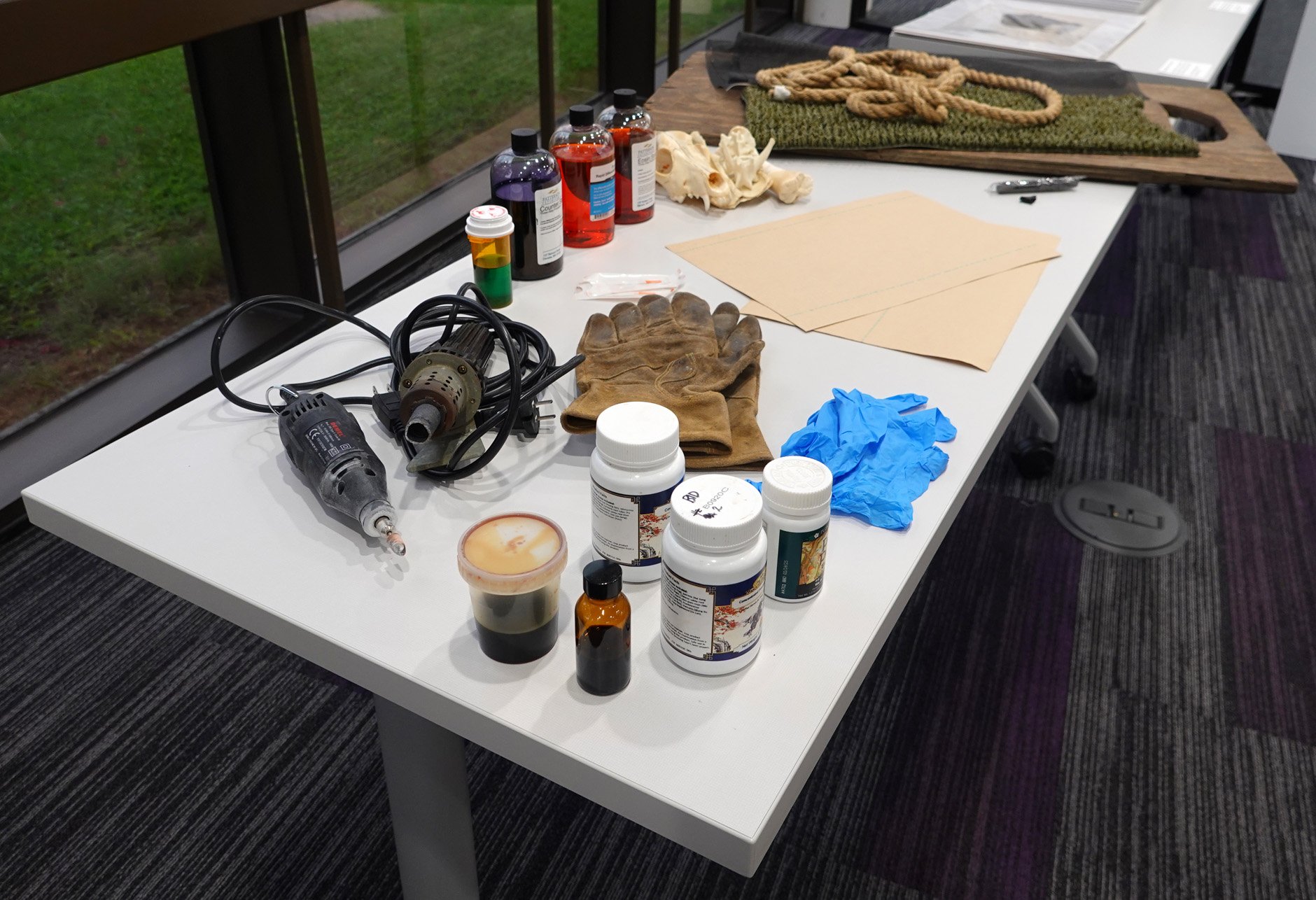
In the slideshow, you’ll see that in addition to the artwork walls and reproduction sales table, I also had a display table of some of the veterinary materials - medicines, chemicals, stains, tools, bones - I used in each of the pieces of artwork!

LSU Vet Med Artist Residency Artwork 20 Process

Here are a couple of photos of the in-progress Vulture Sculpture! In the first image, you can see how I built an internal armature out of pink styrofoam insulation, wire, and disposable chopsticks. Armatures are really helpful for a few reasons: A) they provide structure and support to bolster strength and keep the clay from sagging, B) they weigh a lot less than clay which makes the piece-in-progress lighter so it puts less stress on weight-bearing areas while wet/uncured C) if you leave the armature inside - like you can do with QuickCure Clay - the finished piece is lighter than if it were solid clay which is typically desirable, and finally D) the armature materials usually cost less than using an equivalent amount of clay.

Then in the second image, it’s midway along; I’m still sculpting the QCC (note the head and wings are unfinished) but it’s taking real shape and I’ve already incorporated the artificial turf, though I have yet to “mold” it with the heat gun. Finally, there’s the finished piece in a similar orientation for comparison!

LSU Vet Med Artist Residency Artwork 20

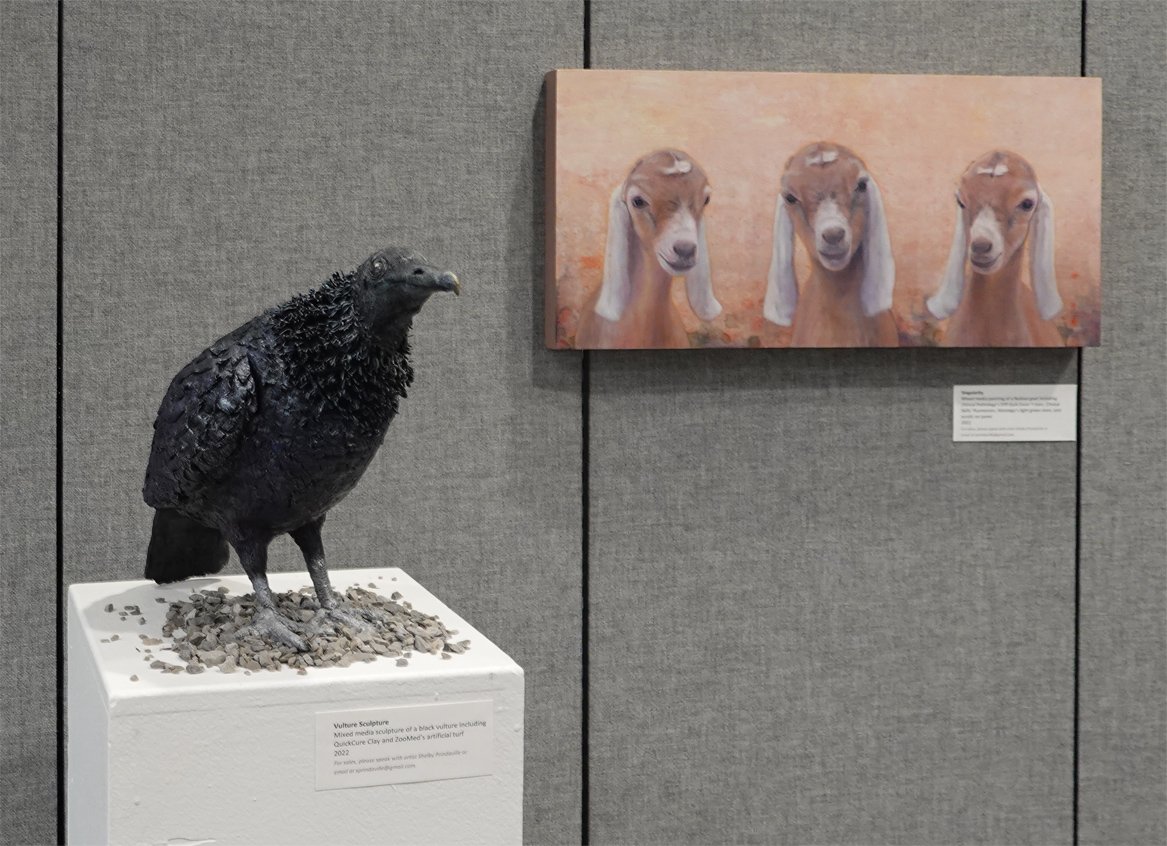
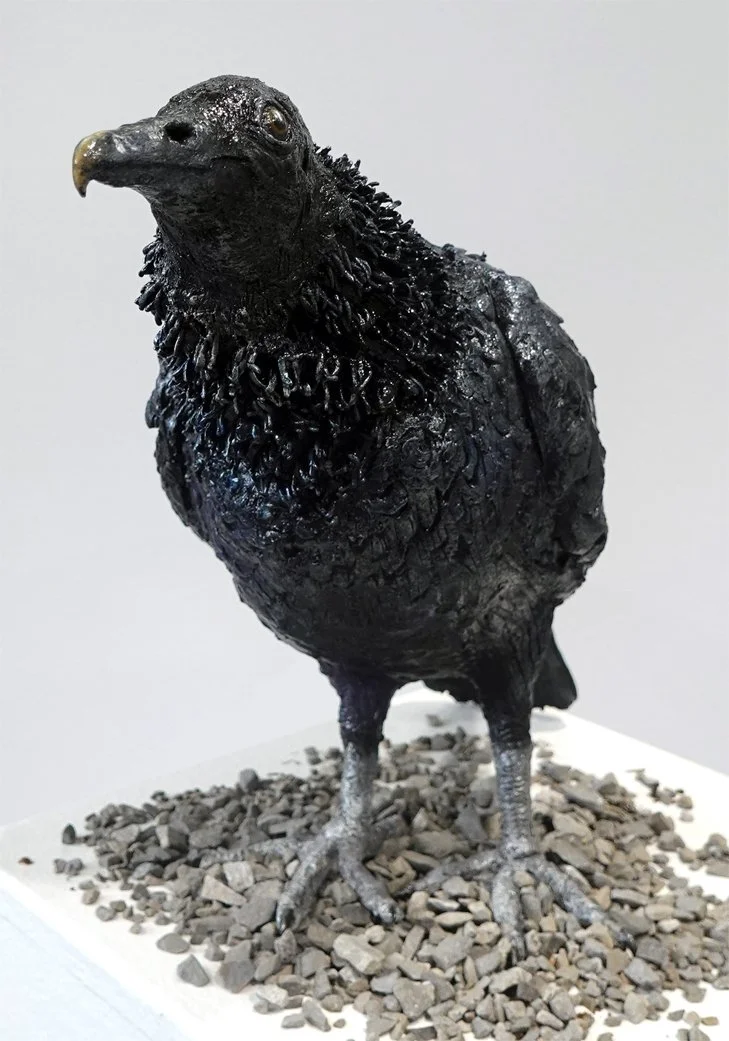
This is the final piece of artwork I completed on-site at LSU Vet Med during my two-month summer 2022 residency! I think finishing 20 exhibitable pieces including mixed media paintings, a relief, ceramics, and a sculpture in 7 weeks is a remarkable feat, so I am very happy with my productivity.

I worked right up until the day of the exhibition opening on this piece, but I managed to get it “finished” in time - I put that in quotes as I still needed to briefly borrow it back from the exhibition midway through to put a protective varnish on top!

I had wanted to do a sculpture this whole time because A) I’ve always liked putting on exhibitions that have multiple disciplines and media on display to more deeply engage a broad viewership, B) I wanted to really highlight QuickCure Clay, as I’d helped create it with Dr. John Pojman at LSU a decade ago and it felt right to use it in at least a couple of pieces this summer, and C) I had been given a couple pieces of artificial turf from the wildlife hospital that I wanted to incorporate into artwork in some way, and relatively early on I had a lightbulb moment wherein I thought the astroturf had vulture neck-feather vibes! It worked very well, in that a lot of people couldn’t figure out where the artificial turf was used and at least one viewer told me she thought I thought the gravel I used as an installation aid was astroturf. Another viewer asked me if this was a taxidermied piece, which made me feel really good about the likeness!

I titled this piece Vulture Sculpture mostly because I didn’t have time to think about titling it when I had to make the show labels (I didn’t even think it was likely to get finished for it!), but I also do like the rhyme and the clear identification of the species of the bird. I sold this sculpture that same evening to the fabulous Dr. Mark Mitchell from Wildlife and ZooMed and his partner Dr. Lorrie Hale Mitchell from Integrative Medicine! They very kindly were willing to let me take it on exhibit first (as I’m doing with the rest of the sold paintings), but I made some delicate choices with this piece - the claws, the beak tip - that meant I thought it best to let them just take it after my LSU Vet Med solo show came down instead of potentially injuring the piece in shipping.

This is Vulture Sculpture, a mixed media sculpture of a black vulture including QuickCure Clay and ZooMed’s artificial turf, 13.5" x 7.5" x 20.5", 2022.

LSU Vet Med Artist Residency Artwork 8-19 Process

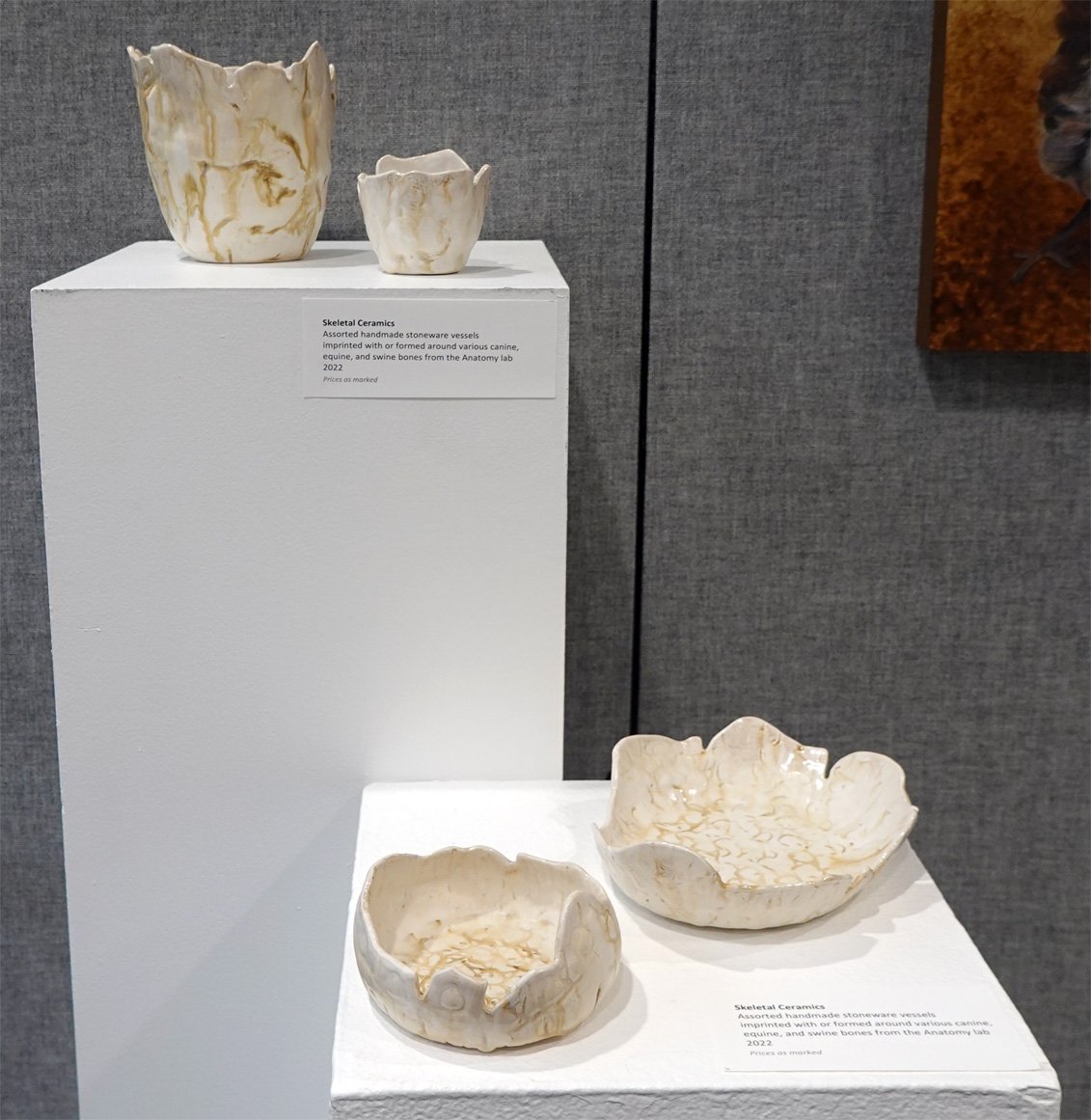
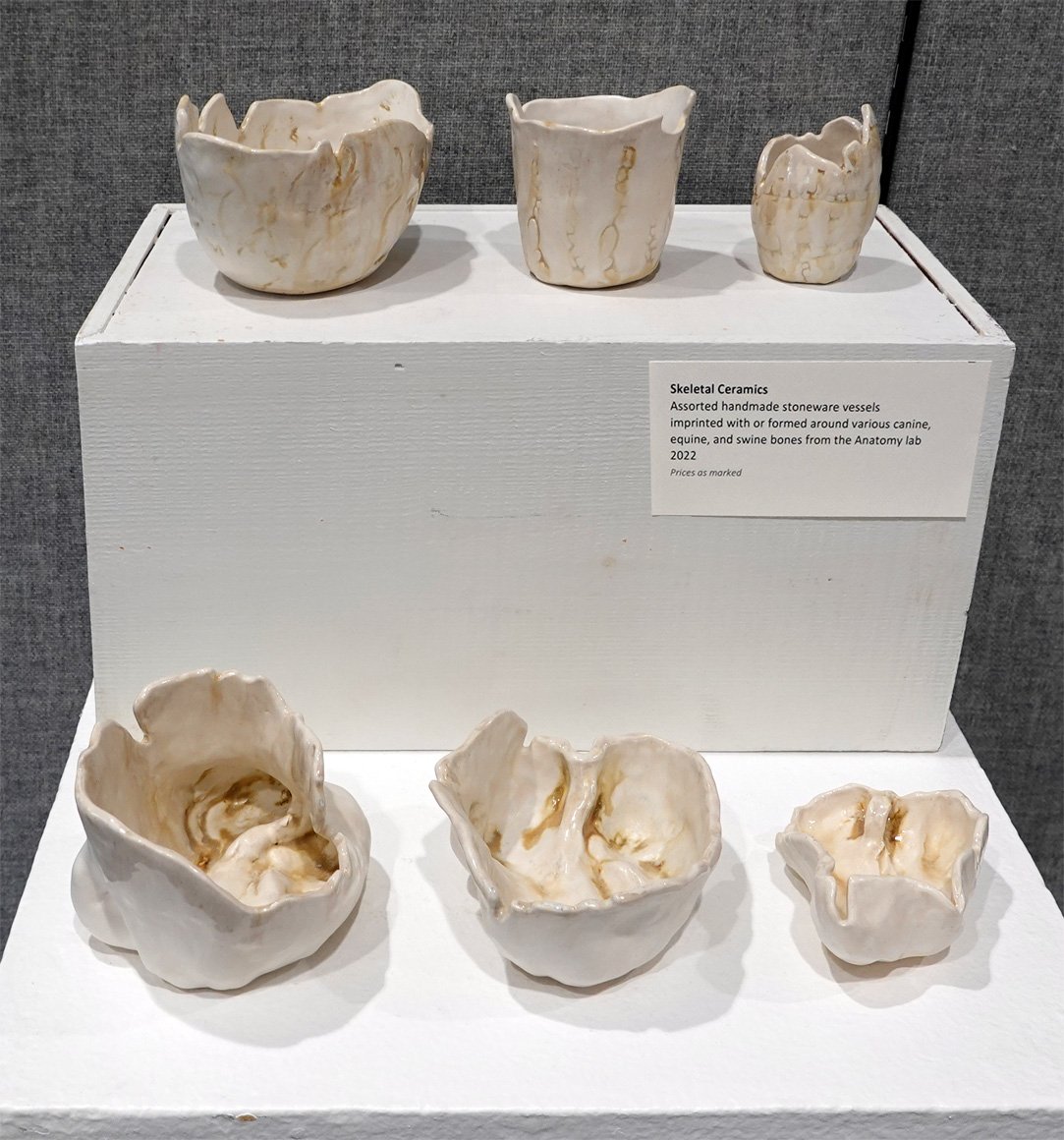
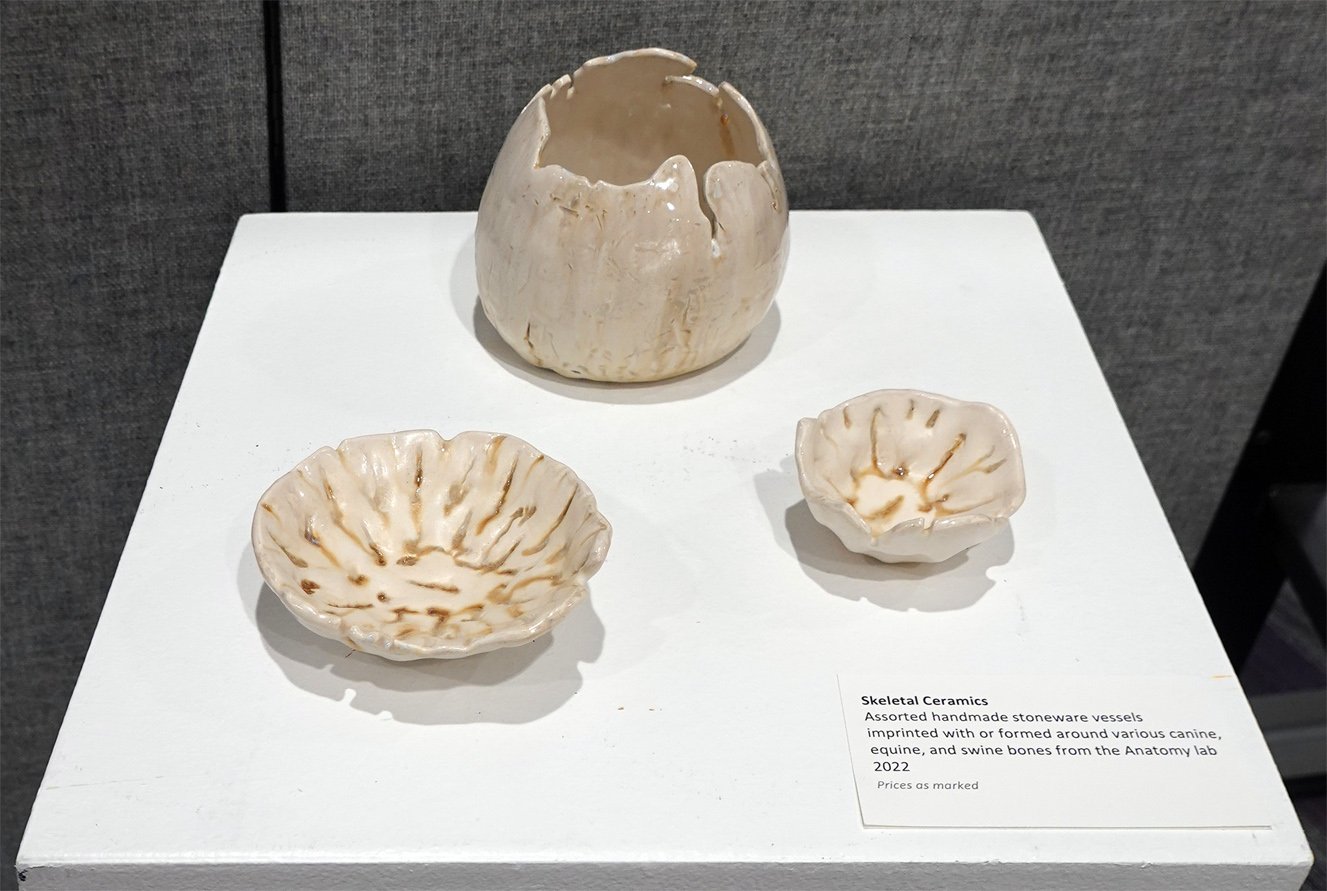
Here are a few of photos of the in-progress work for Skeletal Ceramics. The first image has some of the bones used in their respective vessels, followed by two more images of the raw ware or green ware. I didn’t take photos while glazing because I was doing it outdoors in 98*F weather so I was sweaty and covered with glaze - as well as acutely aware that I probably needed more glazing time than the shop would be open for!

LSU Vet Med Artist Residency Artwork 8-19

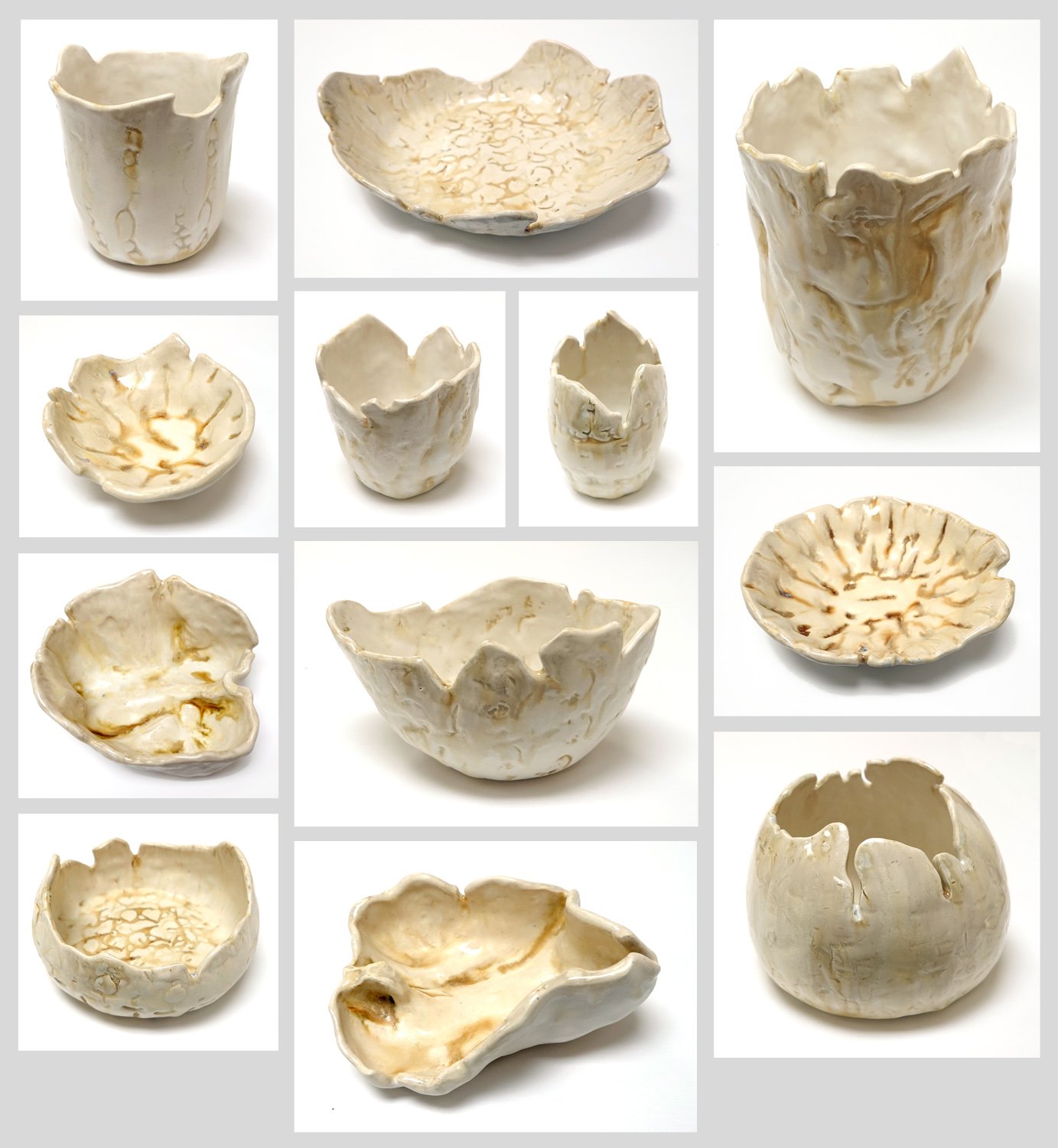
This is Skeletal Ceramics, assorted handmade stoneware vessels imprinted with or formed around various canine, equine, and swine bones from the anatomy lab, 2022.

Shelby Prindaville's Skeletal Ceramics collection

I made this body of ceramics start-to-finish on site at the LSU School of Veterinary Medicine and with purchased supplies and firing assistance from Southern Pottery Equipment. The canine, equine, and swine bones used include skulls, jawbones, various vertebrae, scapula, femurs, and sacra. The glazes used were an Amaco Shino Cacao Matte Cone 5-6 Glaze (SH-32), a Spectrum Satin White Hi-Fire Cone 5 Glaze (1121), and a Spectrum Satin Mottle Hi-Fire Cone 5 Glaze (1122). I applied the Cacao Matte to all the textured/impressed areas and then sponged off the outer surfaces, then put on a generous two coats of the Satin White, and then painted a little of the Satin Mottle on kind of haphazardly and then more carefully at the lips. I fired to Cone 6. I was really happy with how this combination performed, as they do look like bone themselves! Seven of these pieces sold during the exhibition to three different buyers.

The anatomy lab allowed me to take the bones I’ve been using back with me so that I can continue to develop this collection, so stay tuned for more.

LSU Vet Med Artist Residency Journal 7

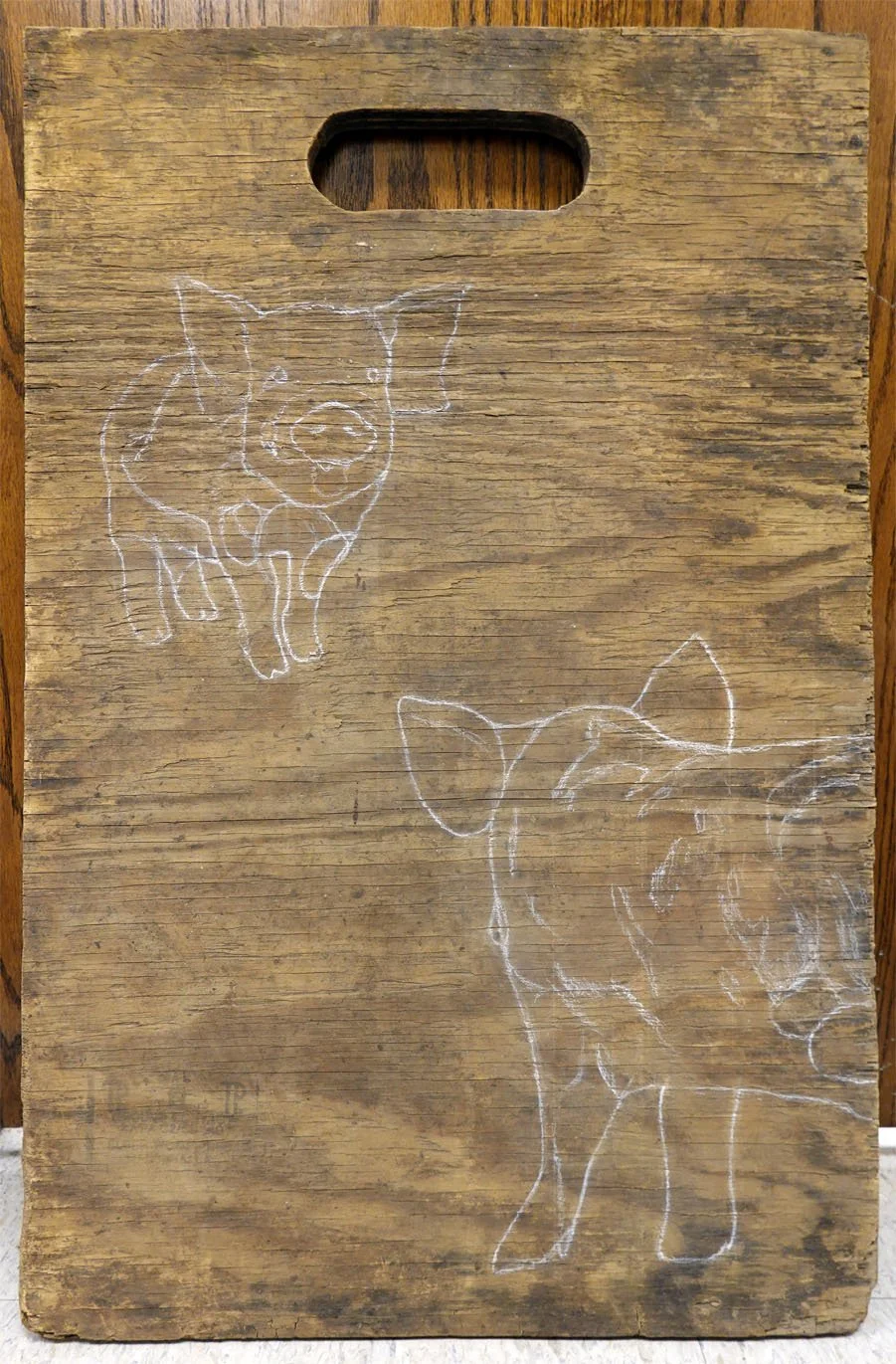
After I was able to return to the studio from COVID, I felt a lot of self-pressure to complete all the work I had envisioned prior to getting sick and losing access for several days. I prioritized my mosquito painting, ceramics, and pig board piece first.

My very kind host Rob Carpenter had helped me order a raw poplar frame from his own framers, and he showed me how to assemble it that weekend. We ran into a bit of a snafu when the museum glass was 1/8” too long, but Michael’s was willing to trim it down (and shared that if it broke in the process they’d also be willing to recut a new piece at no additional cost since it was their error in the first place). I also have to give Michael’s, specifically one of its workers, huge credit as they mounted my mosquito netting to the matboard for me! I was willing to do it myself if need be, but the most logical process was to get the whole matboard in, apply matte medium to the whole face and press the netting on top with a large flat weight (like a piece of plywood) until dry, and then cut the matboard down to size and with the window. They agreed with me about that being the simplest way, and said that they’d take care of it since they’d be doing all the surrounding work to it anyhow! I feel like I got a little taste of what it must be like to have a professional studio assistant, and it is a very nice luxury… They also gave me free foamcore backing and put little metal tabs in as well. Once it was all assembled, Rob helped me wire it and it was finally done!

Switching gears, I was lucky that I had brought all my raw ware down to Southern Pottery Equipment to be bisque-fired just before I came down with COVID, and we decided together that given my timeline I’d go there to glaze it on site so that it could then instantly be put in the glaze firing. So on Tuesday, I headed over!

I had purchased three different glazes which in my head when combined together would give a bone-like appearance. The catch is that I was just guessing based off my previous experience with completely different glazes, and as I believe I mentioned before this was a one-shot, que será, será situation. It took me four hours to glaze all 17 ceramic vessels, but honestly I stopped because the shop was closing - I could probably have glazed for another hour more!

Much of the rest of the week was spent planning out how the show would be installed, tracking down pedestals, and finishing up the pig piece. I also recorded the Arts Council of Greater Baton Rouge podcast. Then I returned to fetch my glaze-fired ceramics! Unfortunately, none had been stilted as the shop hadn’t felt there was a need, but the satin mottle seemed to behave more as a hi-flow gloss and it ran enough to fuse a number of my pieces to the kiln shelf. A large bowl I had impressed with a pig skull fragmented into pieces, and another four pieces had pretty severe damage. One had moderate damage but was still displayable, and then another five or so had varying bottom detritus; I did the best I could to smooth them all out, but I only had a Dremel rotary tool on hand so I was much more limited than if I’d been back in the Morningside studio with our diamond grinders. Despite the damage, about half were completely unscathed and I think I ended up displaying 13 total in the show.

That weekend, I put the pedal to the metal in racing to finish a vulture sculpture I had begun weeks ago but then deprioritized. The one non-art event of the week I did sneak in was to get a haircut! I had looked at the Baton Rouge subreddit for curly hair specialists and there was a woman recommended at the local Supercuts - I decided to try her out, as the rest of the options were all $80+ and I was feeling tapped after outlaying $400 for my isolation housing on top of all the other costs of the residency.

LSU Vet Med Artist Residency Artwork 7 Process

Here are some in-progress photos of Seeing Double!