black-headed gull painting

New Artwork: Loafing

This substrate is one of my favorites: a Soviet military artifact in the form of a preprinted 1980s wall-newspaper “Combat Sheet” used aboard Soviet Navy ships, produced by Voenizdat, the Soviet Armed Forces' own publishing house. It explicitly states in Cyrillic, “DO NOT TAKE OUT OF THE MILITARY UNIT.” These sheets, filled out by hand at the unit level, were the shipboard equivalent of a bulletin board - part morale-booster, part public callout for slacking or bad behavior among the crew. They typically featured brief reports on military exercises, political education notes, commendations for standout soldiers, critiques of lax discipline, and satirical cartoons or caricatures (known as satirical combat sheets) targeting common faults like sloppiness or laziness.

This one was unused, so I filled in the blanks myself: a date, an issue number, a painted black-headed gull, and a signature. In my other black-headed gull paintings, the gulls are actively shooting lasers or flying. In this piece, the gull is loafing.

The issue number and date I chose relate to Mathias Rust’s infamous, unauthorized flight from Helsinki to Moscow. This West German teenager coincidentally chose Border Guards Day (May 28th) for his escapade, which added to the overall confusion. Air defence units tracked his plane for some of the time, but failed to obtain permission to shoot at him. He successfully landed on Bolshoy Moskvoretsky Bridge adjacent to Red Square, and was arrested two hours later.

Rust's flight severely damaged the Soviet military's reputation. The incident inspired dark humor among Muscovites who nicknamed Red Square "Sheremetyevo-3" (Terminal 3, joining the international airport’s Terminals 1 & 2). Rust's Cessna is now preserved on display at the German Museum of Technology in Berlin, and a monument stands at Saka Manor Park in Estonia. (Source: Wikipedia.)

This is Loafing, acrylic and ink on Soviet combat sheet from the 1980s, 17.5x11.2”, 2026.
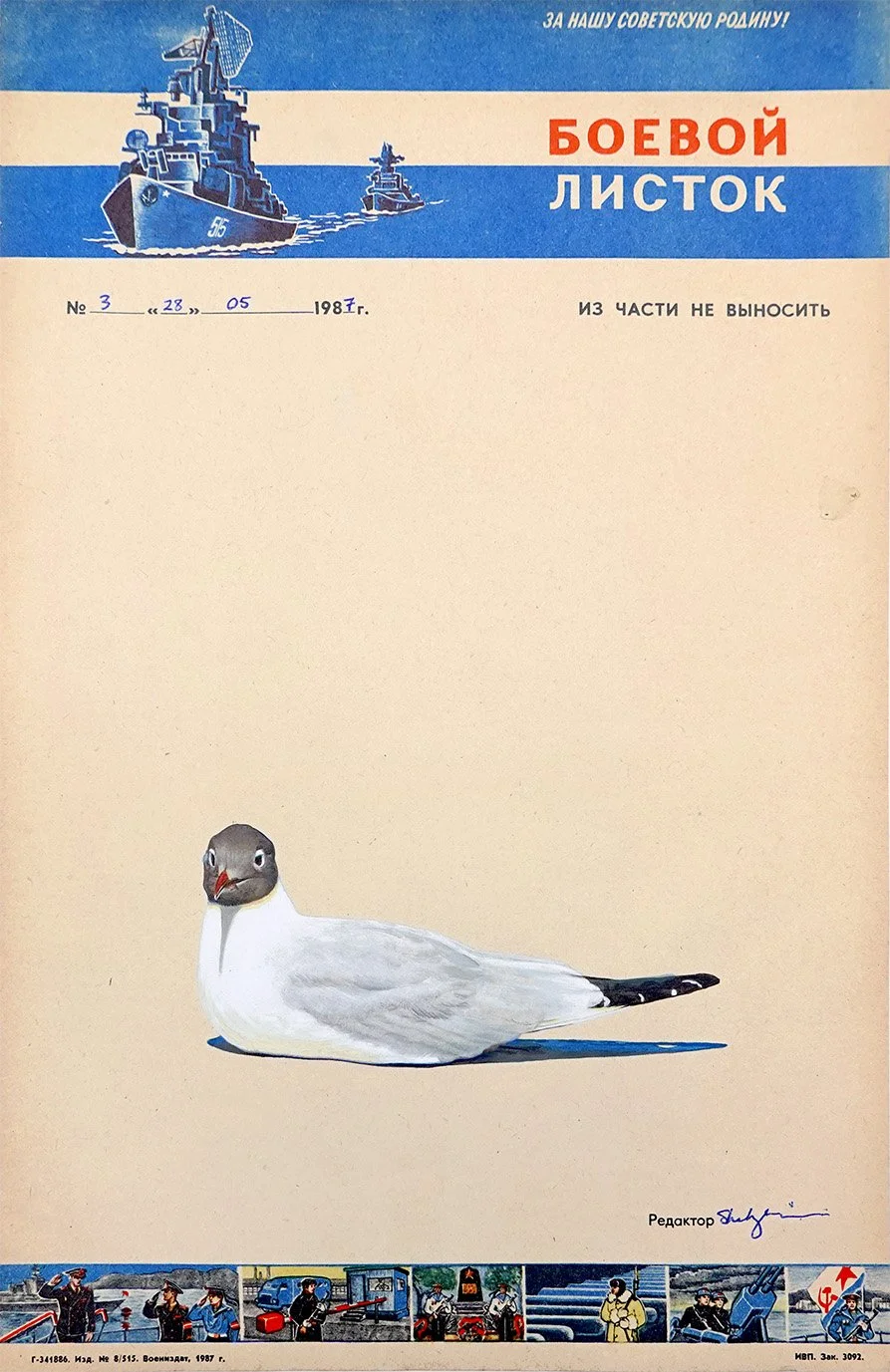
Shelby Prindaville's painting of a loafing gull on a Soviet combat sheet from the 1980s.

Shelby Prindaville's painting of a loafing gull on a Soviet combat sheet from the 1980s.

New Artwork: Vigilance Is Our Weapon

A companion to Surveillance, this work casts black-headed gulls as drones above a sea built from lace- and felt-placemat stencils and stamps. To evoke the stark visual language of USSR propaganda, the composition relies on a limited color palette and flat, simplified forms. The painted red laser beams begin as perfokaart stencils and then scale progressively toward the panel's edges. The substrate is a crochet base panel used for bags and accessories; ironically, the perforations in the panel are laser cut. Through its use of domestic textile imagery and substrate, the piece serves as a bridge between my Soviet occupation series and my ongoing explorations of Estonian craft traditions.

The title of this piece comes directly from a USSR propaganda poster from 1953.

This is Vigilance Is Our Weapon, acrylic, lace and perfokaart stenciling, and felt stamping on crochet base panel, 11.8x11.8x.125”, 2026.

Shelby Prindaville's gulls-as-drones painting on crochet base panel.

New Artwork: Surveillance

I took a departure from my textile mixed-media paintings for this piece. When I arrived at Loovlinnak Creative City Artist Residency, directors Al Padrok and Taje Tross generously gave me access to their tools and supplies, including several stacks of paper. Most of it was unremarkable: construction paper, printer paper, and graph paper. But one small stack caught my eye immediately. I could tell it was old and somehow related to typewriters or early computers, and when I asked, I learned it dated to the Soviet occupation. I adopted all of it, just four sheets, one of which had some math scribbled across it in pen.

Research revealed that it is Soviet-era perfokaart: stiff punch cards with holes in specific positions that fed instructions and data into mainframe computers before modern digital storage existed. From the 1970s through the 1980s, Soviet-bloc computing relied heavily on this technology, running the economic planning, industrial control, and record-keeping systems of the USSR, including in occupied Estonia.

I'd already been planning work that referenced Soviet propaganda posters, so the cards were a natural substrate. I cast a black-headed gull (Chroicocephalus ridibundus) as a drone after photographing many of them in flight. The species' limited, high-contrast palette and missile-like profile suited the graphic style of Soviet propaganda posters.

I sketched a range of compositions that played off the perfokaart's holes and contours while keeping that propaganda energy, and landed on a gull flying high, firing a dotted laser beam down into the punched border. I used the scribbled-on card as a stencil for the laser dots.  I kept the first as-is, and then scaled the rest up so the beam widens from a point near the gull into an even band.

This is Surveillance, acrylic on Soviet-era perfokaart (punch card) c. 1978, 8.2x11.75”, 2026.

Shelby Prindaville's painting of a gull cast as a drone on Soviet-era perfokaart.