bird art

New Artwork: Breaking the Pattern

I found this magazine, Ilutegija (Maker of Beauty), at a vintage bookseller's stall in Balti Jaam, Tallinn, just before leaving Estonia. Ilutegija began publication before Estonia's 1991 restoration of independence from the USSR; this issue was published at the start of 1992. Though I found it in Tallinn, it was published in Pärnu - where my Estonian residency was located. Due to the timing of my finding it, however, this is actually the first of the paintings made at my second residency this summer: Takt in Berlin, Germany.

The page is an embroidery pattern for bullfinches on a pine branch (the Eurasian or common bullfinch, Pyrrhula pyrrhula, on a Scots pine, Pinus sylvestris). Rather than follow the stitching instructions, I painted a realistic male bullfinch and pine branch directly over the simplified pattern for him, leaving the original female bullfinch and the rest of the printed branch untouched, so the pattern and the painting sit side by side.

The bullfinch is a songbird, and in regional folklore it's tied to steadfast winter cheer. Estonia sang its way to independence in the Singing Revolution.

This is Breaking the Pattern, acrylic on Estonian embroidery-pattern page from 1992, 11.6x8.06”, 2026.

Shelby Prindaville's painting of a bullfinch on a pine branch atop an Estonian embroidery-pattern page from 1992

New Artwork: The New Collective

This piece continues my series of paintings atop printed stationery from the Soviet occupation period in Estonia, issued under the ENSV (the Eesti Nõukogude Sotsialistlik Vabariik, or Estonian Soviet Socialist Republic).

The substrate features Soviet-era industrial graphic design for Pärnu KEK (the Pärnu Külaehituskombinaat, or Collective Farm Construction Office). Founded to build infrastructure for rural collective farms, KEK eventually expanded into a broader portfolio of late-Soviet modernist architecture, becoming one of the more distinctive construction enterprises of the era.

I chose to paint another realistic, volumetric stork, this time sitting in a flat graphic semicircle “nest” that mirrors the geometry of the underlying design. KEK's original mandate was building the physical infrastructure of agricultural Estonia. Storks nest reliably on farm rooftops and chimneys across Estonia, colonizing the infrastructure the decommissioned collective left behind.

This is The New Collective, acrylic on occupied Estonian printed cardstock c. 1980, 11.38x8.2”, 2026.

Shelby Prindaville's painting of a white stork nesting on Pärnu KEK ENSV stationery c. 1980.

New Artwork: Submerged Memory

One of my consistent practices when traveling abroad is seeking out arts and flea markets, antique stores, vintage shops, and secondhand dealers. This has become part of my research methodology: an opportunity to encounter reference material, regional craft traditions, and occasionally, nontraditional media or substrates that find their way into the work. While I walk out of most places empty-handed, that's fine; the practice is cumulative.

On my second-to-last weekend in Pärnu, I came across an unbranded antique shop that doesn't appear on Google Maps and opens only when the owner feels like it and puts out a sign on the street. Inside, I found a small cache of printed stationery from the Soviet occupation period, issued under the ENSV, the Eesti Nõukogude Sotsialistlik Vabariik, or Estonian Soviet Socialist Republic. Most of the material was too damaged for my purposes, or carried handwriting and other visual noise that would compete with the work. A few pieces, however, were relatively clean.

The surface is extraordinarily loaded. It's also materially demanding: decades-old printed, coated cardstock that requires careful handling and preparation. I purchased the few that might suit my purposes and got to work.

For this first piece, I inverted the cardstock and painted a split-level waterline view of the Baltic Sea directly over the now upside-down state emblem and its slogan. The sinking emblem remains visible, and traces of the communist motto persist in the lower register: Kõigi maade proletaarlased, ühinege! The standard English translation is "Workers of the world, unite!" though a more literal rendering would be "Proletarians of all lands, unite!"

Above the sea, a black-headed gull scans the surface below. In two earlier paintings from this residency, black-headed gulls appear as drone stand-ins, complete with stylized laser beams that complement their substrates’ perforations. Here, that same subject returns, but without overt weaponry.

This is Submerged Memory, acrylic on occupied Estonian printed cardstock from 1974, 11.38x8.2”, 2026.
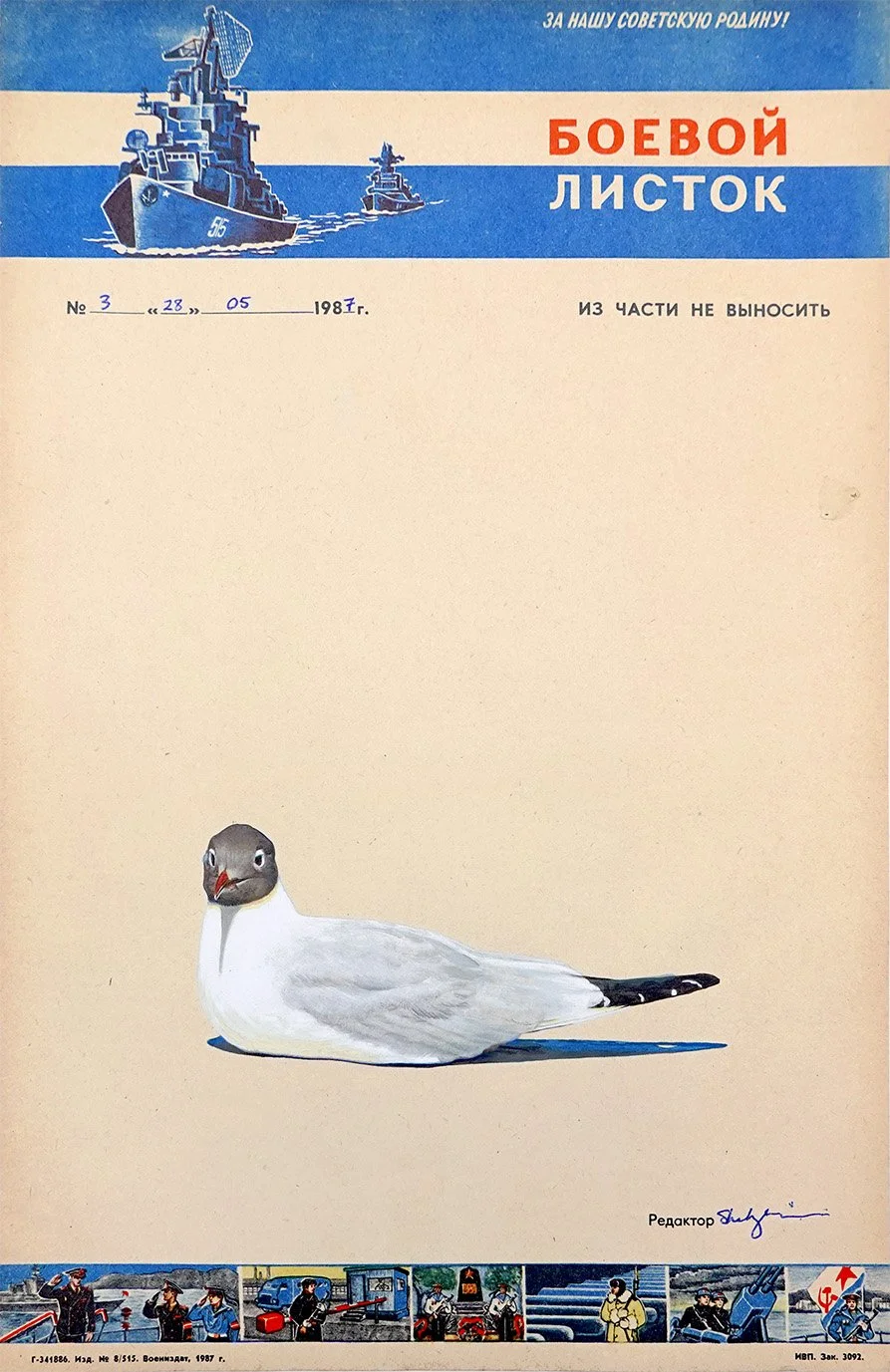
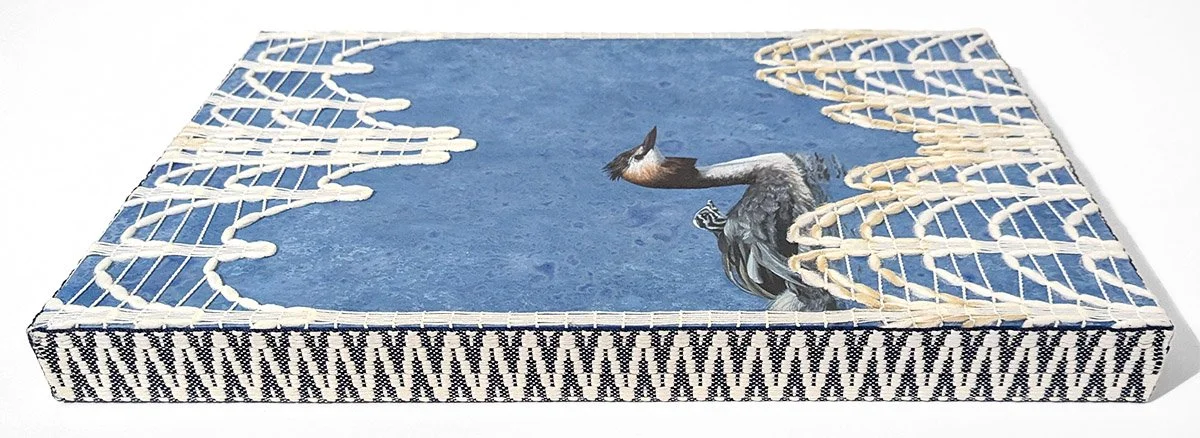
Shelby Prindaville's painting of a black-headed gull flying over the Baltic Sea with an inverted, sinking ENSV state emblem and motto submerged in the water.

New Artwork: Surveillance

I took a departure from my textile mixed-media paintings for this piece. When I arrived at Loovlinnak Creative City Artist Residency, directors Al Padrok and Taje Tross generously gave me access to their tools and supplies, including several stacks of paper. Most of it was unremarkable: construction paper, printer paper, and graph paper. But one small stack caught my eye immediately. I could tell it was old and somehow related to typewriters or early computers, and when I asked, I learned it dated to the Soviet occupation. I adopted all of it, just four sheets, one of which had some math scribbled across it in pen.

Research revealed that it is Soviet-era perfokaart: stiff punch cards with holes in specific positions that fed instructions and data into mainframe computers before modern digital storage existed. From the 1970s through the 1980s, Soviet-bloc computing relied heavily on this technology, running the economic planning, industrial control, and record-keeping systems of the USSR, including in occupied Estonia.

I'd already been planning work that referenced Soviet propaganda posters, so the cards were a natural substrate. I cast a black-headed gull (Chroicocephalus ridibundus) as a drone after photographing many of them in flight. The species' limited, high-contrast palette and missile-like profile suited the graphic style of Soviet propaganda posters.

I sketched a range of compositions that played off the perfokaart's holes and contours while keeping that propaganda energy, and landed on a gull flying high, firing a dotted laser beam down into the punched border. I used the scribbled-on card as a stencil for the laser dots.  I kept the first as-is, and then scaled the rest up so the beam widens from a point near the gull into an even band.

This is Surveillance, acrylic on Soviet-era perfokaart (punch card) c. 1978, 8.2x11.75”, 2026.

Shelby Prindaville's painting of a gull cast as a drone on Soviet-era perfokaart.

New Artwork: Sower's Shadow

Wool is ubiquitous here in the Nordic-Baltic region, appearing in many forms: knitted, crocheted, and felted into clothing, mittens, and gloves; accessories like hats, necklaces, and pins; and home goods like placemats, blankets, and children's stuffed animals.

When I came across a felt letter board at a vintage shop in Pärnu, it spoke to me as a viable substrate. I wanted to incorporate wool in some way into my Estonian body of work given its regional importance, and I also liked the idea of converting a familiar mechanism for rigid text-based communication into artwork that through removal of its frame, rotation, and incorporation of organic form brings new associations.

This second finished mixed media painting depicts a rook (Corvus frugilegus). A member of the corvid family (which also includes crows, ravens, and jackdaws), rooks forage on arable land and nest close to farms and villages.

This is Sower’s Shadow, acrylic, molding paste, and matte medium on felt letter board, 11x14.9x.4”, 2026.

Shelby Prindaville's painting of a rook on a felt letter board.