Estonian

New Artwork: Submerged Memory

One of my consistent practices when traveling abroad is seeking out arts and flea markets, antique stores, vintage shops, and secondhand dealers. This has become part of my research methodology: an opportunity to encounter reference material, regional craft traditions, and occasionally, nontraditional media or substrates that find their way into the work. While I walk out of most places empty-handed, that's fine; the practice is cumulative.

On my second-to-last weekend in Pärnu, I came across an unbranded antique shop that doesn't appear on Google Maps and opens only when the owner feels like it and puts out a sign on the street. Inside, I found a small cache of printed stationery from the Soviet occupation period, issued under the ENSV, the Eesti Nõukogude Sotsialistlik Vabariik, or Estonian Soviet Socialist Republic. Most of the material was too damaged for my purposes, or carried handwriting and other visual noise that would compete with the work. A few pieces, however, were relatively clean.

The surface is extraordinarily loaded. It's also materially demanding: decades-old printed, coated cardstock with a surface that requires careful handling and preparation. I purchased the few that might suit my purposes and got to work.

For this first piece, I inverted the cardstock and painted a split-level waterline view of the Baltic Sea directly over the now upside-down state emblem and its slogan. The sinking emblem remains visible, and traces of the communist motto persist in the lower register: Kõigi maade proletaarlased, ühinege! The standard English translation is "Workers of the world, unite!" though a more literal rendering would be "Proletarians of all lands, unite!"

Above the sea, a black-headed gull scans the surface below. In two earlier paintings from this residency, black-headed gulls appear as drone stand-ins, complete with stylized laser beams that complement their substrates’ perforations. Here, that same subject returns, but without overt weaponry.

This is Submerged Memory, acrylic on occupied Estonian printed cardstock from 1974, 11.38x8.2”, 2026.

Shelby Prindaville's painting of a black-headed gull flying over the Baltic Sea with an inverted, sinking ENSV state emblem and motto submerged in the water.

New Artwork: Vigilance Is Our Weapon

A companion to Surveillance, this work casts black-headed gulls as drones above a sea built from lace- and felt-placemat stencils and stamps. To evoke the stark visual language of USSR propaganda, the composition relies on a limited color palette and flat, simplified forms. The painted red laser beams begin as perfokaart stencils and then scale progressively toward the panel's edges. The substrate is a crochet base panel used for bags and accessories; ironically, the perforations in the panel are laser cut. Through its use of domestic textile imagery and substrate, the piece serves as a bridge between my Soviet occupation series and my ongoing explorations of Estonian craft traditions.

The title of this piece comes directly from a USSR propaganda poster from 1953.

This is Vigilance Is Our Weapon, acrylic, lace and perfokaart stenciling, and felt stamping on crochet base panel, 11.8x11.8x.125”, 2026.

Shelby Prindaville's gulls-as-drones painting on crochet base panel.

New Artwork: Woven Thresholds

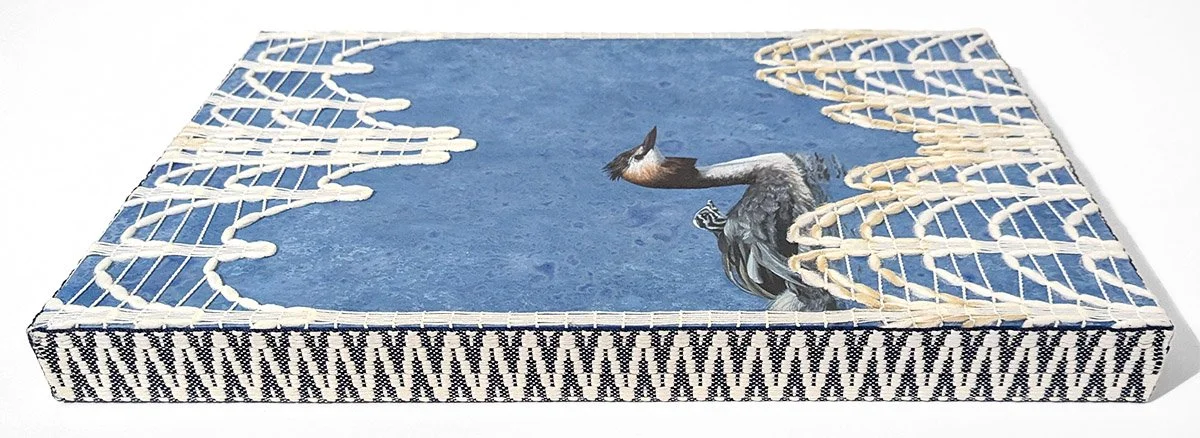
I’ve been painting red flowers lately, and I intentionally chose to continue that trend since I was building around a component I planned to use from the start: a jacquard folk pattern trim I picked up at Karnaluks OÜ in Tallinn. Once I saw a stand of vivid tulips, the rest of the composition came together..

The process differed from Between Worlds. Here, I painted the floater panel and tulips first, then laid down plastic and painted the lace pattern on top of it. After removing both those layers, I worked through a wide range of compositional options before settling on this angled, mirrored lace overlay. From there I secured the lace, added the trim, then cleaned up and secured the back. This was the second piece I started, but the third to finish! The delay was due to the sequential steps I needed to complete, each of which involved drying/curing periods.

Iconographically, tulips function as shields, threshold filters, and barriers across multiple traditions, a symbolism rooted in their nyctinasty: they close their petals tightly at night or on cloudy days, sealing their core away from cold, damp, and nocturnal threats. That self-protective habit is part of why tulips are believed to draw in positive energy while keeping poverty, bad luck, and hostility from crossing into the home, and why they carry associations of safety within oppressive environments. The lace adds a further veil over the tulips, while the mirrored, overlapping composition contributes a sense of movement and dissonance.

The outer border carries its own layer of meaning: it is a traditional Baltic woven band steeped in regional folklore and protective symbolism. Its color scheme has historically represented life, fire, and an active shield against negative energy. The pattern combines two ancient Baltic symbols: the Cross of Māra, tied to the Latvian goddess of earth and home and read as a sign of grounding and stability, and the hourglass motif, which represents the rhythm of time and the meeting point of the spiritual and physical worlds.

This is Woven Thresholds, acrylic, lace, and jacquard trim on wooden floater panel, 14x11x.5”, 2026.

Shelby Prindaville’s mixed media lace painting of tulips on a floater panel with Baltic jacquard trim.

New Artwork: Sower's Shadow

Wool is ubiquitous here in the Nordic-Baltic region, appearing in many forms: knitted, crocheted, and felted into clothing, mittens, and gloves; accessories like hats, necklaces, and pins; and home goods like placemats, blankets, and children's stuffed animals.

When I came across a felt letter board at a vintage shop in Pärnu, it spoke to me as a viable substrate. I wanted to incorporate wool in some way into my Estonian body of work given its regional importance, and I also liked the idea of converting a familiar mechanism for rigid text-based communication into artwork that through removal of its frame, rotation, and incorporation of organic form brings new associations.

This second finished mixed media painting depicts a rook (Corvus frugilegus). A member of the corvid family (which also includes crows, ravens, and jackdaws), rooks forage on arable land and nest close to farms and villages.

This is Sower’s Shadow, acrylic, molding paste, and matte medium on felt letter board, 11x14.9x.4”, 2026.

Shelby Prindaville's painting of a rook on a felt letter board.

New Artwork: Between Worlds

My first finished mixed media painting in Estonia depicts a white stork (Ciconia ciconia).

The substrate is antique lace over wood panel. My process involved attaching the lace to the panel, painting the portrait, removing the lace and altering the coloration of the wood panel surface, and then meticulously re-registering and attaching the lace back on top and sealing it down.

These birds are embedded in Estonian rural life: they're associated with summer farms and considered good luck omens. Storks are also important in folklore, as they accompany souls to the underworld and bring newborns into the world as a part of a cycle of death and rebirth in Finno-Ugric mythology.

This is Between Worlds, acrylic and antique lace on wood panel, 14x14x1.5”, 2026.

Shelby Prindaville's mixed media lace painting of a white stork.