mixed media painting

New Artwork: Sower's Shadow

Wool is ubiquitous here in the Nordic-Baltic region, appearing in many forms: knitted, crocheted, and felted into clothing, mittens, and gloves; accessories like hats, necklaces, and pins; and home goods like placemats, blankets, and children's stuffed animals.

When I came across a felt letter board at a vintage shop in Pärnu, it spoke to me as a viable substrate. I wanted to incorporate wool in some way into my Estonian body of work given its regional importance, and I also liked the idea of converting a familiar mechanism for rigid text-based communication into artwork that through removal of its frame, rotation, and incorporation of organic form brings new associations.

This second finished mixed media painting depicts a rook (Corvus frugilegus). A member of the corvid family (which also includes crows, ravens, and jackdaws), rooks forage on arable land and nest close to farms and villages.

This is Sower’s Shadow, acrylic, molding paste, and matte medium on felt letter board, 11x14.9x.4”, 2026.

Shelby Prindaville's painting of a rook on a felt letter board.

New Artwork: Between Worlds

My first finished mixed media painting in Estonia depicts a white stork (Ciconia ciconia).

The substrate is antique lace over wood panel. My process involved attaching the lace to the panel, painting the portrait, removing the lace and altering the coloration of the wood panel surface, and then meticulously re-registering and attaching the lace back on top and sealing it down.

These birds are embedded in Estonian rural life: they're associated with summer farms and considered good luck omens. Storks are also important in folklore, as they accompany souls to the underworld and bring newborns into the world as a part of a cycle of death and rebirth in Finno-Ugric mythology.

This is Between Worlds, acrylic and antique lace on wood panel, 14x14x1.5”, 2026.

Shelby Prindaville's mixed media lace painting of a white stork.

Arts Itoya 2025 Residency Artwork 3: Blue Hour (藍影)

Painting tanuki (Nyctereutes viverrinus) unintentionally became a multi-year quest, which lived up to the yokai version’s reputation for illusions and light-hearted trickery.

I decided to paint them on the fan-shaped washi paper which I dyed with indigo (aizome) in my workshop in Tokyo in mid-May. Due to the coloration of the washi and the folkloric aspect of tanuki, I chose to paint them in a limited color palette which isn’t completely monochromatic but which has indigo as the key color.

Tanuki are nocturnal, so the English title Blue Hour felt appropriate as the blue hour is a term for the short period of twilight just before sunrise or just after sunset. The Japanese title is 藍影 (Aikage), which means Indigo Shadows.

This is Blue Hour (藍影), acrylic and traditional indigo dye on fan-shaped washi paper, 7.7x15.75”, 2025.

LSU Vet Med Artist Residency Artwork 7

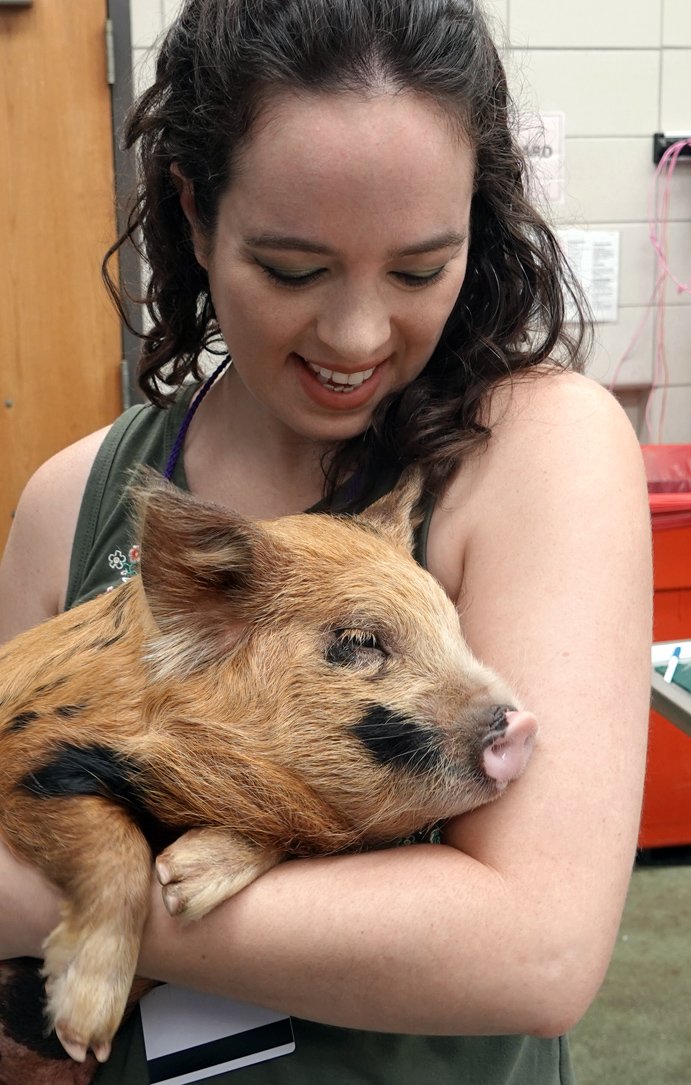
Artist Shelby Prindaville holding Tigger the Kunekune pig.

My seventh artwork almost didn’t get made on site - I knew what I wanted to do, but tried in vain to get my hands on a necessary component until Dr. Clare Scully came to the rescue!

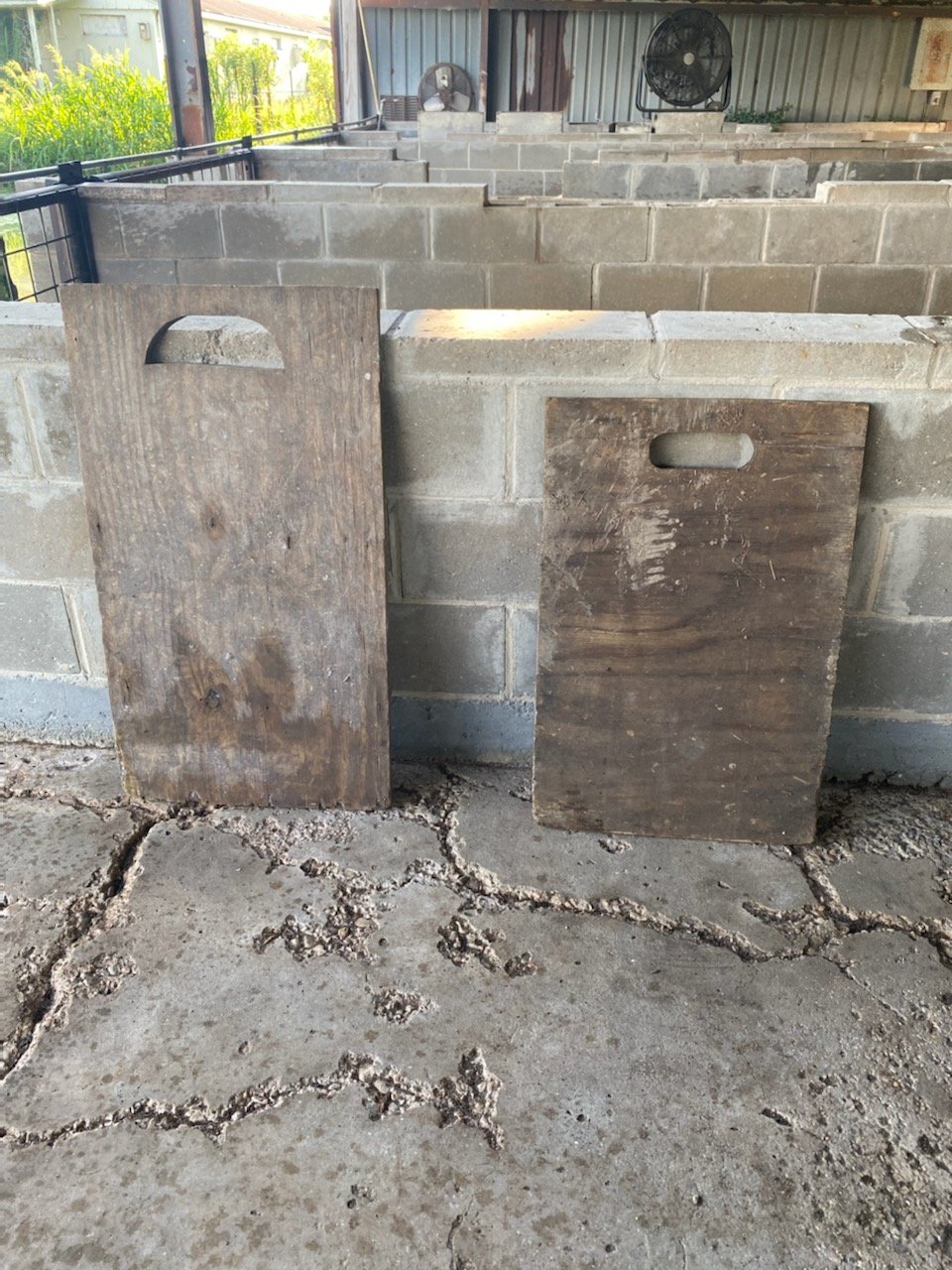
Let me back up and explain it from the beginning. A very cute Kunekune pig named Tigger came in for observation and diagnosis and he left the next day feeling much better (and after I gave him a quick cuddle). With his owners’ permission, I decided I’d like to feature him in a painting or two! As I always do when I see a new species here at LSU Vet Med, I started asking about what veterinary materials they use specifically with that species - in this case, pigs. After hearing about a handful of items, the ones that seemed the most useful for my purposes were the pig sorting panels or “pig boards” and Dremel rotary tools (used to sand down hooves). I had brought a rotary tool with me as a sculpting aid already, so that was easy - but the pig sorting panel was a harder acquisition. This is because all the ones they had on hand were made out of plastic, and were pretty clearly intended to be easy to clean in a way that would make it harder to work archivally on top of and they were also obnoxiously colored. Wooden ones are regularly used, too, but there weren’t any in the large animal hospital as typically the wooden ones are just created on demand in a farm woodshop to save money and time.

two small wooden pig sorting panels or pig boards

I started asking all the large animal veterinarians, residents, and students if they knew of a source, put word out via my communications liaison Sandy Sarr, and posted a Craigslist ad… but a week had passed and my show exhibition was drawing closer so I thought I’d need to wait until I could ask my agricultural colleagues back in Iowa. And then Clare came into the room, we chatted, she said she’d see what she could do, and a couple of days later, she had done it! She had found two wooden pig boards for me that were the dimensions I had been looking for from another LSU site and said they were sufficiently used as to be destined for the scrap heap, so this was a much better use for them.

I happily adopted them both and gave them a light sanding and heavy cleaning. For the first composition I had in mind, the slightly smaller and more “standard” board worked better, so that’s what I went with! I would like to photograph it again when I get back home and have access to a large white background, but this image will do for now.

This is Seeing Double, a mixed media relief including Dremel counter relief, QuickCure Clay, PVP Prep Solution (betadine), and acrylic on a used pig board / sorting panel, 29.75x19.25x1.25”, 2022.

Seeing Double painting by Shelby Prindaville

LSU Vet Med Artist Residency Artwork 6 Process

Here are process photos from Crèche Chic!

LSU Vet Med Artist Residency Artwork 5 Process

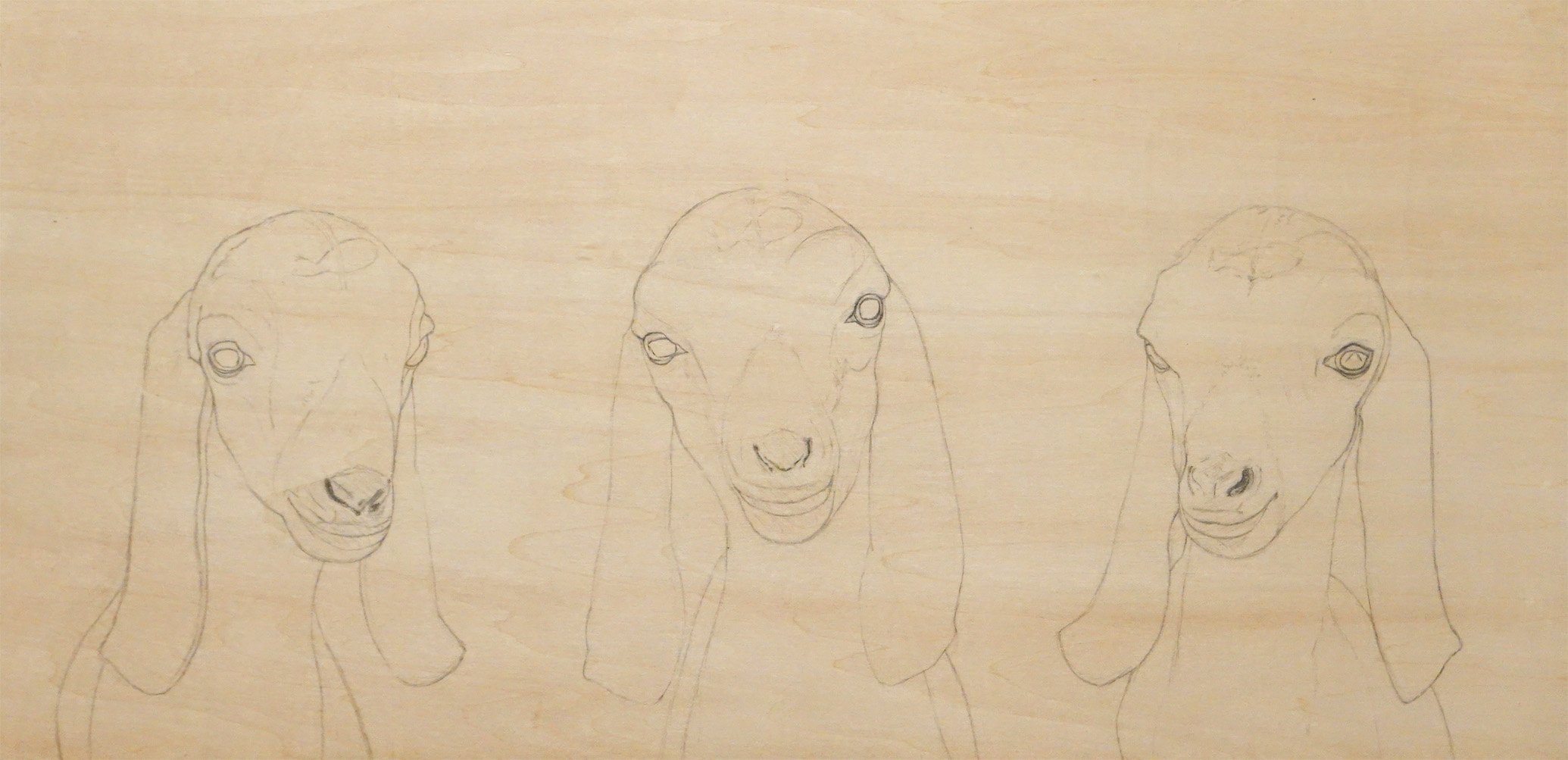
And here are process pictures of Singularity from start to finish!

LSU Vet Med Artist Residency Artwork 5

This is actually the first piece I began here at the LSU School of Veterinary Medicine! I never know how to properly answer people as to how long a piece of artwork takes to finish, as my optimal process involves working on several different pieces simultaneously. If you count start to finish, I worked on it for a month and five days - however, there were a number of days in there that I didn’t touch this piece or only worked on it for a couple of hours…

The subject in this piece is a three-day-old baby Nubian goat; she was fully healthy but was brought in to accompany her brother who was failing to thrive and unfortunately didn’t make it.

Singularity, mixed media including Clinical Pathology’s Diff-Quik Eosin Y stain, Clinical Skills' fluorescein, Histology’s light green stain, and acrylic on basswood panel, 12x24x1.5”, 2022.

A mixed media painting of a baby Nubian goat in triplicate.